Showing posts with label Kenneth A MacRae. Show all posts

Wednesday, 21 March 2018

An unworldly World of their own? A look at 20th-century Free Church life

Rebarbative as the public face and loudly trumpeted doctrines of the Free Church (FC) may appear to many people born in the 20th and 21st centuries, that institution is an inescapable part of the history of Lewis, and so of the family history of the majority of those with roots in Lewis, varied and scattered though these may be. There were other aspects to life on the island, but it was scarcely possible to live in Stornoway without some awareness of the FC and its beliefs - including the one about reaching out to those not already affiliated to it, and telling them off if their habits and customs deviated from its rules. Being a committed part of its demanding world and peculiarly rich emotional life was different, and its details can be viewed as casting an interesting sidelight on the 'history of mentalities', among other things. For an insider's view of Free Church life and thought in the first half of the 20th century, we turn one more time to the Diary of Kenneth A MacRae.
(Dates on the left are those of the diary, not its writer.)
Such marathon Communion sessions in various places feature largely in the book.
Still spreading the Word:
These items were found in a second-hand copy of the Diary.
Theological arguments will not be rehearsed here, nor will doctrinal differences (other sources are available for that sort of thing, e.g. The People of the Great Faith, by Douglas Ansdell, Acair, 1998). On the other hand, MacRae's constant reference to spiritual matters, in particular the state of his own "soul" and its travails, does become repetitive but has a certain fascination, not unlike that exerted by several fictional works attempting in different ways to describe the psychological state of the religious-minded. One might cite James Hogg's Confessions of a Justified Sinner, or numerous passages in the novels of Iris Murdoch, or rather more frivolously, Amos Starkadder in Stella Gibbons' Cold Comfort Farm. Not that any of these can fairly be compared to MacRae, who would have found much to blame in their doctrines: ultra-Calvinsim taken to extremes; Anglicanism and Roman Catholicism, unacceptable by definition; and populist evangelism. There is likewise interest in the language used, the behaviour expected and rituals practised, as well as, of course, the social attitudes evinced.

A page from 'Cold Comfort Farm', by Stella Gibbons, first published 1934
The following extracts and comments are again grouped by topics, often overlapping, not by date.

Interior World

2-6-1912 old 'offensive' preaching urgently required...
27-9-12 disagreement with the strictness and indeed unreasonableness of some of Miss Kemp's views
9-10-12 Edinburgh: new interests and temptations

15-4-1913 back to the university and my godlessness... Perhaps no specific sins. No time... Pride.
26-5-13 I must not quietly pass what I know to be out of accordance with God's laws; must be prepared to endure.
20-7-13 dread seeking souls for my own name as preacher.
9-8 craving for and lure of romance; pride... Vain wretch! (Referring to himself)
5-9-13 cycling not conducive to spirituality
7-9-13 preaching of the "law" - told Lowlanders will not suffer it. Will not alter, to the end: Calvary, judgment and hell.
31-12-13 "The groan or sigh is the prayer most pleasing to God, for there is the least of self in it." (He quotes; mot of his reading was of and by old-time preachers and ministers.)

19-1-1914. What mysterious power is in Gaelic melody?
20-1-14 old couple of old school, condemned in unreserved terms modern civilisation. Wife of strong mettle, uncompromising.
7-6-14 danger of being led away by imagination
25-10-14 I have a right to expect my prayers to be answered.

9-1-1922. Oh that I could be serious at all times!  10-1 spoke on revivals, their dangers.

23-1-22 spiritual benefit of diary: own soul must receive first interest.

World of Ministry, first experiences


28-6-1914 Lochgilphead. Knew I loved the people.
22-11-14 surprised at opinions sometimes held by Free Church people.
21-3-1915 Kildonan: feeling of desolation; the terrible change which has come over our dear land.
1-5-15 Aberdeen. Set forth the present deplorable state of Britain.
16-5 Tarbert, Lochfyne. An inquiry into the prevailing desolation.
1-8-15 the voice of my people; was afraid I was offending some. Feeling that I had set the people against me. 12-9 I had wonderful power. No-one spoke, I saw no smile on any face.

1-1-1916. In the prayer the tears rolled down my cheeks.
9-1-16 tired of preaching and all to no purpose.
14-5-16 If I can't get to preach I don't want to live.
30-7 desire to flee away to Skye or Lewis.

15-4-1917 to get away to the dear north land, God's own dear people.
11-8-17 The sight of Dingwall [his home town], quiet, lying in its peaceful valley across the water.
12-8 Ferintosh Communion. Saw many tears at the table.
13-7-1918 Skye. Man came forward, tears streaming down cheeks and falling on floor.
9-9-18 blight of Moderation everywhere present.
1-10-18 generally heard Free Church people [seen as] queer, prejudiced and narrow-minded. 
7-9-1922 A band of Plymouth Brethren began to sing at the street corner... was longing to go and join them.

Isle of Lewis, some early impressions and observations
MacRae had found much to approve in Lewis, before receiving the 'call' to Stornoway.
9-10-1919 Ness: size and beauty of church. Attendance 650, 1000. Native garb modest and becoming - exceptional today.
10-10-19 One said that those who felt it long at a Question Meeting would find it long in heaven.
12-10-19 Lewis singing... so like the song of glory.
13-10-19 ... amazed at the giving of the people. Black houses: did not think them so bad at all.
14-10 Bragar, Carloway, Callanish - enjoyable run.

6-1-1922 reports from Lewis re spiritual life very encouraging; in November found ministers mourning frivolity and decadence of the young people.


22,26-9-22 Crossbost, Lochs, Gravir. Church holds 1700, crammed to excess. Earnest attention; more brokenness under the Word with us in Skye.


Women and children - maybe not first, but not last either
Although predictably patriarchal in his attitudes, and restrictive in his assumptions about the role of women in the church, MacRae was not a misogynist, showing interest in and appreciation of many female members of his congregation as well as his own family. Women were also assumed to take full unmediated responsibility for their own spiritual development as individuals; there are frequent mentions of them being "awakened" and received into the church after the due process of being "troubled" and "exercised", with assessments of their characters. Women acting as elders and ministers were, however, numbered among the "hindrances to revival".

June 1916 Arran Striking girls, strong, hardy and intelligent; contrast with the poor, weakly dressed-up things [in towns].
Two young girls who vexed me with their inattention and restlessness.
15-8-16 married in Kyle Temperance Hotel. (His wife was a fellow member of the Free Church).
20-8 happiness engaging affections and interests too much.


p.221 on Monday evenings he tried to relax, play with daughter. -224 Wife's account: fortresses of wooden bricks, child became adept. Supply of troops was not meagre: regiments; and alien soldiers, not all of the smartest appearance. Hard peas for ammunition, shouts of victory when battle won, usually by 'Kilties', brought back new from city.


7-4-1932 finished the visitations; would like to reach all the servant girls, pupils and lodgers.

9-4-32 Two awakened. Girl from Back had to be carried out of the church, now serving in the Nurses' Cottage. Other on staff of girls' hostel.
23-10-32 Would that my own daughter were persuaded to come!

11-12-32 girl in tears [at the service], from Point, a gutter in the town.

29-12-1934 little Bayble girl - not easy to arrange private conversation.

28-11-1953 (Australia)... afternoon tea in the park, prepared by the ladies of the congregation.

Stornoway Free Church Sabbath School in the 1930s.
The noticeboard lists 3 services on Sunday (Sabbath) and a Thursday Prayer Meeting.
p.465 MacRae's editor tells us he believed "children enlightened by the Spirit can understand the preaching of the Word" and the Free Church expected quite a lot from its youngest attendees. They were encouraged to call attention to lapses and errors among their friends and neighbours.
15-1-1918 poor wretch, (I) cannot even talk to a child about his soul!

20-6-1932 examined 7 classes in the Nicolson [school, Stornoway] in R.I. (Religious Instruction) It was well done on the whole but no better than in Skye.
22-2-1936 movement in the town among the schoolchildren misguided by the 'Pilgrim Preachers'. I have no faith in it; cocksureness and self-sufficiency. Attendance upon concerts and 'the pictures' mark them off as the victims of a religious delusion.
30-5-36 opposed forming organisations to foster friendships among young people; gave warning as to the serious consequences...
13-6-1953 Melbourne, a very godless city. Restlessness among children.
5-2-1963 lecture on The State and Education
p.486-487 letter on Religious Instruction in schools. 15-3-63
p.480 notes of Address to children at Laxdale school: Holding On.


Evangelism, Revivals and Conversions

While looking forward to a genuine general "revival" and always keen to make the right sort of converts, MacRae was suspicious of many of the movements that arose in the aftermath of the First World War, and later., as indicated in the reference to schoolchildren above, and in other references:


31-3-1922 Reports of revival activity... Fear emotionalism and artificiality.
1925 Lectures on historical revivals; many questionings.
p 220 Kilmuir congregation: an element of Hyper-Calvinism.

Feb. 1928...ultra-Calvinism has generated a mysticism and drowsiness that is strangling the Gospel.
p 224 re Sabbath League, some ministers strangely lethargic.

25-11-1931 Baptism, father unwilling. In a way I respected his thoughtfulness...
2-11-1933 began winter's lectures; spoke on 'Religious deceivers'.  (p.268n other lectures this year included "The Sabbath Question".)
10-11-1934 since Spring Communion, Carloway, 10 men, some ringleaders in frivolity, and 7 female - influence of truth, so concerts etc. cannot now receive enough support to continue.
17-11-34 place of fear as a motive to religion, neglected.

Extracts from early 1933 (p.49 in the published Diary)
evoking the process of securing the right 
sort of adherent.
Note specialised 
use of 'concern', 'broken', 'wakened', 'relief':
it wasn't supposed to be too 
easy or painless.

2-5-1936... very much annoyed on Monday by a good woman (who complained about the church not being open at the former time on Sunday afternoon) ... Unreasonable spirit which refuses religion the right to adapt itself has done infinite harm in the Highlands. Strange, too, how good people can be the main hindrance...

October 1936 Arran: non-churchgoing has come in as a plague.  Renton: annoyed to see a vase of flowers and plants in the church.

pp.319-320 Report to Public Questions Committee: The great mission of some churches would almost appear to be to amuse their young people, but to neglect them and allow them to go their own way is almost as fatal.
p.363- re revivals. Address to the Young. -368 simply, what is medically known as mass hysteria. Young women, nervous reactions (1940). I shall give the 'swooners' no latitude.

10-3-1941 I am inclined... to think a great deal of this business is just a put-on.
p 443- contents of worship to be warranted by the Westminster book of praise. -451 All Scotland Crusade: SY Town Hall hired by Church of Scotland, relayed outside.  -458-9 a sad Assembly…  apprehension as to the future.

1960 report of Church and Nation Committee of Church of Scotland re "half-day Sunday": most devastating blow; Sabbath has been ruined in this land.


A few further animadversions on social life etc.

27-1-1922 unveiling of Clan MacRae war memorial... Doctrinal abuse... Another promising report as to religious conditions in Lewis, Back.

9-2-22 ... (re) marriage ceremony: indicated that the wedding must be over by midnight and have no dancing and such frivolity.
6-5-22 religious type of Highland soldier gone now. My regiment still has the old place in my pride and my affections.
29-12-22 case of the 'poor and the needy'... Thus was Satan foiled.
5-5-1924 Influenza still prevails in the district.

4-6-24 Long prayers are ruining prayer meetings in the Highlands today. They are a weariness to the flesh and they tire the people by their unfitness and selfishness.

30-12-24 having to send up to HQ a report anent the state of religion and morals in the congregation.
1960 report of Church and Nation Committee of Church of Scotland re half-day Sunday: most devastating blow; Sabbath has been ruined in this land.

p.472 Greatest cause of emigration persistent propaganda... Ruin of the Highlands as the home of the Celtic race.  Tourism. 476 Sunday papers.


28-4-1956 Time will alter things in spite of us.

  
17-2-1925 [not on Lewis] funeral, amazed; did not see a tear.

MacRae died on 5-5-1964


May 1964. Reportedly the largest funeral ever seen in the island.


Wednesday, 24 January 2018

More from the Manse: a sideways look at Lewis social history.

In the more than sixty years since Calum Smith complained of the lack of ‘social history’ of his native island (see below), much has been published to remedy the situation, including his own well-received memoir, Around the Peat-Fire (Birlinn 2001 and 2010). It was not with the intention of adding to this body of work that Kenneth A MacRae kept his Diary or the Banner of Truth Trust published a book based on it, but there is much of general, secular interest to be gleaned from its pages, overwhelmingly preoccupied with the writer's religion though they are. Having looked at MacRae's observations in relation to the First and Second World Wars, here (grouped roughly by theme, not in chronological order) is some of what he noted about other aspects of life in the town of Stornoway and occasionally elsewhere.

(Extracts from the diary are paraphrased rather than verbatim, except when in inverted commas; page references are to editorial material in the book Diary of Kenneth A MacRae).
The Old Free Church manse in Stornoway, from the book of the Diary.
The minister's study was on the ground-floor, on the right here.
Mr (the title 'Rev.' was not generally used among Free Church ministers) MacRae noted some differences from his previous congregations and their environment in Argyllshire and on Skye, Lewis being in many ways distinctive. He was a partisan of the Highlands and Islands and of their inhabitants, believing in encouraging the Gaelic language and culture; his editor (pp.471-472) remarks on his concern with the misgovernment of the region and issues of depopulation and emigration, and on how he opposed the idea of a NATO airbase on Lewis, canvassed in the 1950s, saying that it would be an "absurd decision" to locate it so close to the town (echoing his similar anxieties during the war).

On leaving Skye, he recorded how some men were moved to tears at his departure, and shared their emotion. In view of the grimly unemotional image of Scottish Presbyterianism, it's surprising how frequently weeping and tears, especially those of men (including Lewismen), occur in his pages - usually in connection with religion. (Laughter, not so much, although we are assured he had a sense of humour.)

23-12-31...the case of a man, a proper rascal, who was seen in the Seminary.. with the tears streaming down his face. Should this man be brought in [to join the Church] I am told it will shake the town...

11-10-32 It is very seldom that I see tears after worship when visiting [people in their homes] here. Today i had that experience, more common in Skye... the woman in question was a St. Kildan.  The Lewis people never struck me as being emotional, they are too hard-headed for that.

12-4-34 Feeling homesick... makes this island seem very drab and dull.

29-5-54 'Flowers of the Forest' [traditional song/tune, heard in Australia] upset me entirely, I had to go outside.

He was well aware of issues such poverty, unemployment and housing, while not being inclined to take action outside what he saw as the remit of his ministry:

26-10-31  ... Also in the poorer quarters of the town, how miserable many of the houses are! 
24-11-33 Visit to New Valley [just outside the town]: the houses there are mostly poor and one wonders how they make a living at all.

1-10-33 Service - at the close spoke to the young men against the suggestion in the local newspaper that the ministers should busy themselves in providing employment for the workless.

The fishing industry, in decline since the First World War, was still important:

2-10-33 Tonight the first batch of ["herring"] girls leave for Yarmouth for 3 months [seasonal migrant labour], with two ministers [to cater for their spiritual welfare, and no doubt keep an eye on them].

5-6-32 English service in the church for the first time attended by [among others] some sailors from a warship. and some East Coast fishermen.
(English services had been held in a different building, the Seminary. Gaelic congregations were larger, hundreds-strong. Although not a native speaker, MacRae said he preferred the Gaelic, finding in it "a certain sweetness I cannot get in the English". He preached tirelessly in both languages.)

28-6-32 People are troubled because of the poor fishing.

The fixation on Sunday observance for which MacRae was most celebrated, or notorious, was of long standing but inevitably continued and intensified after his move in 1931 to the Stornoway Free Church (2-9-31 Induction. Church packed). He had already found support on the island, having received a letter in December 1930 from the Lewis presbytery congratulating him on the success of the Sabbath League.

Religious observance was of course not only for Sundays, and Thursdays were sometimes designated to be special too:
                2-11-31 Week of Humiliation and Prayer on account of the state of the country. 
[There were several such Weeks, and Days, ordained by the Free Church at national level].

26-11-31 Thursday. This being Harvest Thanksgiving had services just as on a Sabbath. Was glad to find shops and the school closed. Yet the scholars were too prone to regard it as a holiday and preferred to amuse themselves rather than attend church.

18-4-36 thankful to get the Lochness petition [against Sunday sailing] away last night. It bore 10,251 signatures. [Note, p.300: owners proposed mailboat should leave on Sunday night; petition successful.]

His year out in Australia, 1953-54, and the process of getting there, inflicted some shocks to the system. The voyage out on the Orontes was a sore trial when it came to the Sabbath. He did not go so far as to object to the crew working to keep the vessel moving - "necessity and mercy" probably covered that - but he deplored the Church of England-style service, "mainly music and mummery" (12-5-53) A week later, to make things worse, at Port Said small boats came out to the ship in a "veritable pandemonium of bartering, buying and selling... But the people who bought were more guilty than the sellers .. Sabbath was a miserable day and I was glad when it was over." 
                 5-4-54 Sydney on the Sabbath is a sad place... even worse than Melbourne.

Back in Britain, things sometimes looked not much better.
1957 [Farnborough Air Show disaster, letter:] What alarms is the conduct of the promoters and attendees in carrying on after such a dreadful occurrence. Next day, the Lord's Day, a crowd of up to 150,000 attended. [There are other occasions where apparent 'callousness' at deaths strikes him, but this time the fact of the Sabbath evidently makes it even more reprehensible].

(p.471) Reference to hysterical reception in Glasgow on Sabbath night of American film star. “Britain, in abandoning the Sabbath, has lost her crown.”

Politically, it is no surprise to find that the minister was not well disposed to those of the left. This had been made explicit in his reaction to what must have been a lively election campaign, after the first few months of Labour government:
29-10-24 Cycled in to Uig to record my Parliamentary vote. For the first time on record, socialism is receiving uncommon support in these parts [his ministry was in Skye at this time] but this is mainly due to the activities of a few of the advanced type and to the fact that people have not come in contact with the thing itself. It is a solemn day for the country. May the Lord save us from the hands of the godless schemers who are trying to seize the upper hand in the land!
(A Liberal , Alexander Liviingstone, was elected to the Western Isles in 1924; the constituency had a Labour MP, Malcolm K Macmillan, from 1935 until 1970.)

He took a dim view of industrial action:
19-5-33  A dispute has broken out between curers and fishermen which threatens to have very serious consequences for Stornoway. Last night two trawlers and some of the drifters dumped their catch in the sea, a wicked act which is likely to bring its own punishment. Such a dispute in the present state of the industry is suicidal. May the poor not suffer from it!
(Twenty years later, during his year in Australia) 13-4-54  Sydney. Saw the Radnor which the dockers refused to load because she is going to Indo-China with arms to help the French - now being loaded by servicemen. Communism is active in Australia and the situation calls urgently for firm handling by the government.

Comments on the international situation between the wars are few; one stands out:
5-10-35  The wireless reported... the Italians bombing Adowa (Abyssinia [Ethiopia]). If ever there was an unjustifiable war in history this is it. Apparently it was a sheer massacre on a tremendous scale, and considering what modern weapons are, if the war is to continue it cannot be anything else. It will be a foul blot on the name of Italy for generations, and all to satiate the vain-glory of one ambitious, relentless despot! May Britain be kept out of it!
[Later, however, when Britain was at war, he was to castigate Neville Chamberlain for "betraying" Abyssinia among other places.]

23-10-48 [Another] Day of Humiliation and Prayer on account of the deplorable state of the world.

At national level, he may have been right-wing in some respects but was no respecter of worldly persons, whose behaviour he often denounced from the pulpit, and certainly no royalist:

25-1-36 The King yielded to a Greater on Sabbath..  I fear [Edward VII] will not be an influence helpful to true evangelical righteousness. Yet the Lord may change him.
11-12-36 [Abdication.] It is a great blessing and a merciful deliverance!

6-6-53 [Coronation, when he was on board ship heading for Australia] A day of extra vanity… Nonsensical observances… Country given over to vanity... Port wine, declined… Walked out after dinner. Retired early, heard things went to a great length.
[No doubt he would have had something to say about the announcement in a news item on 7-1-18 that yet another royal event was to be accompanied by extended licensing hours.]

While he was in Australia he criticised the fact that the programme for a royal visit was not affected by a train disaster in New Zealand in which 166 people lost their lives, “sport and pleasure” being paramount.

On the occasion of the royal visit to Stornoway in 1956 he declined to be presented to the Queen, on the grounds that she wasn’t someone he wanted to meet, having persistently violated the fourth commandment (“Remember the Sabbath Day…”) by attending polo matches in particular, and had also received Russian politicians. This principled stance caused “considerable public comment”.
Stornoway, showing part of the inner harbour.
The Free Church is building with the tower and roof on the left.
(The spire on the right would be Martin's Memorial Church of Scotland).
Locally, he had no hesitation in making his views known and asserting his influence beyond his own large congregation, believing it was incumbent on him to do so. (This included periodically testing the scripture knowledge of pupils in the Nicolson Institute, both primary and secondary, and conducting services in the boys' and girls' hostels.)

20-6-32 examined 7 classes in the Nicolson in Religious Instruction.

1-1-46 Peace has come, but the nations are restless and uneasy. Politically and economically the year promises to be a very difficult one. Memo re Sabbath night sailings of the Loch Seaforth. Sent copies of a pamphlet to the Provost and also to one of our Baillies who is a great opponent [this may have been Roderick Smith; Calum Smith was not a Baillie at this time].

16-11-46 Town Council agreed to go to the Free Church... Resolved to set before them their relationship as civic rulers to the law and sovereignty of Christ.
(Diary Editor's note) p.380 It was the custom for every new Town Council to attend one of the local churches in a body.

He later recalled postwar austerity when he met an exiled compatriot (13-2-54):  Miss M A MacRae "who sent so many parcels to us during rationing in Scotland". 

He was no pro-European when it came to postwar develpments:
31-1-63 Britain denied entrance to Common Market [preceding the European Union]. We are full of rejoicing.


One of the more commendable sides to his ministry and social concern, from the point of view of later generations, may be its inclusiveness, extending to the “underclass” of travellers, or tinkers 

9-1-49 Tinker wedding at Marybank. The road to the house was awful and the rain was just slashing down. The house was full, but what surprised me most was the nice appearance of the young girls.In their best clothes they would never be taken for tinkers. The bridegroom, a young man aged 22, could not sign his name. This also surprised me. The best man signed army style, surname first, in great scrawling handwriting. The bride, a pretty young girl of 18 with a delicate pink and white complexion, came of the Newmarket Camp. She signed very readily with a quick running hand, as did her sister, the bridesmaid. They were very raw about matters and an onlooker no doubt would have seen much to amuse him, but they were very amenable to guidance and correction. I asked them to come to church, but I don't expect them. Somehow I feel very sorry for them all - outcasts, almost, from society.

11-10-47 Funeral of a little tinker boy who had died in hospital. In one of the erections of beaten-out tins which today are beginning to replace the traditional tents. Felt somewhat moved at the power of death which at a stroke sweeps away all the distinctions of class and station. Pity for the poor creatures who seemed so patient in their grief. As we returned, the Laxdale schoolboys were lined on both sides of the road to pay their respects to the dust of their little schoolfellow - the tinker boy. I thought the schoolmaster's gesture a very thoughtful and considerate one.

2-1-50 Conducted a meeting in a tinker's shanty on the Barvas road in which a death had taken place... Felt somewhat moved in that strange company, especially when I realised how  these poor creatures had an equal claim with ourselves to the blessings of salvation in Christ.

14-10-50 Weather: only about 390 at Gaelic service. Was surprised and touched to see the poor old tinker woman, who lost her husband some months ago, present in a black dress with a young girl beside her. Oh if the gospel would take root out there - !

Although it’s still a question of “them” as distinct from "us", not all his parishioners would have been equally sympathetic and well-disposed, and the tinkers’ problems are not over even now.

Alcoholism was a long-term problem,which he was not slow to tackle:
20-4-32 Lecture. Addressed the Drink question. 
(p.373) The Curse of Strong Drink: A traditional evil which MacRae was convinced was due to massive promotion campaigns. During the war it had disturbed him very deeply that unlimited quantities of free beer had been authorised for service men and women in Stornoway on Christmas day.
1-1-60 ...Drink has demoralised this generation, men and women.

Health in general was another inescapable preoccupation, and visiting the sick was a duty which he took seriously.
6-9-31 Service in the Sanatorium. (p.283: TB was a scourge on the island, the Sanatorium always full).
26-10-31 How well many of the poor creatures look and how pretty many of the girls are! Also in the poorer quarters of the town, how miserable many of the houses are! 26-12-33 visiting Sanatorium
20-1-32 It is a sad place. (- The Sanatorium, known as the Sanny or the ID, was the hospital for Infectious Diseases just outside Stornoway.)

11-9-31 Hospital; many poor creatures.
6-10 Meeting at Poorhouse (Coulregrein House, the former workhouse); most audience mental defectives.

11-1-34 Sick very numerous... getting beyond me.
18-1-34 Heard my visits to Sanatorium much appreciated by patients there.
20-4-35 Poor dying girl, last stages of consumption.
7-3-36 Town is full of sickness, and flu, complicated by septic throat or pneumonia, is rife... I have to go among such cases...

He had his own health probelms: (p.462) serious illness 1957-58; operation in Lewis hospital: "Treated here like a king. Matron, Sisters and most nurses are very nice; some of the girlies are pure gold."

Inevitably the weather could not always be ignored, although it was not always the worst place to be it was said that the mean temperature in Stornoway was higher than in Cambridge (p.229), and one year there was a drought on Skye (where he was visiting) in early March 1963. He often travelled back and forth to the mainland and to Skye, suffering several storm-tossed crossings of the Minch.

14-15/1-32 flooding; seldom seen such rain, unprecedented.
15/16-12-36 Tuesday might's gale: harbour blocked by masses of tangled nets. 90 mph wind.
14-3-47 (After 8 weeks of wintry weather and heavy snow -) view exceedingly pretty.

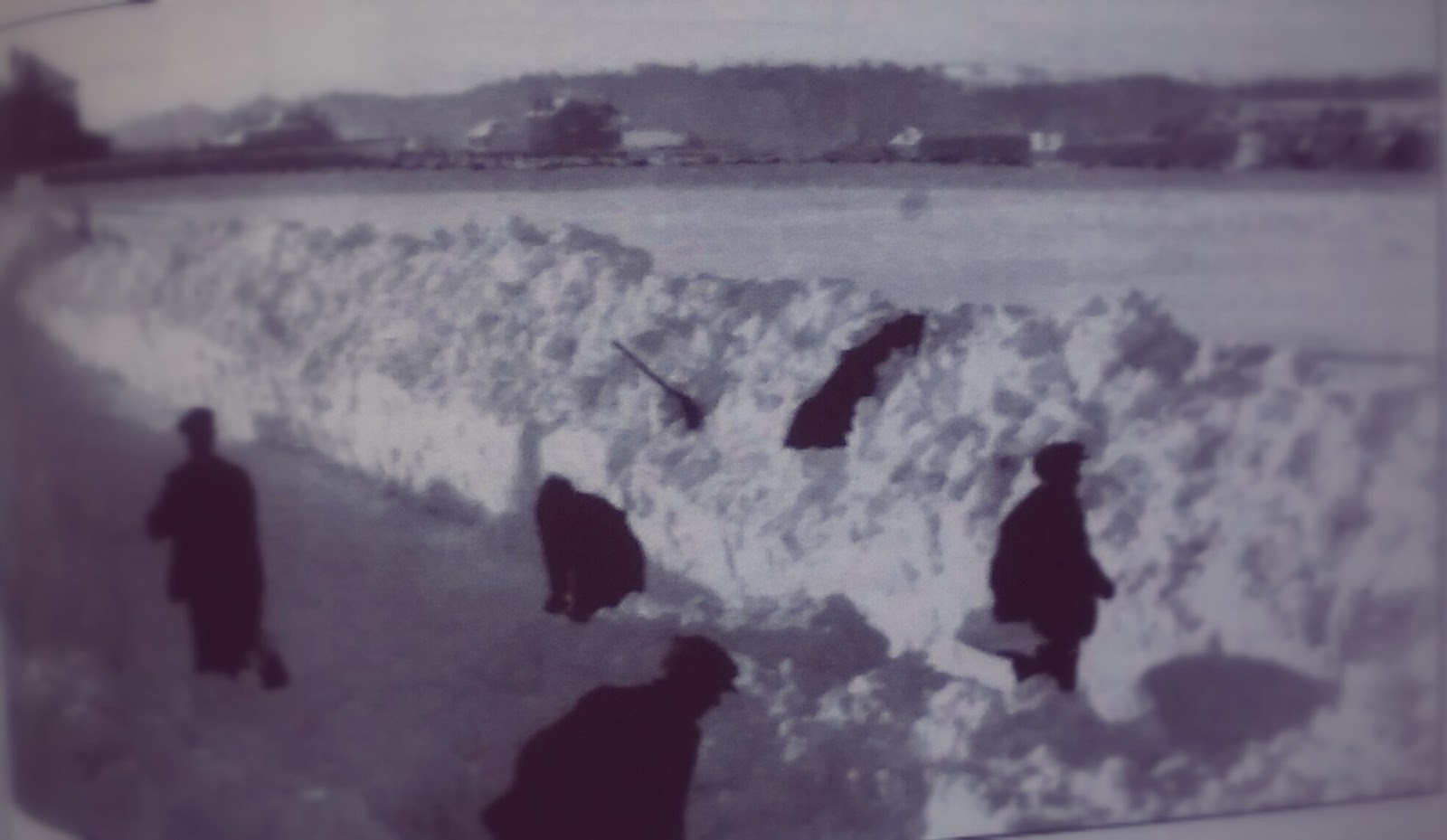
Clearing Snow. 
Really snowy winters were unusual, but this is Stornoway in 1955.
==============
The religious preoccupations and logging of Free Church life that make up the vast bulk of MacRae's diary entries during his more than 3 decades in Stornoway may be looked at, selectively, in a later post. 
 Extract from 'As Safety Saw It':- Historian Wanted


I REMEMBER at one time during the troubled years prior to the outbreak of the last war being involved in a discussion on the teaching of history; and to prove a point that I was making my fellows and myself decided to ask some schoolboys a few questions. We found that they could all tell us that Julius Caesar came to Britain in 55 B.C., and that the Battle of Hastings was fought in 1066. None of them could tell us the date of the Russian Revolution and only one could tell us when the late unlamented Adolf Hitler came to power in Germany. The relative immediate importance upon their lives of the events of which they had heard little or nothing was borne out by subsequent events. These boys found themselves fighting Hitler before 1945 and those that survived were involved in a “cold” war after the other one was over.

            The reason why my mind cast back close on twenty years to that discussion is that someone has just remarked to me how little we know of the history of our own island. For it must in honesty be admitted that the majority of us know very little of it. The name of the notorious Domhnull Cam [Macaulay] is almost a household word, but in how many of these households could anyone say in what century he carried out his bold and often nefarious exploits?

            Now if knowledge of history has any value, and if a historical education on a national or international basis bestows benefits – not the least of which can be the benefit of profiting by our predecessors’ mistakes and not repeating them – then surely knowledge of the history of our own community could bestow an equal or even greater benefit. It is even possible that some of the difficult situations that arise in Lewis today had their counterparts in the events of long ago, and that a better grasp of what happened then could help those concerned to decide what to do now. We should know what impacts were made on our island way of life and story by Scottish and even world history. And equally we should know what impact our island made in return.

            If one only considers what a great deal of archaeological research has been carried out in Lewis it is astonishing that so very little of these researches is known to the people who should be most concerned – the people whose history is being unearthed and revealed. What is wanted, in my opinion, is a new history of Lewis; a history that gives us first of all the story produced by co-ordinating and giving continuity to the findings of archaeologists, and secondly gives us the later story as pieced together from all the written material available.

            Dr Macdonald, Gisla, has done a commendable amount of research covering several centuries; and he has written and published tales that are invaluable in giving an insight into what was going on in some areas of Lewis at certain times. For very often one paragraph from an old manuscript or letter dealing with everyday affairs of ordinary men and women can throw more light upon a country and its people than can whole chapters dealing with the speeches of statesmen or the conduct of wars.

            Within the short compass of one small book, G. M. Trevelyan has given us, in my opinion, the most readable and the most educative history of England that is available today – covering six centuries from Chaucer’s time to 1939, and depending a great deal for its illuminating quality on an apparently inexhaustible fund of quotations covering the period involved.

            A book on Lewis, on similar lines, could be produced in much shorter compass than Trevelyan’s “Social History.”  And if it were as readable it would be as much sought after as was “Clarsach an Doire” [“The harp of the Grove” – Title of a book of Gaelic poetry] at the beginning of this century when an almost inconceivable number of people in Lewis knew huge tracts of it from memory, and even the illiterate could “read” poems and stories from it while holding the book upside down!


19 & 22/06/1956


[Dr Macdonald, Gisla, known locally as ‘Dolly Doctor’, also wrote letters to the Gazette on historical subjects; a collection of photographs from his collection has recently been published.]


Reaction: A letter appeared from "MacThomais", Stornoway, on 10th and 13th July (p.7) endorsing and expanding on much of the above. 

[The writer, Calum Smith, who cane of a Free Church family, used to say that he stopped going to church because he couldn't heckle the minister. Perhaps MacRae was one that he had in mind.]


POSTSCRIPT on Opposition to the NATO base:
"I recall asking the late Rev.Kenneth MacRae, when he told me he wanted a chairman for his protest meeting against the NATO base in Stornoway who must be 'generally respected and acceptable to all', where he could hope to find such a figure. He smiled and answered simply 'John Smith.'  And who in our community would have disputed his choice and judgment?"
 - 'A Memory enshrined in the Heart' by M. K. M. [Malcolm K Macmillan, Labour MP for the Western Isles from 1935 to 1970] in a Stornoway Gazette obituary for John, elder brother of Calum Smith. (1970)


Friday, 22 December 2017

Lewis in the Second World War as viewed from a Free Church Manse

Kenneth A MacRae's diary for 1939 is missing, so that his immediate reaction to the outbreak of the Second World War is not recorded. There is however some account of that time in Stornoway in the introduction to chapter 14, “Preservation from national destruction, 1940-42” of the published diary extracts (cited with reference to the First World War on this blog), as on p.324, describing how naval reservists filed to the pier on the last Sunday in August (a week before the famous broadcast announcing the declaration of war by Britain). The Stornoway Gazette reported the largest crowd ever seen there, “strangely silent”. By the fifth month of the war, January 1940, an estimated 8-10% of the population of the island of Lewis were on active service or under training.

1940
On New Year’s Day MacRae noted, “The year has come in amid the gloom of a colossal war which only seems to be beginning.” As in the First World War one of his main preoccupations was the spiritual welfare, as he saw it, of the troops. Two days later (3-1) he was trying to get names and addresses to send some “good” literature to local recruits. So far he had got 20 for men at sea, most on minesweepers, 2 Airmen, and 19 in the Army. He considered (5-1) the “spiritual provision for those poor fellows is shocking”, provided as they were only with meagre 20-minute English-run services: “Our boys know better.” And again he was concerned with the sinfulness of the times bringing divine retribution. On 11-1 he wrote to the Glasgow Herald re cutting down on luxuries, deploring the financial and moral waste of drink, betting and amusement orgies: “frivolity, intemperance, desecration of the Sabbath run through the land”.


He took a detailed interest in the progress of the war and was ready to criticise its conduct in no uncertain terms, even at times with a bit of caustic humour. This was particularly applied to the local scene. Sometimes it was kind of personal - danger threatened in a direct way when the island was embroiled in the war effort.
On 19-3 he complained of “gigantic blunders”, and of how “our miserable PM (Chamberlain) has betrayed Abyssinia, Spain and Czechoslovakia....” But this did not absolve anyone from responsibility: “Oh that Britain would repent!” was a frequent wish, as on 10th June when Italy joined in the war, and he thought "Unless the Lord intervenes, we are likely to go under." Very soon things looked still worse, in a way that affected some of the townspeople directly:
(This links with the story of the Highland Division left in northern France after Dunkirk.)
  • 13-6 A British division has been cut off in Normandy and 6000 prisoners taken.
  • 17-6 Surrender of France; probability of defeat: life grey; furnace of persecution.
  • Our own local unit hundreds of miles from coast east of Metz. 
  • 20-6 Rather anxious about our local Battery* lads east of Metz. 
  • 16-7 [Asked] how to get letters to POW Territorials via International Red Cross.
  • 26-7 Air raids in Wick, Aberdeen, Peterhead etc.
  • 4-9 news of more than 20 captured Battery boys trickling through.
*p.327 note 1 refers to the Ross Mountain Battery: "In 1940 it was part of the Highland Division serving in France." See also SY Gone By no.49 p.29 - "The whole area [called The Battery in Stornoway] was named after the RNR Battery based there [1878-1819]... " This quotes a plaque erected "to commemorate the establishment of the largest RNR Battery and Training Depot in Great Britain..."
Ibid. p.30 The housing settlements at Battery Park (1905) and Sandwick Park (1921) were built through the Congested Districts Board, for crofters and fishermen... Sandy Matheson in Stornoway Gazette 15-4-2004.


He became more concerned for the safety of those at home too:
  • 2-7 Seeing the concentration of German troops in Norway “means they are preparing an invasion of Ireland and probably the Hebrides. I feel very uneasy about our unprotected state in this area. We have not a gun of any description, a search-light nor a soldier - except upon leave - in the whole Island.” And before the end of the year his unease appeared to have some justification -
  • 7-11 ... increasingly anxious about ourselves in this town, between a seaplane base and military aerodrome (for bombers) with no anti-aircraft gun or fighter plane to defend us. Defences should have had the first consideration, for as things are, if the enemy discover the base and the aerodrome there is nothing to prevent them bombing them to bits - and the town too.
  • 16-11 At 1.15 p.m. two German planes machine-gunned the aerodrome at Steinish and the wireless station at Ness; no casualties. I suppose, now we are discovered, that we can look out for more. But who can excuse the folly of building aerodromes and seaplane base before any defensive measures have been taken? Today those two Nazi machines could have done as they pleased. This is more Sassenach blundering; no Scotsman would be guilty of such folly.
  • 26-11 Heard today that 'Lord Haw-Haw' had been threatening the Stornoway churches with extinction...
As already seen, he was appointed chaplain to the RAF locally, and on 30-12 he “asked the R.A.F. Commanding Officer for a list of the men under my care, with their billets.”

1941 brought more on the same themes of the war’s progress, its local repercussions, and the need for spiritual regeneration, as paraphrased below. In June and through to September, he was focusing on news from the Russian front, his support for the Allies undeterred by atheistic Soviet communism.

19-3 … details of bombing of Glasgow. How inscrutable are the divine providences! How devilish are the ways of men! - 21-3 many of Grant St. congregation killed.
23-3 King has decreed a special day of intercession for the country. Preached, making special reference to the increased wickedness of the town since the war broke out; spoke very directly and forcibly to the young. Pointed out how the wickedness of Cromwell Street* was likely to bring divine judgment upon the town. Atmosphere was very solemn.
28-5 I was told by the adjutant that there are now 300 RAF in the Island: 255 Church of England, 26 Roman Catholic, 19 other. Danger of air raid. Naval vessels beginning to cluster here increasingly.

*The main shopping street in Stornoway, it could get a bit lively on a Saturday night.


11-6 Lewis promises soon to be an area of first-class importance militarily. More airmen are arriving daily and the work at the aerodrome seems to be on the grand scale. Another aerodrome has been begun at Ness...
25-6 Another German plane came over the town early this morning. It is difficult to understand the delay in sending us fighters when the runway has been ready for over a week.

The year ended on another sombre note:
30-12 Feel depressed... God's displeasure with this generation is to be manifested yet awhile. I very much feel the removal of our young people to munitions and other government work. The church services will be poor without them.
31-12 May next year bring in better things and end this awful war!


1942

Better things did not immediately appear, with the fall of Singapore duly noted on 17th February, but in April in slightly lighter vein he drily recorded a "Dad's Army" moment:
(2-4) "Last night we had an invasion practice in which commando troops tried to seize the local aerodrome and the radio location station in Shader. It would appear that their effort was unsuccessful and that the Home Guard were too many for them."

Tragedy was not far away, however.   

       - 2-6 One of our promising young men missing over the North Sea.
  • 15-9 Missing airman found on Islay coast.
  • 18-9 Funeral of Alistair Mackay - detachment of RAF.  How mysterious God's providences sometimes are! 
Meanwhile distrust of the state's wartime leaders intensified:
  • 19-6 Our newspapers, under government direction, are tantalising. One would imagine on reading them that our defeats are victories.
  • 22-6 The repeated surrender of such huge masses of men seems to suggest that Britain's soldiers in this war have neither the stamina nor discipline...
  • 29-6 Such surrendering never occurred before in British history... But it is not to be wondered at. With the present generation principle had gone to the wall and the masses have been living with nothing higher in view than their own gratification... Will the country wake up at last?.. People are now beginning to suggest that we are being sold by traitors high in society but I cannot accept that.
  • 10-7 Every boast in this war, on either side, has been falsified.
  • 3-9 Day of Prayer but very little done. Business went on as usual.
  • 7-9 Egypt. In some mysterious way our forces seem to have found out that they have emerged from recent battles on top. Quite obviously it is the direct outcome of our Day of Prayer.
"Stornoway and the harbour from Lewis Castle in 1943..."
The diary’s editor fast-forwards from the perceived turning point in 1942 to near the end of the war, telling us that MacRae continued to report and comment on the news, and recording (pp.350-351) that on “Peace Day” 9-5-45, marking “Victory in Europe”, he preached in the morning from Psalms to 290 people on “The Triumph and Overthrow of the Wicked” and in the evening to a congregation of over 300 on “Our Great Deliverance”.

The Notes for this sermon include: 
I. Our Peril
II. Our Deliverance
1. It was entirely due to the Lord being on our side - we could not save ourselves.
  2. But how do we know that? Did our wickedness deserve divine assistance?
    (1) How could He be on the side of such wickedness as the Germans perpetrated?
    (2) How could He be with those who persecuted the Jews?
    (3) Humanly speaking, gospel light was largely dependent upon Britain...
III Our Prospects
. . 4. We should never forget that He can cast us down as easily as He raised us up.

When the war finally ended, MacRae recorded (14-8-45) “Peace … but … We have reason to rejoice with trembling.” Just over a week after the dropping of the first atomic bomb and 5 days after the second, his fears for the future may well have been more intense than those he voiced after the First World War – and with reason. 

The two photographs reproduced in the text above
aptly juxtaposed in the latest issue of SY Gone By, p.35
(magazine of the Stornoway Historical Society)
Previously...
Pawns in the War Game, 1940
In and Out of the War: the Free Church and Conscription, 1914-1918