Among
the papers of the late Calum Smith there is a small set of correspondence
apparently relating to a minor but intriguing mystery: the identity and
provenance of a dead body found on the island of Rona, a.k.a. North Rona, in the North Atlantic north and slightly to the east of the main chain of the Outer Hebrides. The date of the discovery is not given in the documents, and whatever (publication, letter, news item?) sparked off the exchange has not been traced, but 1942 seems likely because of the Whitley reference and a possibly related file (see below).
Key points are reproduced here. No
solution to the mystery has been found and nothing about the episode has turned up via online searching. While there is little to encourage conspiracy theorists in this perhaps
almost commonplace wartime/maritime tragedy, the story of the unknown sailor
(if such he was) and the attention he attracted over 40 years later is not without interest.
Some time in (probably) 1942 an
RAF salvage team, sent to recover what was left of a Whitley bomber on a remote
island in the North Atlantic made a grim discovery...
[Initials have been substituted for personal names in these extracts]
Letter
to CS, dated 28-5-86, from (Dr) I M in Derby
Dear Old Friend,
Thank you very much for your letter and its most welcome stories.
I hasten to tell you that S/L [Squadron Leader] P's folio on Rona (correct spelling and
Pronunciation is RONEY according to Martin Martin) is a very full account from
the boss of the salvage team who rescued the stricken research Whitley [1,2]. He
details the sheer-legs, the railway overhead of barrage balloon wire, how they
took the engines out and sailed back to Wick, but my brother D, then 12 years
old, saw them on the deck when they called in at SY [Stornoway] to refuel. The aircraft log
is also given -- it was rebuilt and flew again with training squadrons until
1946 or so when it deteriorated. The fellow in change was a Flight Sergeant
then, later promoted to a commission with a name like W but I have forgotten
it. M G, our neighbour, wrote about her father and Rev L M being asked to go
there and inter the bones, but they never went.
An A S, a native of Habost but now working in Glasgow wrote to give the
story of the body in the uniform of a German Officer. [3]
P has a great deal of information, mostly Air Ministry gen and even of
the two drifters and their full histories.
Please do not go to any trouble.
P was there on Rona in 1984, ostensibly to catch and ring Leech's
petrel.[4] I have read his diary.
I managed to get some books about Rona -- the best being "Island
Songs" by Roland Atkinson published in 1946 but now out of print...
[Continues with reference to "our schooldays", family news, etc.]
My regards to you all,
I.
 |
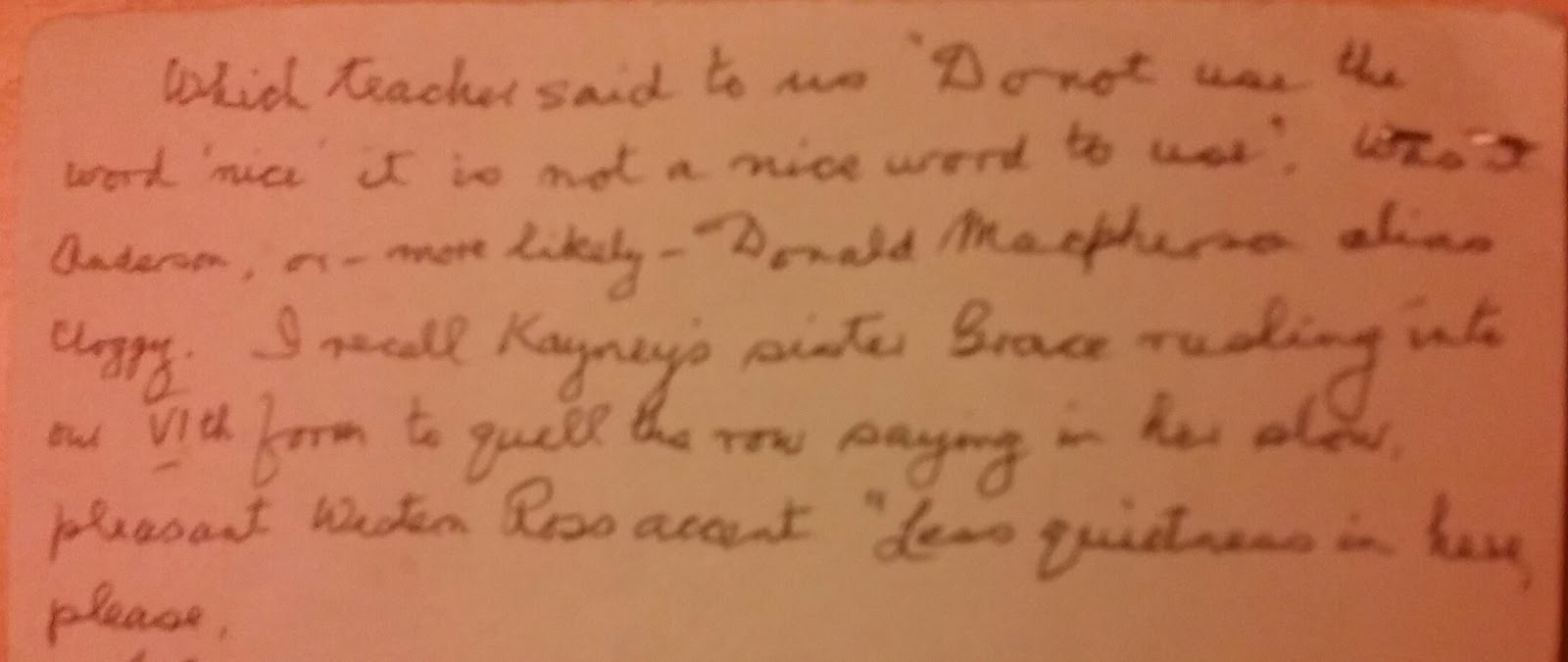
About schooldays on Lewis
("Kayney" was still teaching the next generation in the Nicolson Institute) |
Notes:
1.
The island in question, from the evidence, was the very remote one now
generally known as North Rona, not the (“South”) Rona between the Isle of Skye
and the mainland, nor yet the Ronay to the south-east of North Uist.
2. “Whitleys
[bomber aircraft] were built at Baginton, Coventry and a specialised Whitley
Operational Training Unit flew them in Warwickshire and Worcestershire from
1942 to 1944. No complete examples survive.” There are files in the National Archives relating to the salvaging of aircraft.
3. There were other wartime rumours about bodies in German uniforms being washed up around the British coast, although not, as far as is known, in such a remote location.
4. North Rona is of considerable interest to ornithologists (including those looking for the Leach's petrel), and CP was a leading light in the RAF Ornithological Society, Thus although IM's "ostensibly" suggests an element of suspicion (of a cover-up?) CP's reason for visiting the place in 1984 could well have been simply as stated.
 |
| The island of Rona is the small dot left of centre, north of The Minch |
Letter to C S 22-7-86 from Dr I M in Derby.
Dear Safety [Calum's nickname],
I enclose 2 matters for your interest.
[The first is largely irrelevant here except for telling a bit more about I M - he was a doctor and widely travelled, and
was well regarded. IM and CS were both Lewismen, and close
contemporaries. They would have been in their mid-70s in 1985-86.]
The second concerns George Rona, because M J, O/Ic [officer in charge] of the RAF Salvage Party has
written a fuller account of what he saw and did. George is no longer a
skeleton. He is a decomposing corpse clad in a uniform -- no longer mummified.
There has been too much loose talk and no creditable examination of the body
and its clothes. This is most understandable. No one likes to examine a
putrefying corpse -- especially a layman with no experience of dealing with
unexplained bodies, and he is only too glad to get on and bury it -- and forget
it. Dog tags [identity discs] and all.
However, I think I might have known him. The circumstances around the
body suggest to me he was an R N. officer possibly No.1 in a destroyer who was
pooped by a following sea while fixing something that had worked loose in a
storm of Force 8 or so. We were at sea in that area in February 1941 in
company with two 'I' class boats -- Imperial and Intrepid when the First Lieut
of one was pooped [washed overboard in the manner described]. I knew him as No.2 in my first ship, HMS
Venetia. He was one of the 8 not killed in late August 1940 when she set off an
acoustic mine off Southend. I had left her, reason unknown, the night before.
George Rona (if it was he) was transferred to an 'I' class ship. Hadn't I a
narrow escape?
So there is much more to be done
[I M continues with discussion on English language and usage, another interest
he shared with Calum].
Looking for a note from your good self.
I.
Notes:
1. The name George Rona, used to designate the unknown man, may have been suggested partly by the fact that there was a doctor of that name who was referred to in a best-selling book.
2. National Archives file reference ADM 358/401 is entitled Acting
Sub-Lieutenant P N Hopper, RNR: missing presumed dead; HMS Intrepid. It confirms the presumption of death as requested by Hopper's father, after he was lost overboard in March 1942.
Could IM's memory be playing tricks, mixing up dates
and/or incidents? P N Hopper of the Roya; Naval Reserve (from Newcastle) is said to have been killed on
5-3-42, not in February 1941. Details and location are not given but then they
wouldn't be, in wartime.

[An earlier story, and Rona's links with Lewis]
Sometime around 1680, the
steward of St Kilda, a man called MacLeod, his wife and a "good crew"
were sailing from that island home to Harris, when a great storm blew up. It
drove them northwards for hours, north even of the Butt of Lewis, until at last
it cast them ashore on the island of Rona. They managed to save themselves and
their provisions, but their boat was destroyed.
In the drama of their
scrambling up the rocks - there are no beaches - no one came to help. Perhaps
it was night, or perhaps they'd landed unseen on the island's north side. But
it must have seemed strange, as they filed through fields towards a village,
that they could smell no smoke. Rona was inhabited; it could support about 30
people and had done for centuries. There was a chapel, already ancient, and an
oratory built by St Ronan himself, and a huddle of thatch-roofed houses dug
into the ground. MacLeod's party must have called out a Gaelic greeting, louder
and louder, but no one replied.
Later MacLeod recounted
how they had buried the bodies they found. There had been a calamity - a plague
of rats had come ashore, "but none knows how", and devoured the people's
crop. No supply boat had reached the island that year. "So those deceased
persons ... died of want."
Rona's roll-call nowadays
is limited to yachtsmen, lighthouse engineers and shepherds from Lewis who
arrive perhaps once a year to round up the half-wild sheep. And naturalists:
there is a tradition of parties of naturalists heading for Rona, for the seals
and birds. […]
The seal researchers'
bothy stands proud on the island's south side, like a garden shed pretending to
be a lighthouse. A vague path led uphill towards it.
Leach's petrels are rare
birds that live out at sea, and which come ashore only to breed. They nest in
burrows, usually on clifftops, and come and go by night. To catch and ring them
requires a special licence…
-
Kathleen Jamie, author of Findings (2005), published by Sort Of Books
Letter from MJ to
CP
(both as mentioned
by IM in above)
Kendal 28/6/86
Dear C [not Calum],
I have just been reading the letters I have
received from you, since June '85, with very great pleasure, along with the
reports, letters etc. you have so kindly sent me. The last being the
"Appraisal" by I.M.[1] Now, this has started me going again.
I enclose three pages under the heading,
"The finding of George": which may help slightly. I really do believe
they are correct. I know it is a long time ago, but I am better at remembering
things way back, than last week, thats [sic]
age for you.
Well must close...
(1) The finding of "George" as I remember
it
He was lying flat
on his back in the entrance of the Bothy. The left trouser leg was pushed up
slightly, showing about ten inches of discoloured skin, the skin was not
broken.
He was wearing navy Blue cloth trousers,
similar to Service material, plain straight legs and bottoms, not Bell
Bottoms. The Jacket or Coat, seemed of the same material, though not easy to
see, neither could I see any buttons, or badges of any kind. The coat collar
seemed to button up to the neck, no sign of a shirt or sweater.
These are the only facts I can remember, and
I am certain they are correct.
The footwear, worries me. They could not have
[been] sea boots, or I could not have seen his bare leg. Shoes or bare feet
would have stayed in my memory, so I conclude it must have been boots, and
black ones too?
(2)
Exposure no doubt
brought about his end, for if he was wet and lacking food his chances were nil.
It was suggested I remember that some of the large stones near his head most
likely loosened by rain and bad weather, may have hastened his end.
I hesitate to tell you, (in case you think I
have been reading some Boys Book on shipwrecked sailors), that on
"George's" right side lay, a piece of wood about 6 - 7 feet in
length, with a piece of white material attached to the top. We therefore know
he did not drag himself from the sea and die in the Bothy right away, he made
preparation to try and draw attention to his plight.
The following is a guess (and not too far
away).
George was 5'10½ " and 12 st.[stones in weight]
(3)
If George had to go
into the Sea to get to Rona, would he not have taken off his Jacket/Coat, at
least, yet when we found him, he was fully clothed. Yet if he had only a short
swim, he might of [sic] managed, but what a job he would have had to 'dry out'.
A life Raft, which got blown away, and lost, might have made it possible to get
to the Island fairly dry?
Could George have been landed by boat, in an
exercise which went very wrong?
[signed]
M J
Note
1. IM states in his letter of 28th May 1986: "I enclose a copy of my appraisal of the findings on Rona. It is on a computer so I can always get a repeat if I remember it is filed under Mack." Unfortunately Calum Smith's copy of this document has not so far come to light.
Google Books Result
Dale Carnegie - 2016 -
Self-Help
For example, I have before
me as I write a letter I received from George Rona of Uppsala, Sweden. For
years, George Rona was an attorney in Vienna...
When George Rona read that
letter, he was as mad as Donald Duck...
 |
| "Rona Iland" is shown larger than life on early 17th century maps of Scotland |