Tuesday, 30 October 2012

Favourable notice of Invergordon pamphlet

The Hob’s Choice feature in Black Flag magazine, No. 235, mid-2012, has as its first item (p.36) a mini-review by Ade Dimmick of  Invergordon 1931. Shipshape and Mutiny Fashion: How they Fought the Pay Cuts. It includes a (slightly mis-transcribed) except from the pamphlet’s Introduction, a brief summary of what it’s about (see earlier posts here) and concludes:-
“The pamphlet is based on the various sources available and is probably one of the best overviews from a libertarian socialist perspective written to date.”


Sources for the pamphlet include:
Anthony Carew, The Lower Deck of the RN, 1900-1939: the Invergordon Mutiny in perspective, Manchester U P, 1981. 


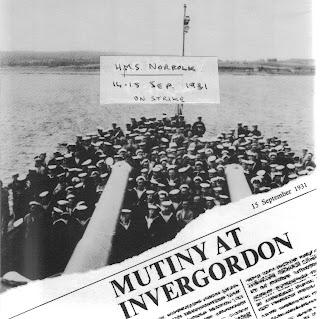
Cover Photograph (Front)
“The crew of HMS Norfolk on strike; Invergordon,  Scotland, 14-15 September 1931. From a snapshot taken by a member of the crew.”


Monday, 22 October 2012

Availability of pamphlets through AK Press and Distribution

Copies of the following SmothPubs pamphlets may now be purchased through  AK Press and Distribution, http://www.akuk.com :
What is Libertarian History? by Liz Willis (2011) 12pp. 90p
Invergordon 1931. Shipshape and Mutiny Fashion: How they Fought the Pay Cuts by Liz Willis (2011). £0.70p
Women in the Spanish Revolution by Liz Willis (Autumn 2010 edition)16pp. £1.00.
These may also be on sale on one or two stalls at the London Anarchist Book Fair on Saturday 27th October: see http://www.anarchistbookfair.org.uk

Bad News for Labour History

In a ‘Statement on status of destruction of archival material Ruskin college’ dated 15 October 2012 historian Dr Hilda Kean tells the sorry tale of how ‘Archive material dating back to the first decades of the twentieth century of the internationally renowned labour movement college, Ruskin College, Oxford has been destroyed and material constituting its radical history has been dispersed. The integrity of the material in the college as an archive of working class history no longer exists. Sadly, this process of destruction and dispersal has not finished.’
‘Although Bishopsgate Institute in London advised the college management that it could take unwanted material in July, the college management did not take up that offer.’
For further details see inter alia http://radicalhitorynetwork.blogspot.com
Whose archive, whose history?       (Comment by L.W.)
There are parallels, obviously, with things happening in other institutions and organisations where mindless authoritarian management rides roughshod over the welfare of people working in them, the needs of those they were intended to serve, and, often, the principles which led to their being set up in the first place. The breath-taking arrogance and ignorance of the Principal’s quoted comments beg the question of how anyone like that was allowed to get into a position to wield such power unchecked, in such a context, but will be horribly not unfamiliar to many who have found themselves working within an admin-heavy hierarchical set-up where corporate newspeak mentality and unquestioning subservience to government policy rule.
On a brighter note, Volunteer students working in the archive instructed to shred labour movement pamphlets acted with the imagination and integrity one expects of the best of the Ruskin tradition. Other material such as pamphlets or ephemera has been squirreled away by staff keen to preserve the past.. .’ Grass-roots spontaneous action has thus achieved some damage limitation at least. Copy that!
Related SmothPubs pamphlet: What is Libertarian History? by Liz Willis (2011) 12pp. 90p/.60p (depending on where purchased).

A new novel set partly in Ladakh

Liz Harris, The Road Back, Choc Lit,  2012. £7.99
It’s not likely that many reviews of self-identified (?-confessed) ‘romantic’ novels will appear on this blog but this one is special. Its inspiration was the same album, compiled by the author’s uncle, which also inspired our Himalayan Encounters pamphlet (see below). Many of the scenes photographed for the album – people as well as places – and described in its notes are visited in the central section of the novel, making for an unusual, perhaps unique, background to a well constructed and effectively told tale. 
This background is perhaps subject to a slight chronological slippage, given that the album with its many authentic details of a vanished way of life dates from the early 1940s, while the two main characters encounter each other about twenty years later, at a time when the region was a bone of contention between India and Pakistan post-partition, not to mention China muscling in. For one thing, it is doubtful whether travel to and within it would have been quite as easy for Brits as it appears here, if indeed it was possible at all.(Politics as such are largely absent, although there is obviously an awareness of imperialist attitudes, culture clashes and other social issues.)  Such pedantic caveats aside, it’s a good read, and an impressive and original first novel,
Related SmothPubs pamphlet: Himalayan Encounters: Ladakh 1944. (Notes on a ‘Trip’ from Srinagar to Khalatse) by Kenneth Behrens.(2011). 20pp. £1.50: pdf here.


UPDATE (June 2017)
A new pdf of the pamphlet with the images is now available

Monday, 11 June 2012

Rough winds do shake th’ Olympic flames of June

They might have known...
“Windy conditions put out two flames on lanterns at the Callanish stones monument, promping an emergency dash to collect a spare flame.” - BBC News UK, 11-6-12
An Ill Wind
“But nor satisfied ever, nor weary / Is ever the wind.”   [A.C. Swinburne, ‘By the North Sea’]
                One of the things about Lewis that visitors find not only disconcerting but even downright annoying is our habit of greeting each other with the words.  “It’s a bit breezy!” when in fact, we are gasping our way through a howling gale; it is annoying for many of them because the persistent high winds is the one aspect of our climate to which they find it most difficult to adjust themselves.
                Natives, like myself, usually accept as a matter of course, especially in the winter time, the necessity of almost perpetually leaning in one direction in order not to be blown in another.  But when one has to resort to such devices for a fortnight in the month of May, even the native begins to grumble, because by that time we are beginning to look for softer weather and some of the balm that gives us growth.
                Instead of that a cold grey wind has been blowing out of the west with wearisome and unabated persistence, keeping home fishing boats in harbour, sending strange craft for its land-locked shelter, chasing the grey seal (which appears to have adopted Stornoway) to some more sheltered nook of his own, blasting flowers, shrubs and trees, laying its mortifying hand on all tender growth, - until as I listen to “the moan that he borrows from darkness and depth of the night” I am left with “the sense that eternity never shall silence his voice.”
                - from another 'As I See It', “M.S.”, Stornoway Gazette, 22 & 25/05/1956

Saturday, 9 June 2012

56 YEARS AGO, Not the Olympics: A columnist looking back in 1956 at Sports Days gone by

 “And we run, because we like it” [Title from C.H. Sorley, The Song of the Ungirt Runners] by
“M.S.”, (AS I See It), Stornoway Gazette, 12 & 15 June 1956, p.3. [Excerpts.]

                ... Some attempt was made immediately after the war to keep alive the spirit of the old Football League Sports – that field day, yes, even gala day, of the ‘twenties and ‘thirties which was the Lewis equivalent of Highland Games. However, in spite of gallant efforts by organisers the endeavour to keep things going weakened and faded until it finally died ...
                Many people will tell you that the “gates” at these Sports became so poor that they could not hope to survive. And, certainly, not only did the public interest of pre-war years never revive fully, but what interest there was to start with petered out. It must, however, be admitted, in fairness to the paying public, that there was a marked deterioration in the enthusiasm of competitors, and a demoralising paucity of entrants for events. Had the sports provided on these days retained the keenness and put on the showmanship of earlier days, spectators would have flocked to watch as they did before; and as they always will do if the show is worthwhile ...
                What appeared to me to be lacking was the general enthusiasm of other times – times when you got a dozen lads entered for the mile race, all of them in and all of them fighting, although very often nine out of the dozen knew before they started that on form they hadn’t got a chance. However, although they couldn’t all be in front, they were all there and the also-rans helped as much to make the race a spectacle as did the prize-winners.
                Now, I will agree that there are not at present very encouraging games or training facilities available for potential athletes. And, in return, I think that such aspirants will concede that in the ’twenties and ’thirties we had no more – possibly less. I’m not arguing that because we didn’t have the facilities they shouldn’t – I think they should be given every chance and encouragement – but why the difference between “then” and “now” if the opportunities were roughly the same?
                I may be wrong but, as I see it, the difference lies in the mental approach to training. Nowadays facilities are expected and, if not provided, the young hopefuls just sit back and wait for them. We knew that facilities would not be forthcoming so we provided our own. Every stone of a certain size and shape was a special dispensation of providence for enthusiastic shot-putters; similarly every piece of timber of a suitable length or gauge was a caber; we made our own “hammers” out of lumps of iron or lead and lengths of chain; every “poll mònadh” [peat-bank] or wide burn was a jumping hazard. We were in training of one form or another all the year round. The lack of training facilities only acted as an incentive. Everything imaginable – and some not! – became a training facility.
                Of course, I think that sports fields and games facilities should be provided. But while waiting for them, could not the young lads [and lasses – Ed.] of today take a few leaves out of their predecessors’ books. Could they not carry into later years the keenness, enthusiasm, and competitive spirit which gives us such good school sports – both urban and rural. Then they would not only be ready for any opportunity that came along but I feel sure they could put on shows that would revive again the almost dead spirit of the inter-war years in Willowglen.
[Isle of Lewis, social history]

Thursday, 31 May 2012

... YEARS AGO: Some 2012 anniversaries which may escape official notice

70 YEARS AGO: Summer of 1942
Experiments begun on Gruinard – a.k.a. ‘Anthrax’ – Island, close to the north-west coast of Scotland by scientists from Porton Down under the auspices of the British government. The first series of trials was to explore the feasibility of producing lethal effects from an airborne cloud laden with anthrax spores. (It was shown to have "enormous potentialities"). As is now well known, after this and two further series, the Island was rendered unfit for human or animal habitation for decades.
References:
E. A. Willis, 'Contamination and Compensation: Gruinard as a 'Menace to the Mainland', Medicine, Conflict & Survival Vol.20, No. 4, Oct.-Dec 2004, 333-42.
E. A. Willis, Landscape with Dead Sheep: What they did to Gruinard Island', Medicine, Conflict & Survival Vol.18, No.2, April-June 2002, 199-210

60 YEARS AGO: Late Summer 1952
 Britain as WMD pioneer in the 1950s: The Hebridean connection
British government’s biological weapons (BW) experiments continued after the Second World War, with multiple ‘sea trials’ in which organisms for plague and other deadly diseases were tested on animals.
Towards the end of ' Operation Cauldron', in September 1952, a Hull trawler passed through the danger area, near the east coast of the Isle of Lewis, while a toxic cloud was being released ('the Carella incident') .This caused a flurry of near-panic in Whitehall driven by concern with maintaining secrecy at all costs.
References:
B. Balmer. How does an accident become an experiment? Secret science and the exposure of the public to biological warfare agents. Science and Culture, Vol.13, No.2, June 2004, pp.197-228.
 ‘Plague tests were carried out by Ministry of Defence off Lewis’, West Highland Free Press 4 Apr 2003, p.10. <http://www.whfp.com/1614/focus.html>
E. A. Willis, 'Seascape with monkeys and guinea-pigs: Britain's biological weapons research programme, 1948-54', Medicine, Conflict & Survival Vol.19, No.4, October-December 2003, pp.285-302

50 YEARS AGO: The OSA (Official Secrets Act) Trial of 1962
The British state secured convictions on a charge of conspiracy against four Committee of 100 activists, for organising an anti-nuclear  demonstration at Wethersfield airbase. Sentences of imprisonment were handed down after a much publicised, patently politically motivated and blatantly unfair ‘show trial’.  
Reference:
‘The road to Wormwood Scrubs’, chapter 1 in Michael Randle and Pat Pottle, The Blake Escape: How We Freed George Blake and Why, Sphere Books, 1990, pp. 1-18.

WORK IN PROGRESS
More on some or all of the above stories here later, possibly.