Friday, 20 January 2017

Alternative Burns Night in Stornoway

Stornoway Historical Society Lecture
 The Nicolson Institute: Myth and Reality
  "The third in the Society's 2016/17 winter series of lectures will be held on Wednesday 25 January 2017 at 7.00 p.m. in the Council Chambers, Sandwick Road. Our guest speaker will be Iain RM Smith who will presenting a talk on the subject of 'The Nicolson Institute: Myth and Reality'.
"Iain Smith was born on the Island of Lewis in 1947 and educated at Lionel School, at The Nicolson Institute, and at the University of Glasgow. He spent some 40 years as a school teacher and then higher education lecturer, initially in secondary schooling and then extensively in teaching teachers, latterly as Dean of Education (2001-2007) at the University of Strathclyde.
"Iain Smith has researched and written about school teaching and - more recently and more interestingly - about Hebridean educational history. He and his wife Joan Forrest are currently working on a book. It is about early 20th century secondary schooling and university access, notably in the Hebrides.
"Entry is by donation at the door. All welcome."

(Of course this would not preclude attendance at a traditional supper too!) 

A snippet from 1959:-


First impressions of science lessons on 1A in the Nicolson, August 1959
(from a letter written by a contemporary of the speaker).

Sunday, 8 January 2017

(North) Rona 1942: the Body at the Bothy

Among the papers of the late Calum Smith there is a small set of correspondence apparently relating to a minor  but intriguing mystery: the identity and provenance of a dead body found on the island of Rona, a.k.a. North Rona, in the North Atlantic north and slightly to the east of the main chain of the Outer Hebrides. The date of the discovery is not given in the documents, and whatever (publication, letter, news item?) sparked off the exchange has not been traced, but 1942 seems likely because of the Whitley reference and a possibly related file (see below).

Key points are reproduced here. No solution to the mystery has been found and nothing about the episode has turned up via online searching. While there is little to encourage conspiracy theorists in this perhaps almost commonplace wartime/maritime tragedy, the story of the unknown sailor (if such he was) and the attention he attracted over 40 years later is not without interest.


Some time in (probably) 1942 an RAF salvage team, sent to recover what was left of a Whitley bomber on a remote island in the North Atlantic made a grim discovery...

[Initials have been substituted for personal names in these extracts]


Letter to CS, dated 28-5-86, from (Dr) I M in Derby

Dear Old Friend,
  Thank you very much for your letter and its most welcome stories.
I hasten to tell you that S/L [Squadron Leader] P's folio on Rona (correct spelling and Pronunciation is R
ONEY according to Martin Martin) is a very full account from the boss of the salvage team who rescued the stricken research Whitley [1,2]. He details the sheer-legs, the railway overhead of barrage balloon wire, how they took the engines out and sailed back to Wick, but my brother D, then 12 years old, saw them on the deck when they called in at SY [Stornoway] to refuel. The aircraft log is also given -- it was rebuilt and flew again with training squadrons until 1946 or so when it deteriorated. The fellow in change was a Flight Sergeant then, later promoted to a commission with a name like W but I have forgotten it. M G, our neighbour, wrote about her father and Rev L M being asked to go there and inter the bones, but they never went.
  An A S, a native of Habost but now working in Glasgow wrote to give the story of the body in the uniform of a German Officer. [3]
  P has a great deal of information, mostly Air Ministry gen and even of the two drifters and their full histories.
  Please do not go to any trouble.
  P was there on Rona in 1984, ostensibly to catch and ring Leech's petrel.[4]  I have read his diary.
  I managed to get some books about Rona -- the best being "Island Songs" by Roland Atkinson published in 1946 but now out of print...


[Continues  with reference to "our schooldays", family news, etc.]


  My regards to you all,
  I.

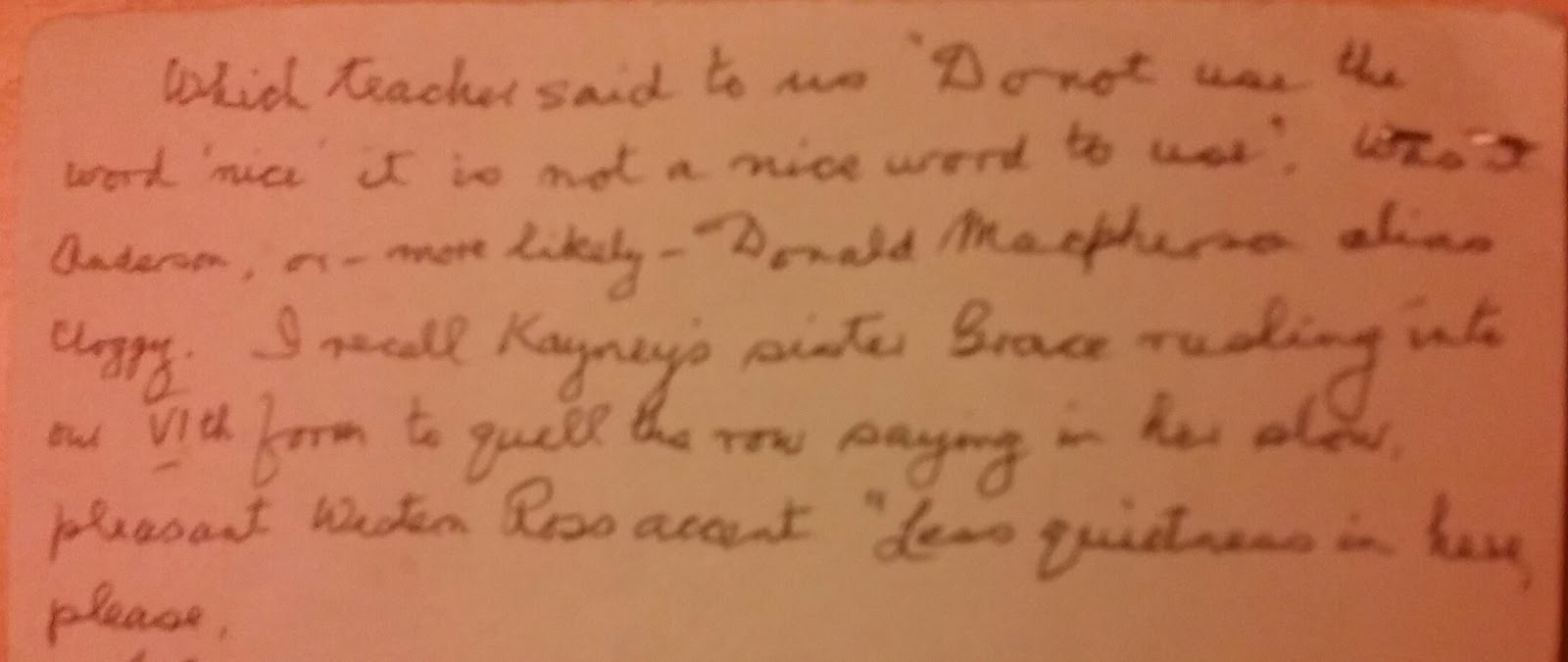
About schooldays on Lewis
("Kayney" was still teaching the next generation in the Nicolson Institute)
Notes:

1. The island in question, from the evidence, was the very remote one now generally known as North Rona, not the (“South”) Rona between the Isle of Skye and the mainland, nor yet the Ronay to the south-east of North Uist.

2. “Whitleys [bomber aircraft] were built at Baginton, Coventry and a specialised Whitley Operational Training Unit flew them in Warwickshire and Worcestershire from 1942 to 1944. No complete examples survive.” There are files in the National Archives relating to the salvaging of aircraft.

3. There were other wartime rumours about bodies in German uniforms being washed up around the British coast, although not, as far as is known, in such a remote location.

4. North Rona is of considerable interest to ornithologists (including those looking for the Leach's petrel), and CP was a leading light in the RAF Ornithological Society, Thus although IM's "ostensibly" suggests an element of suspicion (of a cover-up?) CP's reason for visiting the place in 1984 could well have been simply as stated.


The island of Rona is the small dot left of centre, north of The Minch
Letter to C S 22-7-86 from Dr I M in  Derby.

Dear Safety [Calum's nickname],
                    I enclose 2 matters for your interest.


[The first is largely irrelevant here except for telling a bit more about I M - he was a doctor and widely travelled, and was well regarded. 
IM and CS were both Lewismen, and close contemporaries. They would have been in their mid-70s in 1985-86.]

 The second concerns George Rona, because M J, O/Ic [officer in charge] of the RAF Salvage Party has written a fuller account of what he saw and did. George is no longer a skeleton. He is a decomposing corpse clad in a uniform -- no longer mummified. There has been too much loose talk and no creditable examination of the body and its clothes. This is most understandable. No one likes to examine a putrefying corpse -- especially a layman with no experience of dealing with unexplained bodies, and he is only too glad to get on and bury it -- and forget it. Dog tags [identity discs] and all.


  However, I think I might have known him. The circumstances around the body suggest to me he was an R N. officer possibly No.1 in a destroyer who was pooped by a following sea while fixing something that had worked loose in a storm of Force 8 or so. We were at sea in  that area in February 1941 in company with two 'I' class boats -- Imperial and Intrepid when the First Lieut of one was pooped [washed overboard in the manner described]. I knew him as No.2 in my first ship, HMS Venetia. He was one of the 8 not killed in late August 1940 when she set off an acoustic mine off Southend. I had left her, reason unknown, the night before. George Rona (if it was he) was transferred to an 'I' class ship. Hadn't I a narrow escape?


  So there is much more to be done 


[I M continues with discussion on English language and usage, another interest he shared with Calum].


Looking for a note from your good self.
  I.


Notes:


1. The name George Rona, used to designate the unknown man, may have been suggested partly by the fact that there was a doctor of that name who was referred to in a best-selling book.

2. National Archives file reference ADM 358/401 is entitled Acting Sub-Lieutenant P N Hopper, RNR: missing presumed dead; HMS Intrepid. It confirms the presumption of death as requested by Hopper's father, after he was lost overboard in March 1942.
  Could IM's memory be playing tricks, mixing up dates and/or incidents? P N Hopper of the Roya; Naval Reserve (from Newcastle) is said to have been killed on 5-3-42, not in February 1941. Details and location are not given but then they wouldn't be, in wartime.  


 [An earlier story, and Rona's links with Lewis]
Sometime around 1680, the steward of St Kilda, a man called MacLeod, his wife and a "good crew" were sailing from that island home to Harris, when a great storm blew up. It drove them northwards for hours, north even of the Butt of Lewis, until at last it cast them ashore on the island of Rona. They managed to save themselves and their provisions, but their boat was destroyed.
In the drama of their scrambling up the rocks - there are no beaches - no one came to help. Perhaps it was night, or perhaps they'd landed unseen on the island's north side. But it must have seemed strange, as they filed through fields towards a village, that they could smell no smoke. Rona was inhabited; it could support about 30 people and had done for centuries. There was a chapel, already ancient, and an oratory built by St Ronan himself, and a huddle of thatch-roofed houses dug into the ground. MacLeod's party must have called out a Gaelic greeting, louder and louder, but no one replied.
Later MacLeod recounted how they had buried the bodies they found. There had been a calamity - a plague of rats had come ashore, "but none knows how", and devoured the people's crop. No supply boat had reached the island that year. "So those deceased persons ... died of want."
Rona's roll-call nowadays is limited to yachtsmen, lighthouse engineers and shepherds from Lewis who arrive perhaps once a year to round up the half-wild sheep. And naturalists: there is a tradition of parties of naturalists heading for Rona, for the seals and birds. […]
The seal researchers' bothy stands proud on the island's south side, like a garden shed pretending to be a lighthouse. A vague path led uphill towards it.
Leach's petrels are rare birds that live out at sea, and which come ashore only to breed. They nest in burrows, usually on clifftops, and come and go by night. To catch and ring them requires a special licence…

   - Kathleen Jamie, author of Findings (2005), published by Sort Of Books

Letter from MJ to CP 
(both as mentioned by IM in above)

Kendal 28/6/86
Dear C [not Calum],
             I have just been reading the letters I have received from you, since June '85, with very great pleasure, along with the reports, letters etc. you have so kindly sent me. The last being the "Appraisal" by I.M.[1] Now, this has started me going again.
  I enclose three pages under the heading, "The finding of George": which may help slightly. I really do believe they are correct. I know it is a long time ago, but I am better at remembering things way back, than last week, thats [sic] age for you.
  Well must close...

(1) The finding of "George" as I remember it

He was lying flat on his back in the entrance of the Bothy. The left trouser leg was pushed up slightly, showing about ten inches of discoloured skin, the skin was not broken.
  He was wearing navy Blue cloth trousers, similar to Service material, plain straight legs and bottoms, not Bell Bottoms. The Jacket or Coat, seemed of the same material, though not easy to see, neither could I see any buttons, or badges of any kind. The coat collar seemed to button up to the neck, no sign of a shirt or sweater.
  
  These are the only facts I can remember, and I am certain they are correct.
  The footwear, worries me. They could not have [been] sea boots, or I could not have seen his bare leg. Shoes or bare feet would have stayed in my memory, so I conclude it must have been boots, and black ones too?

(2)
Exposure no doubt brought about his end, for if he was wet and lacking food his chances were nil. It was suggested I remember that some of the large stones near his head most likely loosened by rain and bad weather, may have hastened his end.
  I hesitate to tell you, (in case you think I have been reading some Boys Book on shipwrecked sailors), that on "George's" right side lay, a piece of wood about 6 - 7 feet in length, with a piece of white material attached to the top. We therefore know he did not drag himself from the sea and die in the Bothy right away, he made preparation to try and draw attention to his plight.
  The following is a guess (and not too far away).
  George was 5'10½ " and 12 st.[stones in weight]

(3)
If George had to go into the Sea to get to Rona, would he not have taken off his Jacket/Coat, at least, yet when we found him, he was fully clothed. Yet if he had only a short swim, he might of [sic] managed, but what a job he would have had to 'dry out'. A life Raft, which got blown away, and lost, might have made it possible to get to the Island fairly dry?
  Could George have been landed by boat, in an exercise which went very wrong?

[signed] M J
Note

1. IM states in his letter of 28th May 1986: "I enclose a copy of my appraisal of the findings on Rona. It is on a computer so I can always get a repeat if I remember it is filed under Mack." Unfortunately Calum Smith's copy of this document has not so far come to light.

Google Books Result
Dale Carnegie - 2016 - ‎Self-Help
For example, I have before me as I write a letter I received from George Rona of Uppsala, Sweden. For years, George Rona was an attorney in Vienna...
When George Rona read that letter, he was as mad as Donald Duck...


"Rona Iland" is shown larger than life on early 17th  century maps of Scotland

Tuesday, 3 January 2017

A Scottish schoolgirl in Belgium in 1962


 From a letter written during an exchange visit:-
[Initials are substituted for personal names]


c/o la famille L
.. 
Theux (Pr. Liège)
Belgique

3:8:62.

Dear Mum and Dad,

 I got your letter this morning just before settling out for Spa with J. We've been there all day and it's a lovely town, full of parks with statues, flowers and fountains. I bought lots of postcards...

  I'm having a marvellous time here. The food isn't really too different --I've even had chips a couple of times (better than D's [local chipshop] too!). I'm speaking French all the time, except when J talks English, which she does when she doesn't want anyone else to understand -- very handy, sometimes.


  The best day so far was Sunday. On Saturday J's friend C came back from Italy where she had been with a group of the local equivalent of Girl Guides, and on Sunday we had lunch at her house. In the afternoon we went (J, C and I) to the fĂŞte at LouveignĂ©, near C's. There were dodgems, stalls, etc., but no candy-floss, worse luck! We then had tea at C's before returning here to change for the dance in the evening. J has been coaching me by means of the gramophone... The dances here are much better than in Scotland. The mothers often come along too, and talk over a glass of wine, or even dance, on occasion. No-one liked the orchestra on Sunday, but after the Ben Wyvis Trio, it suited me fine! 

  I always thought I would hate living on a farm, but it's not too bad, actually. J is as much at home milking a cow as dancing a tango! And she also acts as official interpreter around here. There are always Dutch holidaymakers passing, asking for directions, water, permission to camp, etc. She has visited Holland every year since she was 14, and speaks the language so well she has been taken for a native. She has a Dutch friend (she showed us her photo), who is called, approx., using French pronunciation, R, and who is coming here on Monday. R's sister, with husband, and brother, with fiancĂ©e, arrived here on Saturday by car, and stayed for lunch. In the morning we all (except Mme., who was cleaning, cooking, and glad to get rid of us) went to change the cows from one field to another. (I really must join the Young Farmers' Club next session!) In the afternoon we all ate cherries M. L had just picked from the tree in the garden. That's another thing here -- the fruit. Wild strawberries by the roadside for the picking!

  The weather wasn't particularly good for the first week, but it was better today and yesterday.

  As I said in my last letter, the house isn't as isolated as I feared. The snag is, you have to walk quite a bit before getting anywhere except a few farms, etc. Theux is bigger than I thought; I wouldn't call it a village at all. We went to Verviers on Tuesday I think it was, and it's about the size of Inverness. The shops are wonderful -- Woolworths with better quality and more space, and a bit of Alec. Cameron's thrown in. My money seems to be lasting out O.K., but don't be surprised if you don't get much of a present.


  There's still lots I could talk about, but it'll have to wait till I get back... Au revoir.


Exchange pupils were presented with an official guide to the country
... and advice on what to expect and how to behave.

(For many, including the writer of the above letter, it would have been their first time abroad).

Monday, 12 December 2016

Scots Against War, 1914-18 style

Augmented BOOK REVIEW about -  

Robert Duncan, Objectors & Resisters: Opposition to Conscription and War in Scotland 1914-18 (Glasgow: Common Print/Common Weal, 2015)

Previous publications in the past few years have looked at manifestations in Britain of opposition to the First World War (refs. below) and on the impact of the war more generally in Scotland. While all these works necessarily pay some attention to aspects of the Scottish anti-war scene, Robert Duncan's informative book breaks new ground, drawing together evidence from official records and dissident, mostly left-wing press, sources. His half-dozen chapters cover not only such fairly well-known topics as the Glasgow rent strike, the imprisonment of prominent conscientious objectors (COs) - John MacLean, James Maxton - industrial unrest, and the launch of the Women’s Peace Crusade, but also many lesser-known people and events, deploying newly unearthed material. Some great group photographs and two portraits (of women, Helen Crawfurd and Agnes Dollan) enhance its attractive presentation.

The narrative runs from perspectives and protest in the prelude to war through the mass protest rallies and evolving of the anti-war position in the early months of the conflict to the growth of opposition to the threat of conscription. That threat was of course carried out in early 1916, and the longest chapters (4 and 5) deal with COs: what they said for themselves and what was said against them; their trials, testimonies, and punishment in prisons and labour camps; and their ways of surviving and coping. Finally there is an overview of repression and resistance, peace campaigns, and radical politics, 1916-1918 and the striving for a lasting peace – until the sowing of the "seeds of future conflict" at Versailles.


Without dwelling at undue length on cases of ill-treatment in barracks and prisons the book illustrates the sort of ordeals COs had to face, and the authorities' wilful incomprehension of their principled stand:

‘In my opinion Sangster is more than a little daft, and Maxton more insane than sane. Neither is accessible to reason. They are alike in their exaggerated egoism and in their want of a sense of proportion, and I should not be at all surprised if either or both of them become certifiably insane.’  - Scottish Prison Commissioner Dr James Devon on James Maxton and James Edny Sangster, two COs in Perth prison, 10 Feb.1917.
‘His mind has lost grip to a large extent. That such a man should have been a teacher is a marvel and a mystery. He may yet have to be certified. If he were liberated I do not say he would be quite sane, and he may be a cause of trouble in these times.’ – Dr Devon, report on Maxton as above, 16 June 1917. (Both quotations on p.84)

One of the individuals Duncan looks at who deserve to be more widely remembered is Dr John MacCallum, an Edinburgh graduate in Arts and Medicine who in his early 30s had become Medical Officer of Health for Ayrshire, specialising in tuberculosis (and was a Scottish rugby international). He chose to become a CO rather than seek occupational exemption, and was one of those sent to do noxious work in appalling conditions at an ‘artificial manure’ manufacturers in Broxburn, near Edinburgh, where he was victimised. He had spoken out against abusive treatment of the workers and was accused of exerting a bad influence. (p. 109) A letter of protest about his arrest and recall to the army was addressed to the Home Office in May 1917, but he was returned to Perth prison, where he served a third sentence in 1918.

There are interesting similarities between some of the book’s findings and those of researchers elsewhere, notably the harrowing experiences of COs and their capacity for resistance, the existence of support networks, the active part played by women, and the fact that jingoistic hostility, while troublesome, was less than universal. At the same time special features of the anti-war scene north of the border are brought out, such as the apparently higher incidence of ‘political’ (especially Independent Labour Party) rather than purely religious motivation for conscientious objection, and the greater disinclination for the martyrdom consequent upon maintaining ‘absolutism’ to the point of refusing all alternatives to repeated prison sentences. (p.99) 


The map of opposition is extended beyond Glasgow and ‘Red’ Clydeside to show the varying strength of the movement in other cities - considerable in industrial Dundee. It was more difficult to get the anti-war message across unmolested in Edinburgh and Aberdeen, although there were certainly supporters in each, with large rallies in the former, and Quakers from the latter providing much-needed food and encouragement to COs at Dyce camp. Names of smaller towns like Kilmarnock crop up too, but the map seems to stop short of the Highland line, not surprisingly perhaps since the sources used are mainly concerned with the more populous industrialised areas. Demographic and social factors would have made for a lower number of COs in the Highlands and Islands but there were some in even the most remote locations (see previous posts listed below). In this and other respects the research effort is already being extended as more records become generally available. Appeal tribunal records for Lothian and Peebles, used by Duncan, are now online as are those for the Isle of Lewis, and shortly after the book's publication the invaluable Pearce Register of COs with 17,426 records at time of writing was added to the Imperial War Museum website for Lives of the First World War.

[A version of this review may be published in Medicine, Conflict and Survival in due course: now online: 
free eprint available for the first 50 to click here]


References

Objection Overruled: conscription and conscience in the First World War, by David Boulton, Dent, Cumbria, Dales Historical Monographs in Association with Friends Historical Society, 2014.
Comrades in Conscience: the story of an English Community’s opposition to the Great War, by Cyril Pearce, London, Francis Boutle, 2014.
A Small Vital Flame: anti-war women in NW England 1914-1918, by Alison Ronan, Manchester, Scholars’ Press, 2014.
(Combined review of the 3 above in Medicine, Conflict and Survival - online 6 Nov 2014)
The Flowers of the Forest: Scotland and the First World War, by Trevor Royle, Edinburgh, Birlinn, 2013.


Chapter titles and selected additional notes

1. Prelude to war: perspectives and protest
            Labour Leader claimed 100 protest marches in Scotland, from the Borders to Fraserburgh

2. Wartime objection and protest in Scotland: August-December 1914
            “No war fever” in Glasgow, except in the Jingoistic press...
                    few cases of confrontation or obstruction

3. Opposing the conscription threat: 1915-early 1916
              Munitions Act: Militarisation of labour, "industrial slavery"
                   Glasgow rent strike: 40,000 households. May-Nov. 1915

4. Conscription and conscientious objection 1916-1918: testimonies and trials of objectors
               200 Local Tribunals in Scotland + 50 Appeal Tribunals - 
                    Glasgow busiest, most troubled. Supporters in gallery singing Red Flag, often. 
                    Dundee: <50 applications on opening, many moral/political, nearly all refused
                       – furious reaction in town   
                Central Tribunal test case, Cameron Roberts: setback – political objection ruled out 
                      but Exemption from Combatant Service if sincere objection to taking life.
                Case studies [more on some of these to follow] e.g. Hugh Gemell - 
                        class-war socialist, ILP: "willing to fight to defend a workers’ state."

5. Objection and punishment: prisons and labour camps
                Detention in army camps inc. Cromarty, Fort George;
                                          soldiers “kind & considerate” to CO, mutual help
                 Prison: Barlinnie, Calton, Perth. Health effects: cold, food, hard labour 
                          - almost continual solitary confinement, strict silence;
                          mental & cultural deprivation.
                          “COs developed persistent melancholia & committed suicide” - 
                       Charles Yachnies, Feb.1918, certified insane, “criminal lunatic”
                           – committed to Colney Hatch; died 27-7-18.
                  Not to waste lives as martyrs; opting to disappear; 
                            on the run, anti-war propaganda for board & lodging,
                  Work centres usually in country; compulsion, penal conditions.                                                                           Ballachulish. Cancellation of Xmas leave, 1916:
                              6 AWOL; confrontation, arrests 
                              - hunger strike in prison, threat of forced feeding. Letters, pleas in support.
                                (Primitive, reactionary diagnosis of state of mind - see Maxton above). 
                      Dundee COs refused to act as beaters on Cruachan estate 
                               - shooting birds wrong, inappropriate, against principles                                       
                      Willie McDougall, Glasgow anarchist, tried to organise strike at Dartmoor 
                       - successful escape bid, on bike - with help made it back to Glasgow,  
                        "resumed his political activities." 

6. Repression and resistance, peace campaigns, and radical politics: 1916-1918
             Range of repressive measures, disruption; police raids.
             Early 1917 Aberdeen South by-election - F Pethick-Lawrence; jingo mob.
             Women activists' aim of mobilising anti-militarist campaign 
                         with strong base among working-class women
                         Networks: tenements, streets.
              Glasgow May Day, 1918: the 1st of May was a Wednesday  - 
                   thousands took a day off  (strike, unpaid): 
                   70,000 at  Glasgow Green, 20 platforms.for speakers; "mass civil disobedience".

Plus: Introduction, End Notes, and Names Index.

Previously on this blog:-

To follow on this blog: More about some of the personalities featured in the book.

At the People's Palace, Glasgow:
"IN MEMORY OF THOSE WHO OPPOSED WORLD WAR ONE 
IN ORDER TO CHALLENGE THE PURPOSE OF THE WAR AND THE WASTE OF LIVES.
THEY ALSO CAMPAIGNED FOR SOCIAL AND ECONOMIC JUSTICE, 
AND AGAINST THE EXPLOITATION OF THOSE WHO LIVED IN THE CITY DURING THE WAR."


Sunday, 27 November 2016

Après la guerre finie…

A brief Book Notice for November

Au Revoir LĂ -Hautby Pierre Lemaitre (Albin Michel 2013; Livre de Poche 2015).


Published in English as
The Great Swindle (MacLehose Press 2015; Paperback, 3 Nov 2016), translated by Frank Wynne.
'In 2013 "The Great Swindle" (published in French as "Au revoir lĂ -haut") won the Prix Goncourt, France's leading literary award, and it will be released as a film in 2017.... "The Great Swindle" will be developed into a trilogy in the coming years.'

This extraordinary work does much to justify the publishers' claim for it as the great post-First-World-War novel. 
The French title is ambiguous: Good-bye up there, which fits the key scene, or See you up there /in heaven, which is the meaning expressed in the quotation it refers to. (Jean Blanchard, shot [see below] 4-12-14, rehabilitated 29-1-21) 
Although the narrative is about two massive scams, (one based on an actual occurrence) triggered separately by the postwar orgy of patriotic commemoration, it is clear that The Great Swindle is the war itself. Only the opening sections are set prior to the Armistice but it is this time, early November 1918, that sets the conditions for the main characters' future lives and interwoven relationships.
The author has done research and put it to excellent use without obtruding his knowledge. Among the aspects of the reality of war and its aftermath to which he draws attention are mental and physical trauma, the chaos of demobilisation, and the mismatch between public adulation of dead heroes and the bleak prospect facing damaged survivors. The social context brings out further issues of class and gender. Altogether it is an absorbing and affecting read.

#1 Those who thought this war would soon be over had all died long ago.

#8 Non-stop milling about, indescribable chaos. Demobilisation Centre choc-a-block, men were to be discharged in batches of a few hundred but no-one knew how this was to be done; orders back and forth, procedure keeps changing. Men fed up, hassled, pouncing on smallest scrap of news and setting up a clamour, almost threatening... [In Britain this sort of situation was to lead to many instances of actual mutiny in 1919].

About Jean Blanchard;
Charged with deserting their post in the face of the enemy, six men including Jean Blanchard were sentenced to death by a summary court martial on 3rd December 1914 and shot the next morning. The verdict was overturned on 29th January 1921. A monument in their memory was erected at VingrĂ© on April 5th 1925.

Previously on this blog;
Paris, March-June 2014. Introduction to an exhibition 
(The like of which we are unlikely to see listed officially in the UK)
« Shot as an Example 1914-2014. The Republic’s Ghosts»


Monday, 17 October 2016

(Female) Personalities and Power in Spain 1936-39

80 years on from the Defence of Madrid in the Spanish Civil War, a rediscovered look back at one of its best-known protagonists - and at a lesser-known woman of some importance in the same context.

Dolores Ibárruri and Federica Montseny

From Solidarity National Group Paper (co-ordinated by Oxford Solidarity) [1977], pp. 4-5.
(Slightly amended). Full issue available as pdf at libcom.org (history)

  The “big names” of history already get a disproportionate amount of attention. Our concern as libertarians will generally be more with the largely unrecorded activities of those whose struggles are too often ignored and forgotten. But it can be useful to have a look at the personalities from time to time, with a view to demystification.
   In the small welter of publications and programmes commemorating the fortieth anniversary of the “Spanish Civil War”, mentions of the part played by women have tended to be few and far between. Hardly surprising, in view of male domination in the media, and the more complete male domination in Spanish society at the time. There are, however, at least two women whose names must crop up in any account seeking to be comprehensive.
  Dolores Ibárruri and Federica Montseny both made their mark on the history they lived through, and there are one or two questions we can pose about their experience. Were their achievements (and failures) personal matters, or did they wider implication for Spanish women in general? Did they have much in common, to enable them to gate-crash the man's world of politics - or were the differences between them more significant?  

  It was as “La Pasionaria” that Dolores Ibárruri became known to the world in the nineteen-thirties, personifying the resistance of the Spanish Republic to Franco’s armies. But symbols, however romantically appealing, can mislead; the extent to which one individual can represent millions is severely limited, and Dolores Ibárruri had her own particular place in the complex political scene. By 1936 she was already established as a Communist deputy in the Cortès (Spanish Parliament), a member of the Party’s Central Committee. For a number of years she had been active as an organiser, especially among women in several “front” organisations, and was a forceful orator and propagandist. Uncompromising and often vehement in her opposition to the rightists – in March 1936 she urged the execution, in the name of the people’s legality, of those responsible for the brutal repression of the Asturias uprising of 1934 – she was imprisoned at least three times under the Republic (i.e. since 1931).
  After the partially successful Nationalist uprising in July 1936, led by Franco and other militarists, she became an even more impassioned advocate for anti-fascism in the name of the legal Republican government. In the areas where the Nationalists were not immediately victorious, including the industrial region around Barcelona, they were fiercely resisted, by the formation of popular militias and also by a large-scale takeover of factories and farms in what amounted to an incipient social revolution. Ibárruri travelled round the “loyalist” areas, speaking to large crowds and appealing for support. She achieved a popularity and celebrity unique among personalities on the government side, and certainly unusual for a Communist leader. 
  In accordance with party policy, her emphasis was on legality, the defence of the constitutional Republic, not on the furthering of social revolution, so that she must have met with some opposition. In fact, when she went to France with a delegation seeking arms and sympathy for the Republican cause, she was held up in Barcelona by anarchists. All the same the battle-cry of opposition to the rebels and invaders was sure to rally a good deal of support, and if her speeches sometimes had more colour than content this no doubt helped the process, in the short term at least.

   With the defence of Madrid later in 1936 she became an international figure. After the government had departed for the comparative safety of Valencia she stayed in the beleaguered capital, using to the full her abilities as orator and organiser. She was credited with the slogans “They Shall Not Pass”, and “It is better to die on one’s feet than live on one’s knees”, although both had been used before, and was heard constantly on Radio Madrid and over loudspeakers in the streets. Many of her speeches were directed towards women, whom she urged to fight with knives and boiling oil to defend their homes and children, and to join demonstrations encouraging men to go the front.


"Aid the Heroic Defenders of Madrid" 
50 years after the battle: University, Madrid, October 1986:
a peaceful setting for an international conference

Glasgow September 2018
  At the same time, legend has it that there was another side to this fiery, if not bloodthirsty, character: she is said to have saved a number of nuns (from “the anarchists”) and to have risked her reputation by such interventions. There were also rumours of a lover, as is generally the case when any woman achieves a degree of notoriety, although the image of matronly mother-of-five was projected strongly too. 
  In any case, the quasi-mythology and folklore masked a day-to-day political reality. La Pasionaria had her place as a loyal member of the increasingly powerful Communist Party, participating in government intrigues and squabbles, and supporting the suppression of the social revolution. She remained active to the end. When the International Brigades finally withdrew after defeat became inevitable, it was she who, famously, made the farewell speech. It was not until March 1939 that she left for France with other Communist leaders and members of the government. She was given asylum in the USSR, where she fared rather better than some Spanish Republicans, at least surviving to write her memoirs and eventually to return to Spain amid the expected sentimental brouhaha, and to embarrass the new improved Euro-brand Spanish CP of the Seventies with pro-Eastern bloc remarks. 

  Federica Montseny was another well-known orator, but her sphere of political activity was rather different. She came from an anarchist family tradition, and was by 1936 one of the leading militants of the Iberian Anarchist Federation (FAI). Although the libertarian movement did not of course have “leaders” as such, there was enough of a “star” system for a few prominent figures to emerge as effective spokespersons for the large membership of the CNT-FAI (the CNT being the strong libertarian National Confederation of Labour. Montseny was among those anarchists invited to join the Popular Front government, after the strength of the CNT had been demonstrated in the widespread collectivisation that followed upon 18th July.
  From an anarchist, whose basic principle was the total rejection of the state, such an invitation was not likely to win ready acceptance; nevertheless it was not rejected out of hand, as might have been expected. Overtaken by events, distanced from the mass of CNT members, and already used to taking decisions in a small group, the handful of leading militants agreed to give the government a libertarian seal of approval. Their decision was ratified, in retrospect, by the plenum (full meeting) of the CNT, but remains a subject of controversy in the anarchist movement.
  Federica Montseny was aware that traditional anarchists, such as her father had been, would be horrified at the idea of joining the government. Her first reaction was to refuse, but after 24 hours of heart-searching and argument she accepted nomination as Minister of Health and Social Services, claiming that this step was in the best interests of the social revolution.

Mujeres Libres poster:
"Women! Your family is made up of
 all who struggle for Freedom."
  It was at best a position in which she could help to bring about some reforms. This was done, to some extent, and women were able to benefit. Abortion was legalised, under controlled conditions. Refuges open to all women, including prostitutes, were set up – possibly to be seen as a fore-runner of present-day Women’s Aid centres. Birth control information was spread with the help of community groups such as, most notably, the anarchist Mujeres Libres (Free Women). For Spain in the thirties, and compared with the situation there today, these reforms were not negligible.

  Perhaps it was inevitable that, once in office, the Minister of Health should be preoccupied, like her colleagues, with the cares and responsibilities of the position. It was a far cry from the grass-roots work of the collectives, and there was a strong temptation to identify with one’s fellow rulers in their “difficult task” instead of questioning the basis of their existence. The anarchist Ministers went along with the legalisation and subsequent erosion of the collectivisation, and helped to smooth the path for the Communist Party’s consolidation of power.

   In May 1937 the underlying tendencies came out into the open. The government’s attempt to “disarm the rearguard” was firmly resisted by the workers of Barcelona, a stronghold of CNT influence. After three days of fighting most of the city was in the hands of the CNT and its allies, and the government was getting worried. Troops were withdrawn from the front to send to Barcelona if it proved necessary, and the anarchist “heavies” were called in. When her colleagues, the National Secretary of the CNT and the Minister of Justice (yes, another anarchist) had failed to make much impression, Montseny was sent on behalf of the Valencia government. She first obtained an assurance that troops were not to be used – until she thought they were needed.  

Anarchist 'Friends of Durruti' pamphlet on the May events
  In Barcelona her car was attacked, but her radio broadcasts appealing for calm contributed to the confusion and demoralisation of the “insurgents” (i.e. the people who were trying to hold on to what they had made their own). There were concessions from the CNT side and the government was able to assert its control. Shortly afterwards, the POUM (Workers’ Party of Marxist Unification) was proscribed, and the anti-“Trotskyist” witch-hunt drove the anarchists into opposition. Montseny protested against the turn events were taking, compiling a dossier of evidence to combat the wilder fictions of the CP and demanding a change of government. By then it was too late.
   After the defeat of the Republic she went into exile and continued to be prominent among Spanish libertarians in France. She won praise from commentators such as Burnett Bolloten for her honesty in being prepared to discuss, with a measure of self-criticism, the anarchist participation in government, and is still [1977] to be observed engaging in debate on this topic from time to time, in the libertarian press.

***************
    To each of these women a sort of stereotype can be applied, to fit them into an acceptable slot in male-dominated society; this is how their personalities were projected in a television play last July. Dolores’ is the more feminine part: not the docile little woman, of course, but the passionate earth-mother, heart ruling head, devoted to home, husband and children. It is significant that the role she habitually assigned to women was essentially a supportive one, concerned with backing up the efforts of “their” men rather than struggling alongside them on equal terms. At the same time, she managed to function as an efficient leading member of an extremely hard-headed political party – stereotypes can’t be expected to fit exactly.
    Federica, on the other hand, comes over as the intellectual, the blue-stocking, committed to her cause and therefore, so the assumptions go, a bit sexless – although she too was a wife and mother. This is how male society has long dealt with women who step out of their appointed place. They can participate in the masculine sphere but will be regarded as not quite fully female. Perhaps it doesn’t matter very much and will cease altogether when women are everywhere so integrally involved that their presence is no longer remarkable.
  In any case, there is little sign that Federica Montseny was affected by it. She remained aware at least of some of the specific interests of women and did something about them, without trading on her own femininity or conjuring up any romantic female role to fulfil. She recognised throughout that her political actions were what mattered, and whatever our criticisms of those actions, she can be respected on that account.

  It is in political terms, in a wide sense which includes their womanhood without over-emphasising it, that we have to assess the careers of both those personalities in power at a crucial stage of Spanish history.
L.W.

Glasgow commemorates 'La Pasionaria' (but not Federica M.)
Added Notes
1. On the backgound context generally, see "Online pamphlet" on Spain and the World looking at many aspects of the Spanish Revolution and Civil War, 1936-39, on the Radical History Network of North-East London blogThe sequence starts with Spain and the World... (Preface) 15/6/11 and includes:-
  • Spain and the World: Aspects of the Spanish Revolution and Civil War (1) The View from the East End. (Joe Jacobs, Out of the Ghetto) 15/6/11
  • Spain and the World: Aspects of the Spanish Revolution and Civil War (3) Health Service Spain 1936-39, 15/6/11
  • Spain and the World: Aspects of the Spanish Revolution and Civil War (on Workers' Control) 16/6/11
2. On Mujeres Libres, see Free Women of Spain by Martha A. Ackelsberg: review on libcom,org
3. On the role of women in this context: