Showing posts with label nuclear weapons. Show all posts

Sunday, 29 April 2018

Cold War Crimes: More on Nuclear Tests


 - Book review -
“Over 50 years, the Western powers used the Pacific region as a laboratory for nuclear testing.”

France was not of course the only or the first country to inflict damage on other places and peoples in the course of developing and testing nuclear weapons - and arguably far from the worst, although its resumption of the programme in the 1990s made it for a time the main focus of protests. 


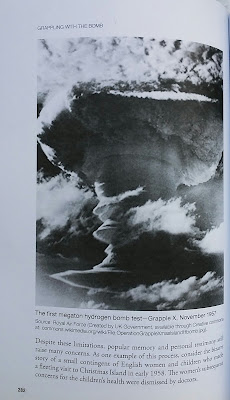
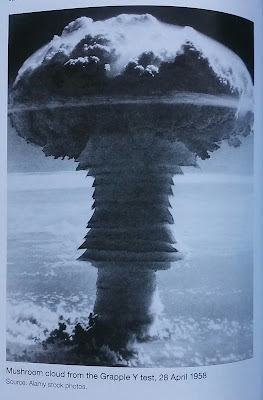
"Britain tested nuclear weapons in Oceania between 1952 and 1958. There were 12 atomic tests at the Monte Bello Islands, Maralinga and Emu Field in Australia (1952–57). These were followed by nine hydrogen and atomic bomb tests in 1957–58 at Malden Island and Christmas (Kiritimati) Island in the British Gilbert and Ellice Islands Colony (GEIC)—today the Republic of Kiribati." - Preliminary pages, p.xv in:


Nic Maclellan, Grappling with the Bomb: Britain’s Pacific H-Bomb Tests. (Pacific Series). Australian Nation University (ANU) Press, 2017. ISBN (print): 9781760461379/ ISBN (online): 9781760461386. 
Download free https://press.anu.edu.au/node/2626/download (5.0MB HTML, Mobile 5.8, epub 5.7.)  Buy Print $55 (£41.91 new via Amazon) 
An extraordinary and important new book published last year in Australia records, documents and comments on the devastating effects of what Britain did in the late 1950s on and to Malden Island and 'Christmas' (Kiritimati) Island in the Pacific.
See download for larger-scale maps
The book's structure is original, effective and readable, combining the best features of journalism (its author's profession), history writing and presentation of research findings. As the titles of its chapters indicate, it is first and foremost concerned with people, from the distant decision-makers to the all too close participants in the test, above all the large number who were adversely, often catastrophically affected by them.
This includes a wide variety of individuals and groups, among them some who tried to stop the tests and many who struggled for some semblance of justice in their aftermath. Here they often speak in their own voices, to an extent unusual in historical or scientific accounts, although not for the first time - interviews by Nic Maclennan with Pacific islanders were published in an earlier book, and much testimony has been recorded in the course of the long battle for 'compensation' to have their sufferings acknowledged. A major factor in hampering their quest, compounding the harm, has been the failure of the authorities to keep records of their exposure to radiation, or to destroy any that existed.
In each chapter, however, there is much more than biographical detail and anecdote. Memory, admittedly fallible, is supplemented by solid contextualisation and correlated with well-documented back-up evidence. For the non-scientist or non-historian, the relevant facts are presented in a straightforward, accessible way. The book begins with a time-line and glossary; 'interludes' expand on the key issues, and the extensive bibliography is helpfully arranged by subject (including American and French atomic tests) and type of material. And there are some striking and terrifying pictures.  

Sailors of the Fiji Royal Naval Volunteer Reserve, May 1957


On deck in readiness for the test: HMS Warrior
A campaigning work, it presents a comprehensive indictment of British government meanness, bad faith and abdication of responsibility for those whose world was taken over and whose lives were irrevocably damaged and shortened for the sake of preparing even more damage and destruction.     
As we mark the 60th anniversary of the Grapple tests in 2017–18, the issues of British nuclear weapons, indigenous rights and a nuclear-free and independent Pacific are still with us.

There are debates in the UK parliament about the cost of renewing Trident, the heart of the UK nuclear arsenal. Post-Brexit, Scottish nationalists are calling for a nuclear-free and independent Scotland as they move towards a second referendum on independence. The Republic of the Marshall Islands—unsuccessfully—has taken Britain and other nuclear weapons states to the International Court of Justice (ICJ) over their failure to meet disarmament obligations under the Nuclear Non-Proliferation Treaty. As a consequence, in February 2017 Britain withdraw from the compulsory jurisdiction of the ICJ on matters of nuclear disarmament, in order to halt further cases that threaten its nuclear arsenal.

Eight Pacific island countries co-sponsored the December 2016 UN General Assembly resolution to establish a treaty banning nuclear weapons, with negotiations amongst 130 governments commencing in March 2017. The South Australian Government is seeking to establish a nuclear waste dump on Aboriginal land, even as the Australian Government exports uranium to fuel nuclear reactors like Daichi Fukushima, which since 2011 has continued to contaminate the land and marine environment. Meanwhile the Tokyo Electric Power Company is wondering who will pay the horrendous price tag—US$160 billion and counting—to clean up the world’s latest nuclear sacrifice zone at Fukushima. The list goes on …

Even as some pundits call for an expansion of the nuclear industry to address the challenge of climate change, we have not addressed the costs and consequences of nuclear activities in the 1950s. As we enter a new era of uncertainty, following the Brexit referendum and the election of Donald J. Trump as US President, it is important to remember the tragedy of the nuclear era in the Pacific, so we are never forced to repeat it.

Moreover, it is time for the citizens of the United Kingdom to call on their government to do the right thing and address the legitimate claims of the Grapple survivors.

-   Introduction, p.16   
War Resisters' International pamphlet 1988
A longer and more academic review of Grappling with the Bomb is available online (June 2018). Journal: Medicine, Conflict and Survival, vol.34, no.2.
Link for e-prints (free for the first 50) here.

Tuesday, 3 April 2018

Reggane 1960: Dummies in the Desert

French Nuclear Tests in the Sahara


Notification from the research group “achac”:
Research group ACHAC - Colonisation, immigration, post-colonialism
"In the context of 'fake news', the photograph titled Reggane 1960 is a perfect example of the controversies and differing interpretations to which a picture can give rise. Taken by the French Army in the Algerian desert in December 1960, as part of the Gerboise mission – the first series of French nuclear tests, carried out in the midst of the Algerian War – it shows two lines of rigid, unmoving figures tied to stakes. Published in Les années 50. Et si la guerre froide recommençait ? [The 1950s: What if the Cold War started up again?] (La Martinière, to be published on 5 April 2018), it is deciphered here by the three authors of the book, Farid Abdelouahab, art historian, Pascal Blanchard, historian, and Pierre Haski, journalist and President of ‘Reporters sans frontières’."

Fallout from a Photograph


"This photograph of dummies set up to test the effect of the nuclear blast in the atmosphere gave rise to polemics. It was linked, as evidence, with the story of Algerian "human guinea-pigs" said to have been sent to the (test) site and deliberately irradiated by the French authorities; a news film proves that they are really dummies and not human bodies." [Reggane, Algeria].

Translation from French text, 'Fate of a photograph'
(slightly shortened)

We chose this photograph to illustrate one of the symbols of the Cold War, showing dummies set up by the French Army to test the blast from the explosion. But this picture, like present-day “fake news”, became the image of a crime perpetrated by France, that is the impact of these tests on a civilian population and on French soldiers, but also, according to some people, the “proof” that France had exposed not dummies, but FLN (National Liberation Front) prisoners of war in nuclear radiation tests. […]

On this photograph we see a dozen dummies in military uniform – very diverse and unregimented – set down in the Algerian desert. We ascertained that it should have been dated to the third test, that of 27 December 1960; this is confirmed by film and other archive images. For many years this photograph has featured in accusations brought against the French authorities by representatives of Algerian institutions … demanding acknowledgement of serious matters concerning “crimes against humanity”. In fact it is often used, mainly on the internet, to denounce presumed experiments carried out on 150 Algerian FLN POWs said to have served as ‘guinea-pigs’, in some cases disguised as dummy soldiers and tied to stakes about 1 kilometre from the epicentre in order to inform military scientists about radiation effects. The survivors/remains are supposed to have been taken to France for further research…

The First French atmospheric tests
To understand this, we need to go back to the early nuclear age… [USA 16-7-1945; USSR 1949; UK 1952}. In 1958 General de Gaulle, on coming to power, confirmed the order for nuclear weapons experiments and speeded up the preparations already begun by is predecessors two years earlier, and the Minister for Defence created a consultative committee tasked with studying the problems related to nuclear tests. The machine had got going…


In the following years the Operational Group for Nuclear Experimentation (GOEN) defined security zones. Contemporary military theories from the Warsaw Pact envisaged the possibility of manœuvres and confrontations with the enemy in zones contaminated by radioactivity after explosions. In the wake of the other great powers, the French army during that period doubtless had to take on board such views.

The Sahara Centre for Military Experimentation (CSEM) in Reggane began to emerge from the Algerian sand at the end of 1957, in the midst of the Algerian War, bringing together several thousand civil and military personnel in the Tanezrouft region, in a vast complex situated about 40 kilometres from Hamoudia.
The explosion of 13 February 1960 initiated a series of four atmospheric tests code-named ‘Gerbils’ – Blue, White, Red and Green (the gerbil being a small rodent of the desert). They went on until 25 April 1961, a few days after the generals’ putsch in Algiers.

Launched from the top of a metal tower, the first blast released energy of the order of four times that of Hiroshima (70 kilotons). Around point zero, military materiel (aircraft, vehicles…) and also animals (rabbits, goats, rats) spread about in cages had been placed in order to analyse the biological effects of the flash and proceed to ophthalmology experiments. Each test entailed numerous assessments to be made with a view to ascertaining the consequences of the energy release: nuclear diagnostics, high-speed photography, radiochemical analyses carried out on the particles collected by aircraft flown inside the radioactive cloud. The zone, in particular the Touat Valley, contained both sedentary and nomad populations. Many people would be contaminated by the tests. Like numerous French soldiers and technicians, most of them in shirt-sleeves and sunglasses, as well as many Algerian workers, and about twenty journalists present at the site, all of them subjected to large doses of radiation.

A French Senate report dated 2009 states that, “… the measures taken at the time were not sufficient to prevent the exposure to contamination of people who either participated directly in the experiments or were present in the zones around the explosions. These security measures, first and foremost did not prevent the occurrence of many technical mishaps during the preparation for or course of the tests.” (Report n°18 (2009-2010), Marcel-Pierre Cléach, on behalf of the Commission for Foreign Affairs, 7 October 2009). To sum up, things were not perfect. According to data from the Algerian League for the Rights of Man, 24,000 civilians and soldiers were directly exposed. A document declassified in 2013 and made public the following year highlights the significant duration of the fallout. All these indications tend to the same conclusion: the impact on the environment and on local populations was major.


On the day after the first explosion, the radioactive cloud reached Tamanrasset and Central Africa then moved up towards West Africa, reaching Bamako.


Criticism was powerful, but the French media and the services concerned were to develop counter-propaganda. 
Two weeks later, still laden with radioactivity, it reached the Mediterranean coastlines of Spain and Sicily (Fabienne Le Moing, « Tribunal administratif : les conséquences des essais nucléaires en Algérie » [archive], France 3-4 September 2014). Some radio-isotopes thrown out by the explosion could have been ingested by people on the ground in spite of being diluted in the atmosphere. 
There is no doubt that these radioactive elements cause cardio-vascular disease and cancers. (Brunot Barillot, « Le document choc sur la bombe A en Algérie », Le Parisien, 14 February 2014). 

This is all known and acknowledged today but it is necessary to proceed with the story as it relates to the famous photograph. 
The second explosion, much less powerful (4 kilotons) was carried out on 1st April 1960 during the official visit of Nikita Khrushchev to France (23 March to 3 April 1960), and Gaumont news announced that “France, for its part, wished to demonstrate, at Reggane, that its inclusion in Nuclear Club was not simply a matter of form”.  The means of detonation and measurement were installed in barracks and the bomb was placed on a platform at ground level (for all the other test, it was placed in shelter at the top of a hundred-metre-tall tower, later a smaller one of 50 metres).  (Pierre Billaud (Direction), La grande aventure du nucléaire militaire français. Des acteurs témoignent, Paris, L’Harmattan, 2016). The explosion set off a fireball more than 100 metres in diameter going up to 280 metres above the ground.

For the third atmospheric test of 27 December 1960 several hundred animals and military materiel as before, but along with dummies dressed in uniform (supplied with radiation receptors according to some sources), were placed at various distances around ground zero, situated 15 kilometres from the command post. The two tests, with two different dates, are central to the mistake made about the photograph, this is why the facts are important.

As can be verified in a news programme of the time (Gaumont News, December 1960, Reference 6101GJ 00006), those figures held up by iron bars are certainly made of cloth and cannot contain human bodies, dead or alive. They are the same dummies which are to be found on the photograph we published in our book (so dated December 1960), and which subsequently illustrated articles denouncing the use of human guinea-pigs in tests for radioactivity… but locating the event in April 1960. 
But the image is powerfully symbolic and invokes the violence of the Algerian war and those terrible years. This is why it is re-invoked regularly. A narrative now emerges about the use of Algerian prisoners who were allegedly deliberately contaminated and this picture has become the most obvious symbol or even ‘proof’, given its composition and the violence it illustrates in such a situation. No-one really sets out to seek its real context, nor to find the other pictures or film relating to the event. Then conflation begins. The arrival of the dummies - which can be checked on other photos (like one from the archives of l’Établissement de Communication et de Production Audiovisuelle de la Défense, Réf.: F 60-20 R651) - is as if non-existent; no-one has looked for the images or they have failed to find them. The Gaumont film archives or those of the army are forgotten. In this respect too, no-one has pursued the investigation to its conclusion.

In the course of the fourth blast, Operation Green Gerbil – a failed test since its power was no more than 1 kiloton, whereas it was initially estimated at between 6 and 18 kilotons – ‘tactical exercises in the nuclear environment’ [blog ref. supplied] did take place. Operations involving about a hundred troops: helicopters, armoured vehicles, and infantry provided with protective equipment undertook reconnaissance in the contaminated area. Nearly 200 soldiers were involved after the blast, in exercises which put them within 650 and 300 metres of ground zero for several hours. Showers were their only means of decontamination. The Parliamentary Office for Evaluation of Scientific and Technical Choices Report, 2001, indicates 42 cases of skin contamination among personnel in the test area. The obvious, known shocking thing is this above all – the contamination of soldiers and civilian populations in all the tests – but the polemic citing the image as evidence persists; on the contrary, the ‘fake news’ becomes more significant, copied form one site to another. It makes people forget the central evil and most importantly this photograph is taken as proof, when a genuine investigation should be undertaken on the use of guinea-pigs during the Algerian War. 

This question is even more important today since in early 2018 the French Constitutional Council reviewed all the traumas suffered by civil populations and decided that Algerian civilians who had sustained physical damage from violence attributable to the conflict could now claim pensions paid by France. The Constitutional Council removed the words ‘of French nationality’ which until then had restricted these benefits to victims of the ‘Hexagon’ [‘casual synonym for the mainland part of Metropolitan France’] only, invoking the principle of ‘equality before the law’ guaranteed by the Constitution. From now on, Reggane can be included in an extensive set of questions about possible compensation for populations affected at the time. It is therefore a major subject and investigation of provable and alleged facts must be resumed.


Where did the myth around this photograph come from?
It was natural enough that the French authorities always disputed the secondary effects of Reggane: “There was never any deliberate exposure of local populations,” a Ministry of Defence spokesman asserted in 2007… “Only dead bodies were used to study the bomb’s effects,” he added. Such a statement only added to the controversy, and gave support to those who thought that France had committed a crime at Reggane. Acknowledging that cadavers had been used left room for further doubts. And what bodies were involved? Might it be new evidence that living people had been exposed at Reggane in December 1960?

To reopen this question is also to investigate a state secret, relating to the pact concluded between Paris and Algiers allowing France to continue its experiments after independence until the site was dismantled in 1965. It explains the silence of the Algerian regime (or at least the complex twists of history writing) which, under military influence, has until the last few years made little use of the tests in anti-French propaganda or critiques. So it was human rights organisations that took up the fight on this issue and took the “Reggane dummies” as an icon of their struggle, a just one insofar as it concerned their quest for knowledge, but based on a misleading image.


In fact, numerous recent studies have shown that the populations of Reggane and of Eker in Tamanrasset are still suffering the effects of those tests, which have cost the lives of thousands of people and led to serious illnesses. At Reggane, where the tests were atmospheric and covered a vast unprotected area, doctors say that exposure to ionising radiation has caused more than 20 types of cancer. Before the tests, cereals and dates were grown there, and there were various types of animal. That has all gone.

This major ecological crisis is part of the historical record. Attention turned to the testimony of a Legionary said to have taken part in the assembling of 150 prisoners in March 1960 – this was taken up very quickly by the Algerian league for the Rights of Man – a fact reported by a hero of anticolonialism, the unassailable cinéaste René Vautier. In fact Vautier, who was then working on his film Algérie en flames (Algeria in Flames), seems to have been told this story by another director, Karl Gass – second hand testimony, never repeated, but for many this was taken as irrefutable proof.

Then the Canard enchaîné published photos in a dossier. Forensic doctors validated the photographs. There was talk of many others, but they were never seen. There was talk of numerous witness statements showing that the prisons had been cleared of 150 prisoners by the French Army and these taken on to the Reggane site. From here on, no-one saw dummies any more, but human bodies wrapped in clothes. This photograph had to be the missing piece of evidence, to influence opinion. Actually, it was a false trail and the investigation stalled.

Witnesses mixed up dates and evidence. What did it matter if the “150 Prisoners” business dated from March-April 1960 and the photograph from December 1960? It became an icon, pictorial proof. Witnesses like a doctor from El Harrach hospital confirmed the facts. Some people began to denounce the secret clauses of the Évian accords regarding the tests, negotiated in 1961-62… The FLN had agreed that France could use the Saharan sites for nuclear, chemical and ballistic tests for 5 more years. So the French could not be held to account, then or now.

In Algeria, the lawyer Fatima Ben Braham stated: “A study of certain photographs enables us to affirm that the position of the so-called dummies is oddly like that of human bodies wrapped in clothing. Besides that, a number of Algerians detained in the west of the country and sentenced to death by special tribunals of the [French] army have contributed illuminating testimony. Some of those sentenced to death were not executed in prison, but were transferred and never seen again. They were said to have been handed over to the army. Research in the registers of judicial executions yields no trace of their executions, still less of their release. The same fate was reserved for other individuals interned in the concentration camps.” But those testimonies are neither published nor verifiable. [... A couple of other examples.]

It all tends in the same direction. Still, there is confusion over facts, evidence and dates, on several levels. There are the facts – what happened at Reggane during the Algerian War, in the midst of unlimited violence? There are witness statements and evidence, their value impossible to assess. And there is the photograph, which has become 'the' definitive proof. Of course this does not mean that the alleged crime has no basis in fact, but it does mean that a photograph has a history and cannot be taken as evidence without being examined.

The picture actually recounts another story, about France in Algeria during and after the war, with a total of 11 tests carried out after independence, up to February 1966, tested its bomb, in the process contaminating with no shadow of doubt French soldiers, scientists, and thousands of civilians. A government which has no doubt made experiments on bodies, living or dead, as the then spokesman of the MoD, Jean-François Bureau, rashly acknowledged in 2007. But the investigation is still at an early stage.

All this now requires in-depth study. Improper use of the picture involved is stopping us from getting at the truth. A mistake which has become typical of our time: claiming without proof, affirming without investigating, favouring ‘fake news’ over thorough research. It is the role of historians and journalists to question facts and images and go beyond appearances to try to understand what really happened at Reggane. In 1960. In the middle of the Cold War. In the nuclear arms race. Pictures tell us about history and can make history, but like facts they need contextualisation, analysis and validation.
=======================
Previously on this blog:
- and protesting in 1966 against them 

Tuesday, 29 March 2016

Then It Could Be Told: book review


The Secret State: Whitehall and the Cold War, by Peter Hennessy. Allen Lane, The Penguin Press, London, 2002, xxi + 234 pp. ISBN 0 713 99626 9.


   Even before it starts, this book plunges the reader into the nightmare world it investigates, with endpapers (at front and back, produced more fully on pp 164-8) listing ‘Probable nuclear targets in the United Kingdom: Assumptions for planning.  This 1967 document of the Joint Intelligence Committee names 65 targets related to nuclear strike capability and 20 major cities, in every part of the country, so we can see just how close the perceived threat came to home.  The text fills in the details of what it would have meant.
   Peter Hennessy displays 'The Cold War state which British insiders built alongside the existing one, from roughly 1947 onwards' (p. xiii) and which his researches and discoveries, in the Public Record Office (PRO) and among surviving participant insiders themselves, have brought to light.  The nuclear factor was, as he says, central throughout the period and as such it is the focus of his study, presented in six fact- and figure-packed chapters (and earlier summarised to an appreciative audience in the Penguin History Lectures 2001).  Some of the material will be familiar, in general terms at least, to those who lived through that era, especially if they tried to expose and oppose the machinations of the Cold War state.  For surviving participant outsiders there may be a certain grim satisfaction in being shown how right they were, not only on the major issue of the scale of nuclear devastation and how close to the brink of it we came, but about the activities of Special Branch - they were watching quite a lot of us - and Civil Defence - no doubt many volunteers meant well, but what a grotesque farce it was.  These and other accoutrements of the Secret State are exposed extensively, though not exhaustively. 
  Although the author remains a corridors-of-power man, relishing contacts in the upper echelons, the unguarded remark of the once-powerful, and the machinations of government at the highest level, he accords sympathetic attention to the activities and viewpoint of dissidents, highlighting for example the ‘Spies for Peace’ episode of Easter 1963.  For him the surprising thing is not that a Campaign for Nuclear Disarmament (CND) developed, but that it took so long, and he cites official statements and analyses which he considers would have kick-started it years earlier, if made known to the public.  In this context the Strath Report of 1955 was a primary source which was still closed to him at the time of writing but has since been opened by the PRO, perhaps thanks to his efforts in getting at and publishing its gist.  Those reviewers who have drawn the inference that after all nuclear deterrence worked (and that CND was wrong) are ignoring quite a lot of the story.  As Hennessy notes: It is simple to the point of being seriously misleading to suppose that the creation of a nuclear weapons capability on both sides of what became the Cold War offers an all-embracing explanation of why the nuclear taboo has not been broken…’  (p.xi)  It is easier to answer the question what if x number of bombs had been used (see Table) than what if they had never been invented or had remained the monopoly of one country plus or minus its allies, although in the second case, at least a vast amount of money would have been saved.
   The title gives a slightly exaggerated idea of the books coverage, largely limited as it is to the nuclear-armed aspect of the Cold War and to certain departmental sources - probably the most significant with regard to policy-making - in Whitehall: the Cabinet Office (which alone covers a multitude of sins), the Prime Ministers Office, and Defence.  One way in which the work could usefully be built on would be by looking in more detail at manifestations and ramifications of their policies.  For example, further material is available on surveillance of the peace movement, Admiralty reactions to anti-Polaris demonstrations, and on the war-games exercises and detailed plans drawn up by practically all and sundry.  To dip one’s toes briefly into these last, murky waters: the Ministry of Agriculture, Fisheries and Food (MAFF), as well as conducting elaborate Atom Bomb Target Studies all over the country (PRO: [National Archives ref.] MAF 99/562 1952 etc.) was diligent in considering matters ranging from seed supplies in wartime to monitoring of farm produce for radioactive contamination in wartime, the effects of radiation on bull semen, and the slaughter of livestock following nuclear attack.  All departments were required to think about and prepare for the prospect.  The Ministry of Labour would, via a National Service Officer, direct any person in Great Britain to perform any service of which he ['or she' is implicit] was considered capable, restrict workers from leaving jobs, and so on.  Defence Regulations covered nursing, police, fire, merchant navy; certain other industries and services.  The Home Office excelled both in scaring scenarios and hilarious absurdities, with its much-satirised sixteen pages of Advice to the HouseholderPublic control after attack was the subject of special consideration; Civil Defence Wardens, and/or your local Street (Party) Leader, would coordinate the effort and should be obeyed.  Church bells were to be rung to signify fallout coming within one hour.  Housing and Local Government proposed arrangements for emergency sanitation and storing of water.  Under a dispersal policy ‘priority classes’ including pregnant women, children, and disabled, totalling about 9.5 million or 43% of the population, were to be moved from major centres to reception areas.  Even the Ministry of Pensions and National Assistance was ready at one stage, if there was a nuclear war, for the NA Scheme to be modified and known as the War Assistance Scheme.  An Index of Official Announcements on such matters was held in readiness for eventual broadcasting. 
   One finding that emerges from documents and interviews is that the state was not so monolithic, and did not present such a united front with its allies, as opponents often tend to assume. There are recurrent allusions to anxiety about the chances of US over-reaction to Soviet ‘provocation’, and the USA wais frequently portrayed as a threat to world peace (plus ça change), needing to be restrained by British reasonableness (well, perhaps some change there), for which British nuclear clout – ‘enough nuclear power to prevent foolish decisions to our detriment by the US’ (p. 62) – was seen to be required. 
   In spite of the end of the Cold War and its effects on international relations, the final chapter reminds us powerfully that this is far from being all over, past history in a supposedly, in some ways, more secure world.  Several nuclear bunkers may now be derelict or refurbished as tourist attractions, but the top people still have their bolt-hole and every British Prime Minister has to decide whether to authorise, for posthumous implementation, mass murder on an awesome scale.  Nuclear submarines carry sealed orders, ready in the event of that say-so to go and kill - whom? - when the rest of us are dead. 
  In spite of its subject, this is an entertaining and not an over-long or difficult read, with the bonus of sharing the author’s pleasure in his research, and triumph at finding the odd significant gem whose sensitivity seems to have escaped notice, lurking in an obscure file.  While it is an excellent introduction, there are several areas in which the story could be expanded, and it is reasonable to hope is likely to be, with researchers taking an interest in the topic.  Many files are there to be explored and new ones being released all the time, so that more works of this quality and accessibility may be produced on Britain’s nuclear past, reaching as it does into our present and future.  
L.W.
First published in the journal Medicine, Conflict & Survival, 2003.

From inside the book's back cover
Extract from PRO file HO 226/71:
Casualties from a heavy nuclear attack on the United Kingdom  1958
HO Scientific Advisers Branch
 Casualty estimates for ground burst 10 Megaton bombs, Table1:
No. of Bombs
No. killed (no evacuation) 000s
5
7,479
10
12,216
20
17,735
30
21,051
40
23,487
45
24,884
 The comment is added that estimates are almost certainly too low.