The documents in
question are letters in Ron's Archive at www.thesparrowsnest.org.uk, three from/to/about respectively Silvio Corio, the Italian
anarchist who was the long-term partner of Sylvia Pankhurst (one to be translated from French), and one to their son Richard Pankhurst about his Conscientious
Objector (CO) Tribunal (i.e. he was appealing against conscription for National
Service).
Wednesday, 22 May 2013

Saturday, 16 March 2013
The [abused?] Daughter of Time
(… or fostered by wrong-headed romantics?)
On the plus side, Josephine Tey’s 1951 novel is an engaging detective story which appeals to the reader’s sense of fairness, seeking truth in place of unfounded allegation and exposing the way in which history can be and is written by the victors, especially after a change of regime. It also made scathing criticisms of the unthinking myth-mongering prevalent in what is now the heritage industry and in primary-school textbooks, too often endorsed without examination in more serious works.
Where it goes seriously haywire is not so much about Richard III as in the matter of “Tonypandy”.(pp.109-110 and onwards recurrently to the end of the book). This resonant Welsh place-name – later sneered at as “silly”- is hijacked to characterise the sort of myths referred to above (p.127: ‘Pure Tonypandy. A dramatic story with not a word of truth in it.’) Tey’s supposed justification for doing so actually embodies many of the faults she picks up in the sources for what we may call Shakespeare’s Richard*:
· a distorted account imputed to the tradition she is attacking – “the shooting down by troops that Wales
· reliance on hearsay (40 years after the event), use of selective or no evidence, tabloid-style slander unsubstantiated.
· victors’ version of events uncritically accepted. Tonypandy was not an isolated outbreak of lawlessness; the miners were forced back after a protracted struggle with numerous clashes.
Of course Tey had no sympathy for striking miners or for the lower orders generally. Similar instances of blatant bias, dogmatically asserted as undeniable truth, and the familiar buzzing of favourite bees in her bonnet (like the fixation on physiognomy with which her detective’s quest begins), occur throughout as in her other works.
Why bother about all this? Because historical accuracy matters, and those who denounce official versions should be more scrupulous, not less (or no better), in our own practices than purveyors of the established orthodoxy.
You don’t have to be a wrong-headed romantic to think there is a good case made out in the book for rejecting the once-traditional, Tudor-led assessment of Richard III, but it may help, especially if you buy the whole package of Tey’s portrayal of him. Being a mid-20th century-style family man and general good guy would have been somewhat at variance with his military side as well as his position of power. But it would be seriously wrong-headed and worse than romantic to take her unsupported word for any of the other instances of what she so wrong-headedly calls Tonypandy, first and foremost that significant episode of British labour history and class struggle itself.
On p.221 Inspector Grant realises, no doubt speaking for his author as usual, that “History was something that he would never understand…” Evidently – as long as the experience of the vast majority of humanity is discounted as of no interest.
Page refs. as in: Josephine Tey, The Daughter of Time. London
Tangentially related SmothPubs pamphlet: What is Libertarian History? by Liz Willis (2011) 12pp.
Even more tangentially related article: E. Willis, ‘English detective fiction and the “People’s War”’. Forum for Modern Language Studies, vol.42, no.1, 2006: 13-21.
* The enduring fascination of Shakespeare’s Richard – as crime-fiction noir not history; as memorably portrayed by Paul Daneman in the BBC’s 1962 Age of Kings series, not pantomime villain – is another discussion.
Remembering 1911 - see also Tonypandy riots article on wikipedia.
Medicine, War - and Murder: Health Professionals in English Detective Fiction of the Second World War. Another sidelight on detective fiction, otherwise unpublished Word document here
(It may be worth noting here that in editions of the
collected works, Shakespeare’s
play is called “The Tragedy” , not “The History” of King Richard III).
Remembering 1911 - see also Tonypandy riots article on wikipedia.
 |
| Reality Check: A Place in History, by Colin Philpott (Ammonite Press 2012) |
New suggestion for further reading:
Josephine Wilkinson, The Princes in the Tower: Did Richard III murder
his nephews...? Stroud, Amberley, 2013.
A sequence of essays presenting a scrupulous and
thorough consideration of the evidence now available in relation to different
aspects of and suspects in the case. Delivers several “not guilty” verdicts but
arrives at no final conclusion, although sign-posting a direction in which one
may be sought. And more, or More (as in Sir Thomas, on whom Tey expended so
much scorn, and who first supplied many of the key details in the traditional
tale): in effect endorses a crime-fiction categorisation of the Shakespearean script
by demonstrating how More’s patently inaccurate narrative was shaped by
dramatic moralising rather than historical imperatives.
To treat Thomas More’s History of King Richard III as a work of history,
then, is to do it a disservice and to overlook More’s point entirely. (p.127)
[... It] has no place or purpose as source material
for historical enquiry. (p.128)
Given that More’s History
of King Richard III should be viewed as
drama rather than as history, it is perhaps only fitting that the darkest and
most memorable portrayal of Richard III should be found in the work of the
greatest dramatist of the all, William Shakespeare, whose play Richard III clearly owes much to Thomas More.
(Note 54, p.176).
 |
| Paul Daneman as Richard in BBC's An Age of Kings, 1962 |
Thursday, 7 February 2013
Richard was a Good Lad –
Extract from Smothpubs booklet As ‘Safety’ Saw It: Around Stornoway in the 1950s, 2009, p.32 (See previous posts for more about this publication.)
Tyrant Exposed
It took the English several centuries to discover that Henry the Eighth was an unscrupulous, insanely bad-tempered, and bloody tyrant. Everybody knew he was a bad husband – but his excesses in other directions were glossed over by his historians who were more concerned with fawning upon his immediate descendants than with historical truth. Thus was created a fictitious character known to schoolboys as “Bluff King Hal”. The bluff was all on the part of the chroniclers, and strangely enough they got away with it until comparatively recently.
Not only could they whitewash to the advantage of the monarchy, they could smear with equal facility for the same reason. Richard the Third, it has been discovered, was not as black as he was painted. His was a discredited dynasty and all the self-seeking scribblers set about maligning him to keep in with the Tudors. Even Shakespeare took a hand in it – and thus we had created for us another fictitious character known to schoolboys as Richard Crookback.
Now we are beginning to find out that Richard, although he suffered from a physical deformity, suffered from none mentally. He had a fine intellect and set out to be a good and benevolent monarch – and he might have succeeded, with a less unscrupulous court and in less troubled and intrigue-ridden times, in establishing himself as one of the ablest and best of English kings.
Now the point of all this is that up to the present day it seems to have taken centuries to get some historical characters into their proper perspective – at least in the countries in which those characters lived. The onlooker sees most of the game – and of course each country writes its own history differently. For example it is obvious that British history is taught in some European countries quite differently from the way it is taught in British schools. And vice versa. And European contemporaries of Richard III and Henry VIII would have recognised them for what they were.
In the same way it had been widely recognised in this country for some considerable time before his death that Stalin had established a dictatorship in Russia
Perhaps this is another trend of modern times. The attainment of historical perspective may be speeding up in the same way as everything else seems to be doing nowadays. What it took English “history” a few centuries to discover about “Bluff King Hal” Russian “history” has discovered about Joe Stalin in as many years.
The Russians may have their own reasons for doing it, but that it is being done at all, and done so soon, is a step in the right direction.
Who knows? Perhaps in future historical skeletons will be taken out immediately for public gibbeting, instead of being white-washed or left to moulder in cupboards. Certainly it is unreasonable to expect that “nil nisi bonum” [nothing but good {to be spoken of the dead]] should apply to tyrants!
'As I See It' Stornoway Gazette, 3 & 6/04/1956
Like many readers, Calum Smith, author of the above, was greatly impressed by the arguments in “The Daughter of Time” by Josephine Tey (a.k.a. Elizabeth Mackintosh, a.k.a. Gordon Daviot), in which the search for the truth about Richard III and “who done it” (the Princes in the Tower) is presented as a detective story. [‘Spoiler’ alert:] Henry VII emerges as the villain of the piece.
To follow: More on “The Daughter of Time” and its idiosyncratic author, and why even people who normally have little time for royalty in any form care about this half-millennium old question.
 |
| Edmund Kean not looking too villainous as Richard III |
Monday, 21 January 2013
Self-Publishing Surge Continues: Two to watch
Pete Grafton, author of YOU, YOU & YOU! The People Out of Step with World War II (Pluto Press, 1981) has recently started his own blog at <http://petegrafton.wordpress.com>. He intends to publish the original, longer version of the book online in late Spring, and to follow it with an interesting new project resulting from his work on letters written in the late 1940s to and from Glasgow , Cairo
YOU, YOU & YOU! is now being published on-line. Chapters uploaded so far can be found in a Word version here
Telling what it was like to be a work Christmas worker in a postal sorting office, Paul Petard’s excellent small (A6) pamphlet “They used to give us cake” is to be followed by others in an ‘eclectic series’ – see www.whingerpress.blogspot.com – good news for radical and libertarian historians.
Saturday, 15 December 2012
More on 2012 anniversaries: 3. The British state versus anti-nuclear demonstrators in 1962
The OSA (Official Secrets Act) Trial of 1962: Some gleanings from the files
The British state had secured convictions on a charge of conspiracy against four Committee of 100 activists, for organising a demonstration at Wethersfield airbase. Sentences of imprisonment were handed down after a much publicised, patently politically motivated and blatantly unfair ‘show trial with the Attorney-General leading for the prosecution.’. Reference: ‘The road to Wormwood Scrubs’, chapter 1 in Michael Randle and Pat Pottle, The Blake Escape: How We Freed George Blake and Why, Sphere Books, 1990, pp. 1-18. See also Peter Hain, Political Trials in Britain. Penguin 1985.
National Archives: HO 291/63 Inadequacy or severity of sentences: Nuclear demonstrators. [When accessed, this turned out to be a collection of 4 files bound together, under the one reference number]
[Notes from top file as above; the others related to earlier demos and arrests. Comments are those of the file, except when in square brackets]: -
Early Day Motion re. prerogative of mercy, Shinwell et al., 53 signatories. Leader of House declined to find time. Representations from Mrs Joyce Butler re. Helen Allegranza: no grounds for intervention found; no trouble since then as far as this prisoner is concerned.
28-6-62 Recent disturbances outside US air base at Greenham Common. If prisoners were willing to abstain from illegal action in future, might be right to consider clemency, but no indication that this is the case; question of treatment in prison being pursued separately. House of Lords: Judges unanimous that offence had been proved. A number emphasised sincere motives of prisoners. No fresh grounds on which interference could properly be recommended.
1-7-62 Deputation. Shinwell, Greenwood, Brockway, Butler, Hart. Sir Charles Cunningham,
17/7: Clearly wrong that they should be treated differently; to do so would lend colour to claim that they are in prison for political reasons and form a special category; 4 [2?] of the men already in open prison on application of ordinary rules; Randle and Allegranza are difficult prisoners and it looks as though they would not behave themselves in open conditions.
Times 13-7-62, Law Report for 12/7: "Unconstitutional doctrine" (Devlin) put forward by Attorney General that once it was proved intention was to interfere with a prohibited place Judge should be entitled to direct jury to return Guilty verdict. Question whether nuclear weapons are in country's interests dependent on an infinity of considerations.
4-7-62 Note of Deputations. They referred once more to the "hunger strike" of Mrs Allegranza.
28/6 Briefing: In early May, Mrs Allegranza was "fasting" as a protest against the resumption by the US govt of nuclear tests and also withdrew her labour; awarded certain punishments by Governor and later by Visiting Cmte.; ended fast on 9th May, no further trouble. [See below]
Re. Greenham Common, interesting note (Times) that C100 had given pledge no attempt would be made to enter base, which may suggest that the "OSA trial" has had salutary effect. Fines, temp courtroom in Newbury; 196 arrests, 4 remanded in custody inc 18-year-old girl who would not give name; 1 Not Guilty; fines £2-£5 + costs / 3gns. [= £3.15p] for obstruction. If this is raised, offences are not comparable. Trafalgar Sq. meeting planned for 7/7 re demo outside Air ministry on 9/9: to organise breaches of law, so cannot be allowed. ["Raymond" Chandler on draft, uncorrected].
Press reports {on same file]: Guardian, Times. 13/2-21/2: Purpose of action; solidarity, self incrimination (Russell, Redgrave) witnesses Pauling, Watson-Watt, Dr J F King; Air Commodore. Wethersfield demonstrators planning to give themselves up to police on guilty verdict.
PCOM 9/2208 ALLEGRANZA, Helen: member of the `Committee of 100'; at Central Criminal Court (CCC) on 30 January 1962 convicted of conspiracy to commit breach of Official Secrets Act; sentenced to 12 months' imprisonment; died [whilst in after] confinement. 1962-1963
This file reveals the treatment in prison of the only female defendant, and her repeated clashes with the authorities, as well as detailing unsuccessful appeals made on her behalf. Knowledge of the level of support may not have been clear to her as letters to her were withheld The description (when last seen) incorrectly states that she died in custody; in fact she committed suicide not long after her release.

Update:
See also chapter in Jeremy Hutchinson's Case Histories: From Lady Chatterley's Lover to Howard Marks - by Thomas Grant (John Murray, 2015; 2016 pbk.)


Monday, 3 December 2012
More on 2012 anniversaries: 2. BW sea trials 1952 (and after)
After the Second World War, five series of experiments with animals at sea were undertaken as part of the British biological weapons (BW) research programme:
·Operation Harness [a pilot scheme] in Caribbean waters off Antigua, Bahamas, 1948-49
·Operation Cauldron in Scottish waters near Stornoway, Isle of Lewis, 1952
·Operation Hesperus (same location as Cauldron), 1953
·Operation Ozone in Caribbean waters off Nassau , Bahamas
·Operation Negation (same location as Ozone), 1954-55.
At the end of 'Operation Cauldron' a fishing trawler, the Carella, passed through the danger area while the plague organism was being tested, and was kept under covert observation while returning to Fleetwood and then proceeding to the Icelandic fishing grounds, until the incubation period was over. Ministers met to discuss action, and briefings were prepared for the PM. A Naval Medical Officer was on stand-by to render medical assistance; help was not to be sought in any foreign port. The Admiralty kept only one complete file on the 'incident'; all other records were to be destroyed by fire.
The ‘Cauldron’ experiments took place in a bay - on the side of the island nearest the mainland, not way out in the Atlantic - where the deadly germ cloud was released from a specially adapted warship, HMS 'Ben Lomond '. On 15th September 1952, the captain saw the 'Carella' rounding the headland to the north at 19.01 hours. Thinking that the fifteen minutes before anything dangerous could reach it was ample time to get the trawler to change course, he went ahead with the order to begin the test at 19.02. The cloud soon wafted towards its destined target, a pontoon-load of caged monkeys and guinea-pigs - and towards the 'Carella', which did not change course despite frantic signalling from the 'Ben Lomond '.
When news of the incident reached Whitehall Gruinard Island
The authorities were certainly not going to tell the boat's crew of the threat hanging over them and advise them accordingly, since a medically appropriate response would reveal that what was being looked for was plague, with all its terrifying associations. Initially the line was that the "incident should be ignored and nothing said or done about it". The Minister of Supply who had oversight of the administrative side disclaimed any responsibility - "beyond that of having manufactured and released the bacteria".
Meanwhile, the 'Carella' returned to Fleetwood on schedule on the morning of 17th September, and thence to Icelandic fishing grounds, with the crew unaware that they were being watched all the way. In response to discreet enquiries the owners agreed to keep the Admiralty informed about its movements, and details of the crew were elicited on the pretext of concern that they might have seen "some secret material or weapons". A Warning Notice to Fishermen posted at Stornoway harbour in June had described the prohibited danger area to be used for "special trials… from time to time" over the summer, so that something hush-hush was known to be going on there.
HMS 'Zambesi' was instructed to be ready to give medical aid if required and to prevent the 'Carella' from entering an Icelandic or other foreign port should any disease develop. A few days later the fishery protection vessel HMS 'Truelove', was detailed to stay within 50 miles of the Carella's estimated position on the way back and keep a watch on her signals. The Naval Medical Officer (MO) should be in a position to render assistance but must at all costs avoid any occasion to call at any foreign port for urgent medical reasons. The end of the danger period for possible infection was agreed with the Ministry of Health as 19.00 on Monday 6th October, three weeks to the minute from release of the germs. If there were no reports of illness on board before then, no further action need be taken and all precautions would be stood down. Evidently this was what happened.
Orders went out ten days after the incident was officially over decreeing that all copies of the signals to HMS 'Ben Lomond', HMS 'Zambesi', and HMS 'Truelove' were to be burnt, and certificates of destruction by fire returned for all the written evidence, including War Registry copies. Only one complete record of the affair was to be kept, in a 1953 Admiralty file (eventually declassified as number ADM 1/26857 in the Public Record Office/ National Archives).
The Captain of the 'Ben Lomond' was considered by their Admiralty Lordships to have made an "error of judgment" in ordering release of the toxic agent before making sure that the trawler would not pass through the danger zone. An fogivable error, though, keenness overcoming judgment - like, as someone understandingly put it, "trying to get off the last shoot at the end of the day with the glass falling".
So the scientists and their political masters had got away with it and were all set to proceed with the next series of BW trials, Operation Hesperus, in the same location in the summer of 1953. This time the Scientific Trials Officer would conduct proceedings from a control hut to be built on a pontoon, which was to be moored further to seaward for a clear view to the north. Again no breach of security was reported: locals showed "the same lack of interest" as in 1952, and HMS 'Ben Lomond' - now with a different Captain - had allegedly become a "not unpopular feature of the North Hebridean landscape". On two occasions small freighters, believed to be Icelandic, crossed the trials area when danger signals were showing, and as no trial was actually in progress they were allowed to proceed.
The next year the trials moved to the Bahamas US deploying BW in Korea
Forty years later, in a written reply to Parliamentary Question 20, 19th January 1994, the chief executive of the Chemical and Biological Defence Establishment (yes, Porton Down as usual) gave a list of "trials into the dissemination of agent aerosols at sea" including: "Operation CAULDRON in Scottish waters off Stornaway [sic] in the Isles [sic] of Lewis in May-December [sic] 1952 which established that several pathogens could constitute a hazard if used as BW agents [and] Operation HESPERUS in Scottish waters in May-August 1953 which aimed to consolidate data and compare several dissemination and collection methods." Thus Operations Cauldron and Hesperus were written into the official record - even if blandly, sketchily, decades late, and with imperfect accuracy. The 'Carella' cover-up was almost entirely successful for rather longer.
Subsequent publicity about them was sparse and sporadic: an MP's question in 1979; a front-page article in The Observer on 21-7-85, "Germ Bomb Sprayed Trawler"; a mention in A Higher Form of Killing: The Secret History of Gas and Germ Warfare (by Robert Harris and Jeremy Paxman, first edition 1982). PQs in the mid-1990s brought a little more information as noted, then, after declassification of the relevant file, Operation Cauldron received extended treatment in the (Scottish) Sunday Herald in March 2003 and the Carella incident was described in the West Highland Free Press in April 2003. More detailed accounts appeared shortly thereafter in a couple of academic journals (see below) which in turn fed into significant though short-lived publicity in other media.
. __________________
The tests tok place off the north-east coast of the island, between Stornoway and the Butt of Lewis.
The tests tok place off the north-east coast of the island, between Stornoway and the Butt of Lewis.
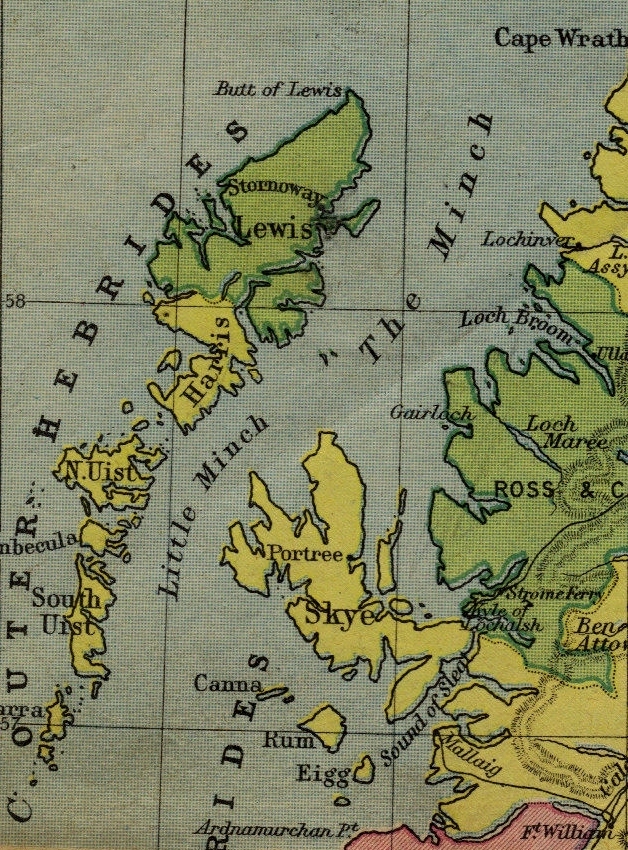
Adapted from: ‘Plague tests were carried out by Ministry of Defence off Lewis’, West Highland Free Press 4 April 2003, p.10. <http://www.whfp.com/1614/focus.html>, and from a seminar paper presented at the Institute of Historical Research
More on the sea trials: E. A. Willis, 'Seascape with monkeys and guinea-pigs: Britain here.
More on the Carella incident: Brian Balmer. How does an accident become an experiment? Secret science and the exposure of the public to biological warfare agents. Science and Culture, Vol.13, No.2, 2004, pp.197-228.
Friday, 30 November 2012
Before 2013. More on 2012 anniversaries: 1. Gruinard 1942
Experiments carried out in 1942 and 1943 by British government scientists on Gruinard, a.k.a. ‘Anthrax’ Island
What was done?
Official files reveal how the first series of trials began in July 1942 to explore the feasibility of producing lethal effects from an airborne cloud laden with anthrax spores. It was shown to have "enormous potentialities", with "effects on animals of an order of magnitude quite different" from either high explosives or chemical agents. "Most Secret" veterinary report told how the sheep were bought in Inverness , and gave the gruesome post mortem findings. All the animals were destroyed whether or not the spores had got them (as is the norm in animal experimentation), the carcases covered in earth (peat in sandbags), and "the whole finally [supposedly] obliterated by rock blast".
The second series in September 1942 aimed to confirm the results of the first, obtain further information, and test the same anthrax bomb in conditions approximating to operational use. Trials one and two were considered very satisfactory from all aspects. In Trial three the bomb fell in a very boggy patch, making a three-foot crater, and no animal died. Trial four - an anti-tank project - was satisfactory, establishing a prima facie case for the use of anthrax in anti-personnel munitions.
To ensure that all deaths were due to inhalation of spores from anthrax, the sheep were not just tethered but fixed in special crates to limit head movements. The spores were thought to provide perhaps an ideal "war gas" in a cloud scarcely visible and probably odourless, of a toxicity which far exceeded that of any "pure" chemical agent so far discussed. Scientific and service personnel were thanked for participating with enthusiasm in these difficult and dangerous trials, and locally-based helpers acknowledged.
A third series of tests was conducted in July to September 1943 using four-pound aircraft bombs. Experimental staff were deemed to be at no great risk, although they needed protective clothing. When participants returning from the south of the contaminated area waded through a stream of surface water supplying washing tanks, it was thought it might be "inadvisable" to use this water for washing face, neck and hands.
Who was responsible?
A team had come from Porton Down in Wiltshire. At the end of September 1939 Prime Minister Neville Chamberlain had approved a proposal for an expert committee to discuss the possibilities of infection being transmitted by various forms of micro-organisms through the air. The House of Common's Defence Committee sanctioned "appropriate measures to enable retaliation (if the need should arise, i.e. after first use by the enemy) without undue delay". And, as Paul Fildes, who headed the team, observed in his report of Series three of the trials, "experiments of this sort can only be carried out in remote places". Of course it doesn’t seem so remote if you happen to live there.
What about the locals?
Unofficial reports leaked out of an outbreak of anthrax on the mainland in 1943, thought to be from one infected carcase that had been hurled too far out by the disposal blast.
News of a number of inexplicably dead animals was communicated by the Divisional Inspector for Animal Health on 28 February 1943. The death of a heifer a week previously had been reported to the police as suspected anthrax; the background was the washing up of a carcase of a breed and origin unknown locally in an inlet off Gruinard Bay
A cover story would be needed if there was to be an official response to the compensation claim lodged by the dead heifer’s owner. A Mr Fish, who described himself as a security officer, had the bright idea of ascribing the anthrax’s origin to one sheep, which it was to be said had been traced to a Greek ship. The utmost secrecy as to the actual source of the sheep was essential, Fish explained, to prevent news of the Gruinard experiments reaching Germany
The possibility of recurring outbreaks was a difficulty. Alfred Duff Cooper, Minister of Information, was against further payments in the event of more animal deaths. He thought the Greek ship story feasible, but the Treasury rejected it, although they could suggest no alternative other than to pay up and shut up about why. A conference extending to include Foreign Office and Scottish Office participation granted that crofters had suffered, for them, considerable loss. After discussion it was settled that officials would accept the view that the trouble was in some way related to war conditions, and that it was made on account of the death of farm animals. They would continue to monitor the situation.
In September 1943 anthrax was found again, confirmed in another dead heifer. No clue to the origin of the infection could be found other than the ‘centre’ at Gruinard. A letter went out on 10 July 1944 stating that no compensation was being offered, but payment was being made with reference to the death of the animal. An envelope in the file contains a certificate of infection with anthrax.
In June 1945 Fildes admitted that Gruinard Island
In April 1962 the Member of Parliament for Ross and Cromarty was prompted by some of his constituents to pursue the matter of the island. Three years previously he had been sent a letter stating the place was still unfit for human habitation. Certain areas of soil contained organisms dangerous to man and beast, and this hazard was thought likely to persist. An MRE (Microbiological Research Establishment, i.e. from Porton) inspection party visited each year to take samples.
"When safe again" the island would be offered to the former owner. It was likely, though, to remain contaminated for the foreseeable future, was dangerous, and should not be approached. In 1963 people wanted to know what progress had been made, and the media were on the case; the MP had suggested decontamination, until convinced by the authorities that it was not possible. A press release was prepared for that year's inspection, admitting for the first time the nature of the contamination, giving the official line on how and why it occurred, and the need for the annual check.
As a civil servant explained to the Minister concerned, they had hitherto always refused to disclose details as not being in the public interest. Indeed, a former Under Secretary of State had banned use of the word bacteriological "unless cornered". But this was no longer enough. There were rumours, for example, about radioactivity, and incidents of trespass or inadvertent landings, and efforts to maintain secrecy had become an embarrassment. To stop the rot, on 1st August 1963 it was decided that the "Secret" classification for Gruinard files could be abandoned.
How to clean it up?
The annual testing of soil samples, begun in 1948, was continued until 1968, then again in 1972 MoD staff found viable spores although accurate counts were not made. In 1981 experts from the Chemical Defence Establishment (CDE - there were many name changes) at Porton Down published their report on the results of the first full survey conducted in 1979. Areas around the gantry where the anthrax bombs were suspended remained contaminated at detectable levels, along with a much wider surrounding zone of undetectable contamination - possibly containing localised high concentrations of spores, which could also constitute a hazard.
Within a year it was announced that the MoD intended to try to clean up the island, after a small spate of Parliamentary Questions. In 1982-83 preliminary results of field trials and laboratory tests showed that decontamination was possible. The work was to be undertaken by a small party from the CDE with a Scottish Home and Health Department representative in attendance.
The Ministry's refusal to give details of the chemicals to be used raised some concerns, while the leading science magazine Nature was fairly relaxed about the anthrax itself and claimed that tourists frequently strayed on to the island without falling ill. Journalists were allowed on in July 1986, the largest group of people to visit the island since the experiment.
All better now?
Finally in 1990 it was announced that Gruinard Island
The fears and misgivings aroused by the name of Gruinard may be still more difficult to eradicate.
__________________
Mostly adapted from: ‘Faraway places: The post-war fate of Gruinard Island Gruinard Island
For the 1943 ‘compensation’ story, see E. A. Willis, 'Contamination and compensation: Gruinard as a 'menace to the mainland', Medicine, Conflict & Survival Vol.20, No. 4, Oct.-Dec 2004, 333-42.
Subscribe to:
Posts (Atom)