Saturday, 21 May 2016

A Findochty Flett in Canada

In Imagination and Memory...

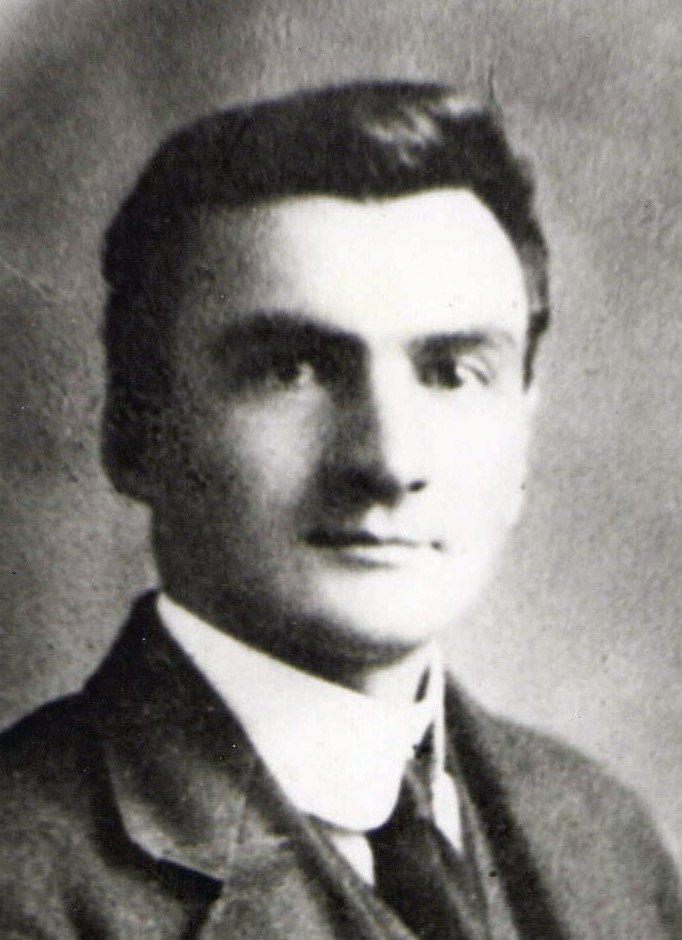
Joseph Flett was aged 27 when he sailed to North America in August 1915, 28 when his young wife and baby daughter joined him in May 1916. While he may at that time have intended to make a permanent home in Canada, circumstances decreed otherwise and he had returned to Scotland 13 years before his novel Bid for Fortune was published in 1934. The book contains several chapters set in Newfoundland where he had spent over five years. Although a work of fiction presented as an escapist adventure story, it clearly draws extensively on the author's knowledge and experience (as well as his thoughts and feelings), including some about his temporarily adopted country.

Written on May 21, 1916:
"No desire to return to Scotland", but circumstances decreed otherwise five years later
In the context of post First World War alienation and lack of prospects the four main protagonists in the novel, after a failed business venture, turn to less legal schemes for securing some kind of future for themselves. While one takes care of the main plan, to smuggle accidentally-acquired diamonds into the USA with a view to disposing of them, the other three proceed via Newfoundland to rendez-vous with him in New York. Rather than wait idly, they decide to have a go at putting another idea into practice, rum-running from the French colony of St. Pierre to the Prohibition-era dry States. Rum-running to the USA, one of them has argued, would constitute a "real service" as well as being "almost respectable":

"For the greater convenience of rum-runners and Newfoundland fishermen - they've got Prohibition even in their foggy clammy island, poor devils! - there happens... to be two bits of rock off the south coast of Newfoundland that still belong to the sensible and thirsty Républque Française... an oasis in an arid land." (Chapter 5, p.55)

Anyway: "The Americans didn't despise law-breakers; the only thing they really despised was poverty. And rum-running was by now almost a respectable industry in the States."  (Chapter 14, pp.128-9)

On board ship their fellow passengers "cursed Prohibition. It was leading the youth of the country astray... It was killing the young men and corrupting the young women." (Chapter 17, p.148)

The next morning they were swishing through slob ice, with an occasional bump and grinding into the harder hummocks. Late in the afternoon they came up to the narrows of St. John's harbour. Huge cliffs towered above the narrow channel, bare grey rock plastered white in every cranny with snow, formidably wild and desolate-looking. Wooden huts and scaffoldings of fishermen [boats] perched on shelves of rock just above the water. A grim land it looked. Passing through the narrows, they entered a calm, land-locked harbour, full of drifting ice and little anchored schooners, Christmas-toy-like in their frosted shrouds and the long icicles pendent from bow and stern and gunwales.
 ... A small fleet of sleighs awaited the landing of the passengers... A grim country. A devil of a climate. (Chapter 17, p.148-149)

These first impressions are expanded into a more elaborate description of the place (with a small sting in the tail): "A rover of the sea turned merchant... St John's achieves, too, the metropolitan air... shares in the councils of the nations. She has a parliament all of her own... active mentally, and that's the great thing... It loves to take the stranger in, in one way or the other." (Chapter 18, p.150)


The next objective was to be Saint-Pierre-et-Miquelon, travelling to which was possible but advised against by locals at this time of year, the advice being heeded by only one of the three: "Jimmy, listening to the proposed itinerary, ruled himself out of it. He wouldn't, deliberately and of his own free will, shove himself into such horrible discomforts. But Tommy and Jock were still of the mind to go through with it." (p.151)

Tommy and Jock decide to kit themselves out, gradually, in seamen's clothing –

Then, on pretence at first of touring the outports, they crept down the coast, from one fishing hamlet to the next... until at last, from long rubber thighboots to mackinaw and ear-flapped cap, there was naught to distinguish them outwardly from the most native of natives. The local accent, a peculiar blend of West-Country English with the Irish brogue, presented much more difficulty to Jock... Jock, they decided, would have to pass as a Cape Breton Gaelic-speaking Scotsman, in whom any variety of English, from the purest to the most broken, gives no surprise to anybody - or at least so they had gathered from their boon companions in St. John's.
From Placentia... they drifted down... Everywhere they landed they found houses that would take in the weary traveller for a dollar or two... (p.154)

After an enforced wait that turns out to be "comfortable and jolly" in Grand-Bank, Fortune Bay, "there came a morning at last, even in a Newfoundland February, when the raging seas simmered down into a sullen heave of swell."

They landed on rocks at an unfrequented part of the island...
Saint-Pierre was quiet.. The transatlantic headquarters of the French cod-fishing fleet, its busy time was over for a year, except for the occasional visit of a big French trawler and its surreptitious activities in the rum-running trade...
The cod-fishing business was not what it had been. Newfoundland long ago had done its direst to kill that trade by prohibiting the sale of Newfoundland bait to the French, and in any case the business of fishing was getting more and more into the hands of big steam-trawling companies... (p.157)


While this adventure proceeds:

Jimmy put in the three weeks' waiting at St. John's pleasantly enough. He skated on the ice-rinks; he practised snow-shoeing until he quite fancied himself as an expert; he played poker and bridge; avoided women... As soon as it was certain that Jock and Tommy had made the passage, Jimmy packed up and took sleigh for the railway station.

The journey turns out to be something of an epic one. "The train lurched and bumped... in a manner disconcerting to the novice", eliciting the reassurance that [JF does the voice] 
"This ain't the season yit foh upsets. Next month now, yoh go to sleep mebbe in a lowah berth and waken up in a uppah berth with the train turned right upside down"  - in which case the procedure would be to climb out by the windows, with "drifts of snow fawty feet deep sometimes" at the "tops'ils". Asked "How do you like it up here?" the attendant replies that there are drawbacks and 'vantages: "We coloured gemmen have fah moah considuation up heah, sah. But dis consumption play the devil with coloured folks up heah, sah." (p.181-182)

The same attendant breaks the news to him when they get snowed in, and the conductor confirms that nothing can be done until the storm blows itself out and the "rotary" clears a way for them, which might take weeks. There are very few passengers in the sleeper - "Only the strongest urgency could persuade anyone to do the cross-country voyage at this time of year" - and after three days of being cooped up with them Jimmy, "ready for anything, no matter how desperate, that would break the monotony", decides to set out walking. Grand Falls he reckons is only about 80 miles away; some houses are scattered along the route; he expects to find "lots of English people there, employees of Northcliffe's paper mills".  Although he goes equipped with snow-shoes and green-tinted spectacles bought from a fellow passenger, his initial optimism as he begins "to follow the line of railway telegraph posts over the deep and pathless snow" is seriously misplaced.

On the point of collapse, he is rescued by a gaunt elderly woman and then tended by her two young attractive daughters, in whom he observes "that peculiarly well-bred manner, direct and fearless, treating all as equals and none as superiors, of those brought up in the complete independence of the wilds". However (half way to Grand Falls after ten days):
The happy interlude was brief, as usual. One morning smoke was seen down the line; then came the rotary, throwing up cascades of snow before it.. [The train] did not come along until the next day. With the usual obligingness of Newfoundland trains it stopped for Jimmy's excited wavings and took him aboard. (p.204)


The remainder of the journey is more pleasant - 
Without much apparent thaw the snow had long since begun mysteriously to disappear... The first taste of spring comes sudden and sweet in the countries of the long long snows…
The barren monotony of the interior changed as they came to the West Coast to high hills and woodlands. The River Humber roared through its steep and matted gorge down to Bay of Islands, still fast and serene under six feet of ice. It was a strange sight to Jimmy to see horses and heavily laden sleighs creeping over the frozen sea.

The country had a further test of endurance in reserve - 
"... when they arrived at Port-aux-Basques, the terminus of the railway and the port of transhipment for Canada. The s.s. Kyle had already been waiting there two days, already full of passengers who had come with her direct by sea from St. John's; the gulf was full of heavy ice, now packed close and tight to the land by the in-wind that had been blowing... The usually spick-and-span mail-boat had been putting up a losing fight against overcrowding and delay... (p.206)
"Another day of dank, smelly, tedious misery... then Jimmy woke up to woke up to the throbbing of engines and the swish and grind of a ship forcing her way through ice...
Up on deck the air was dancing, the ice-fields glittering in the strong sunlight. 

Finally - 
Here was the land again, praise be! and freedom from the mob. A drink!.. He had been looking forward to it ever since he smelt that ship. Now without preparation or softening the blow was dealt to him. Nova Scotia was dry. The country of all countries that needed a drink to was down its miserable dullness was dry!
The Syrian, who had been a fellow-passenger... now proved a friend in need. Nova Scotia was dry all right; but you could get all you wanted just the same; the only real difference was that you now had to pay through the nose for it.
... In defiance of all law, Jimmy was a bit flushed and smiling when he joined the train at North Sydney that evening. (p.209)

Jimmy's farewell to Canada is not final. After the four friends are reunited and share some further adventures and difficulties, they each end up (spoiler alert) with a substantial sum of money, and the partnership is dissolved. Jimmy,'with whom the narrative has opened, also occupies the closing chapter, in which after much soul-searching and existential agonising, he diagnoses the root cause of his troubled state as "nothing but that most common of ailments, the mating fever".
He had been unhappy... ever since he had left that lonely spot in the wilds... His mind went back to that scene, visioned the snow and the lake and the little fir tree.. Suddenly young Susie's face flashed up and filled his mind...
Having been characterised as English (distancing him from Joe) and therefore prone to snobbery, he has to account for his choice of this young woman from the wilds (while remaining apparently unfazed at the prospect of an intermittently homicidal axe-wielding mother-in-law). A momentary misgiving is set aside - "Susie was not a young savage; she was a native princess in her own right... glorious and free." (pp.271-273)


Recollecting -  her mother had said there was "no keeping young girls at home nowadays"  - that "she had been thinking of going away, of leaving home; a lamb going out innocently unafraid into the jungle" (pp.275-276) he loses no more time in organising his return, "a different man", to a different experience:
The s.s.Kyle, now neat and clean enough. Port-aux-Basques, raining as usual, but this time warm muggy rain. The casual leisurely crawl of the Newfoundland train... the homely genial atmosphere that more than made up for all discomforts... No such thing as time in Newfoundland: nothing for it but to wait, as tranquilly as everybody else. (pp.277-278)
The train may be slow, but the story now skips briskly onwards to the required happy ending.

*****************
(A more thorough and critical review of the novel appears later on this blog.)

J.S.Flett, Bid for Fortune. Moray Press, Edinburgh & London, 1934
The adventures of four young men. Price 7/6 [Seven shillings and sixpence = 37.5p. 
Second-hand copies have been available on-line at different highish prices, e.g. at £35 about 12 years ago, £399 (80 years after publication), £50 without jacket (currently).]

The book sat well with its mid-1930s contemporaries in the Moray Press list
 of (would-be) popular but far from unintelligent adventure yarns.

Saturday, 14 May 2016

National Health in the Highlands and Islands

Addendum to previous post

The Highlands and Islands Scheme

            To provide a comprehensive medical service which would comply with modern standards special measures have been necessary in the sparely populated and poor area of the Highlands and Islands, where communications are still often extremely difficult. Inquiries made in 1850 showed that there was only one doctor to serve the 5,000 people who were scattered along 60 or 70 miles of the Sutherland coast.In the Isle of Lewis there were only three. Not only were doctors' fees impossibly high for the people, for it sometimes took several days to reach a case, but the medical men were desperately overworked and nearly as poor as the people they attended. Conditions were substantially the same after the [1914-19] war, when the scheme was launched [inexact].

            The Highlands and Islands Medical Fund, administered by the Department of Health for Scotland, has a total income of £80,000 a year - £70,000 from the State and £10,000 from the National Health Insurance Fund in respect of the mileage allowance which would normally be paid direct to the insurance practitioners. From these grants are made to doctors for attendance at reduced fees on families of insured persons and members of the cottar and crofter classes. This makes possible a visit from the doctor for a maximum fee of 5s [5 shillings = 25 new pence] - irrespective of the distance he has to travel. Care is taken to see that adequate income is provided for the doctors, who are panel doctors and often medical officers engaged in statutory health duty in addition. Transport by car and motor-boat has also helped to improve their positions, with the result that more highly qualified men are attracted to practices in the far north and west or in the islands of Scotland. Some indication of the value of the service is given by the fact that the proportion of uncertified deaths has fallen from 10.54 per cent. in 1911-13 to 4.51 per cent. in 1931-33.

            The service has also brought about a vast improvement in the nursing arrangements. About 200 nurses are now employed in the area, and close co-operation between them and the doctors has been secured. Hospital and specialist services have been centralised at the Royal Northern Infirmary at Inverness. This has been made possible partly by developing the wireless and telephone communications of the Highlands, and by creating an air ambulance service. All who have examined the service have been impressed with it, and the P E P Health Report commented: "The co-ordination of the services for doctors and nurses, the use of modern methods of communication, and the tentative development of a centralised hospital system are object lessons to other parts of the country."

 - pp.168-170 in Britain's Health by S. Mervyn Herbert, 1939, a Pelican Special based on P.E.P. (Political and Economic Planning) Report.

The Dewar Committee was formed in 1912.
From Saints and Sinners, by Iain Smith and Joan Forrest, Acair, 2017

Mr. AINSWORTH 
asked the Secretary for Scotland whether his attention has been drawn to the necessity of an improved medical service for the Highlands and Islands of Scotland, and also to the fact, as made clear by the Report of Sir John Dewar's Committee, that the rateable value of the Highland counties is insufficient to meet the demands of modern local government, especially as regards medical service; and what steps he proposes to take to remedy the present state of affairs in these counties?
Mr. McKINNON WOOD 
I have carefully considered the Report of the Committee, and my knowledge of the Highlands and Islands leads me to agree entirely with their view that an improved medical service is urgently needed. The Report has also received the sympathetic attention of the Government. A special item for the current year dealing in part with this matter appears in the Supplementary Estimates, and the whole subject is receiving the most careful consideration.

43. Mr. CATHCART WASON 
asked the Financial Secretary to the Treasury whether, in view of the pressing needs of the Highlands and Islands for medical nursing and sanatorium treatment, and the recommendations of the Committee presided over by Sir John Dewar, and of the fact that these recommendations have been unanimously approved by the Scottish Liberal Members, he will state when he will introduce the Bill which he has promised, especially in view of the fact that it is stated the Bill will be non-controversial?
44. Mr. AINSWORTH 
asked the Financial Secretary to the Treasury whether he is aware of the disappointment felt in the Highlands and Islands of Scotland that no practical effect has yet been given to, the recommendations of the Committee presided over by Sir John Dewar; and, seeing that the necessary money has been promised, will he say when the statutory authority to administer the Grant will be set up?
54. Mr. MUNRO 
asked the Financial. Secretary to the Treasury whether, looking to the urgency of procuring money for medical service and nursing in the Highlands and Islands of Scotland and, to that end, of giving statutory effect to the Dewar Report at the earliest possible moment, he can now state when the Bill providing the money and setting up the authority to administer it will be introduced?
Mr. MASTERMAN 
The Bill is already in an advanced state of preparation, and will be introduced as soon as the exigencies of Parliamentary time permit. The Estimates presented to Parliament include a sum of £10,000 only in respect of the proposed Special Grant for the purpose of providing for special charges in respect of insured persons pending the setting up of the new machinery. A Supplementary Vote for the balance of the Grant will be required when the Bill has received the Royal Assent.
MARQUESS of TULLIBARDINE 
May I ask, in view of the statement in Question No. 43, that the Bill will be non-controversial, whether the right hon. Gentleman has come to an agreement with the Secretary for Scotland on the full details of the Bill?
Mr. MASTERMAN 
It is a Government Bill in every sense of the word, and is, I believe, non-controversial as between the two parties in the House.
See also: 
Crosfill ML. The Lewis hospital, Stornoway: some aspects of the development of medical care in an island community. Medical History 1973; vol. 17, no.1, pp.49-60. 


Wednesday, 20 April 2016

A Stornoway Girl in New York, 100 Years Ago

A world away from the war...?


A Letter from Canada, May 1916

The writer of the letter transcribed below, aged 22 at the time of writing, was the daughter of a Stornoway shopkeeper. After some time as a student at the prestigious Atholl Crescent College of Domestic Science in Edinburgh, in 1913 she married Joe Flett from Findochty, whose family's fish-curing business took him to Canada in August 1915. This was before the introduction of conscription, but his involvement in work of national importance (food supply) might have rendered him exempt in any case.

Outward Bound passenger records show Joseph Flett, aged 27, Fish Curer, sailed 20/08/1915 on the Tabasco from Liverpool to St Johns, Newfoundland. Country of last permanent residence England, intended future permanent residence Newfoundland.


Outward Bound passenger records show Mrs. Flett, H'Wife, sailed 23/04/1916 on the Tuscania from Liverpool to New York, not shown to be accompanied by husband or child: Country of last permanent residence “Br. Protectorates” [maybe they didn’t know where the (old) Hebrides were?!]; intended future permanent residence USA.
[Some of this doesn't quite fit, but perhaps her seasickness prevented her details being recorded properly if this was done after embarkation, and explains her child not being close by - see letter.]

In fact Mrs. Flett (Lizzie) had her 15-month-old daughter with her and they were going to join Joe in Canada. He met them off the boat in New York and they spent the next 4 days in the city.

Atlantic crossing record for Joe


Atlantic crossing record for Lizzie
Border crossing (Canada-US) for Joe, 27-4-1916
--------------------------
A. Flett & Co.
of Buckie Scotland
Herring Curers


Curling, Newfoundland
21st May 1916

Dear Ma,
            At last I have reached my destination & found time to write. It is more than a fortnight now since we landed; we spent a week in New York & took 4 days to go from there to St Johns where we stayed another few days & finally reached here last Wednesday.
            Marjorie is none the worse of all this moving about & is as fat & rosy as ever. The people in New York used to stand & gaze at her rosy cheeks, the children are all very pale & pasty there. She was not a bit sick on the "Tuscania" but I was bad the first two days. I don't know what would have become of Marjorie those days, but fortunately I fell in with an Irish girl who took a great fancy to her & looked after her all the time. She was going out to Bermuda as housekeeper to a naval doctor; she was one of the most decent creatures I have ever met. She thought that babies should get a bit of everything that was going & when I came up on the 3rd day I found Margie having a high old time with peppermints & ginger cake. She even used to get her share of biscuits & cheese at lunch.
            It is a wonder to me she wasn't half dead, but she fairly enjoyed the trip & was the pet of the whole ship - "Red coat" was all the rage. You would have laughed to see her trotting down the deck in a breeze with the deep sea rowl & her head down in the approved style. Joe met us at New York & fortunately she went to him at once - I was quite thankful. He was wild because I did not travel first class & understood all the time that Mary was coming with me. We had a most glorious time in New York, it beats London & Paris to sticks - better shops, better theatres, better restaurants & better fashions & far nicer things to eat. I was just enchanted with the famous Broadway & 5th Avenue. We went about all the time with Mr & Mrs Vidvotsky wealthy Russians in the herring trade. They were awfully nice to us - their servant took Margie out in the afternoons & stayed with her at nights. We bought a nice small American pram which was most useful - you should have seen Joe pushing it down 5th Avenue - I wouldn't dare put my hand near it. We used to take her out ourselves in the mornings, then the girl took her to the park in the afternoon while Mrs Vidvotsky & I went to a matinee or shopping & our husbands did business. Then after we had put Margie to bed we would all go off together to dinner, the theatre & have supper at some dancing cabaret. Mrs Vidvotsky is awfully nice - she is only 24 & has been married 5 years - they have no family. She showed me round all the shops - I bought two nice hats & some white blouses also a white linen dress. The childrens clothes were simply lovely. I got some nice dresses for Marjorie - a fine yellow linen empire, with turned back cuffs & collar of white & a black velvet belt - short sleeves. She is a dream in it with blue socks & black patent slippers; I also got her a blue in same style & a white linen with blue smocking. All this description is for Mary A's edification.
            We came up to St John's by boat & of course I was sick again. It is quite a busy place but the shops are not up to much and the fashions very demodé. If I was old fashioned in New York, I was the biggest swell in St John's by a long chalk. This place is nearly a day's journey from St John's. It is very quiet, but pretty & I think I will like it all right. Joe is not yet sure whether we will be here for any length of time. He likes being here very much & says he has no desire to return to Scotland. He says I may go home for 2 months every winter if I like, but who would be bothered crossing the Atlantic in winter for that.
            Joe is quite balmy about Marjorie - I found that everyone in the place had seen her photo & knew her name, age & weight & one kid had a doll called after her. [...]

            I will be expecting a letter soon with all the news. [...]

                        Love from us all

                                    Lizzie

Birthplace of the couple's two younger children
"Curling is a sub-division of the city of Corner Brook, Newfoundland and Labrador. Located in the humber arm of the Bay of Islands, Curling was originally a fishing community. It is the oldest section of Corner Brook."

Studio portrait of Joe
Studio portrait of Lizzie


Toddler Marjorie
in Newfoundland

The letter was addressed to her mother in Francis Street, Stornoway

SS Tuscania was a luxury liner of the Cunard subsidiary Anchor Line, named after a town in Italy. She was torpedoed in 1918 by the German U-boat UB-77 while transporting American troops to Europe and sank, sending 210 people to their deaths.[3] https://en.wikipedia.org/wiki/SS_Tuscania_(1914)
See also; http://www.islayinfo.com/loss-troopship-tuscania-islay.html


A commemorative service was held on the centenary of the Tuscania tragedy (BBC Scotland news item 5-2-2018, also available in Gaelic.) [And see comment below].

Monday, 4 April 2016

When the NHS came to the Isle of Lewis

Thoughts of Calum Smith on the impact of the National Health Service on his home community.
(Some of these may relate to the Highlands & Islands Medical Service, forerunner of the national organisation.) 
A View of Stornoway, Isle of Lewis
From an unpublished letter written in July 1990:-

[...]
            About your query reference the National Health Service, my recollection is of a revolution in attitudes towards the seeking of medical attention. No longer did sufferers have to wait until at death's door, before calling a doctor, because of fear of the subsequent bill. Now immediate attention was freely available, with specialist or consultant expertise if required. A far cry from the days when, for example, in many villages, the only midwife available was an untrained local woman whose only claim to any qualification was personal experience. In my own family [myself and four siblings] were all delivered by Eilidh Mhor (Big Helen), a near neighbour. It was only after we left Shawbost and moved to the outskirts of Stornoway that my mother had the benefit of a District Nurse to help her.
            But always there was the prevalent fear of doctors' bills - probably stimulated in the Hebridean mind by the recollection of the drastic consequences that could follow any form of debt incurred, especially non-payment of rents. Your great-great-grandfather [named] was evicted from his croft in Uig for rent-arrears, and landed with his family on the inhospitable Atlantic coast at Shawbost. your great-grandmother [named] was twelve years old. (A digression!)*
            But among the G.P.s in rural Lewis there were some Robin Hoods - they made sure they were well paid by those who could afford it and sent no bills at all to the very poor. In fact my sister [A] tells me that there was one practitioner (who shall be nameless), who when he sent his bills actually sent a receipt to my mother.
            But in spite of all the generosity and dedication of many G.P.s, the great reluctance to ask for help remained.
            So I suppose the main impact of the introduction of the Health Service was the realization and acceptance by ordinary people that medical help was available and that they did not have to count the cost.
            I hope that this is a help [...]


* For background on the rent-arrears trap and its dire effects, see :-
1851 Diary by the Chamberlain (landlord's agent) - 


Extracts from: John Munro Mackenzie, Diary: 1851. Stornoway, Acair, 1994.
p.20 Thursday 23 Jany.  Wrote to the Lochs, Uig and Barvas Ground officers at considerable length on emigration, stating the offer made to the people by the Proprietor and directing them immediately to make a tour of their several districts to ascertain what number will be got to emigrate volun[t]arily -- There are two classes I would propose to emigrate, first of all bad payers, say those in two years in arrear of rent if able bodied & have no reasonable grounds of excuse for being so far in arrear -- Secondly -- I would propose to clear whole townships which are generally in arrear and are not conveniently situated for fishing and can be converted into grazings several of which are in the Parish of Uig...
p.32 Thursday 13 Feby.  Walked to the Manse of Uig... Went to the Parish School & found it quite crowded there being more than 40 schollars [sic] present, and on enquiring the cause was told that Mr Watson gave notice to the people that unless they sent their children to school he would pindfold *[sic] every sheep & cow of theirs he found on his grass – He expects to get the parents to attend his Church in the same way but I fear he will be disappointed -- Met with the people of [4 place-names] and explained to them the condition on which they were to emigrate... We fixed on sending four families from Braenish none consenting [further details follow]... The greater part of the people fixed on today for America are even now destitute of food, several families have not even one meal of food -- Carnish should be cleared altogether....
"*[pinfold] ...To confine in or as if in a pinfold. [Middle English pynfold, alteration of Old English pundfald : pund-, enclosure + fald, fold.]."


"No seer foretold the children would be banished/
That a degenerate lord might boast his sheep."
- Canadian Boat Song
The diary includes many such tables,
listing families' arrears and whether they were "willing" to emigrate
also 13/2 (p.32)  [R]eceived a dispatch from the Sheriff with a parcel containing the Census papers -- With Mr Camerons [sic] assistance divided the whole island into enumeration districts...
Friday 26 [September]  Proceeded to Shawbost... North Shawbost is one of the largest townships in the Lews, a portion of it occupied by people removed from Uig who I hope will do better here than in their former holdings... There are several in North Shawbost who I fear cannot pay rent... 
Ruthless as some of the above statements may sound, Mackenzie was far outdone in this respect by his successor as Chamberlain (Factor) of the Matheson estate, whose reign of terror and eventual overthrow are described in: None Dare Oppose: The Laird, the Beast and the People of Lewis, by John MacLeod (Birlinn, 2011). The eviction to which Calum refers would have occurred in the latter's time as Factor, c.1859. 


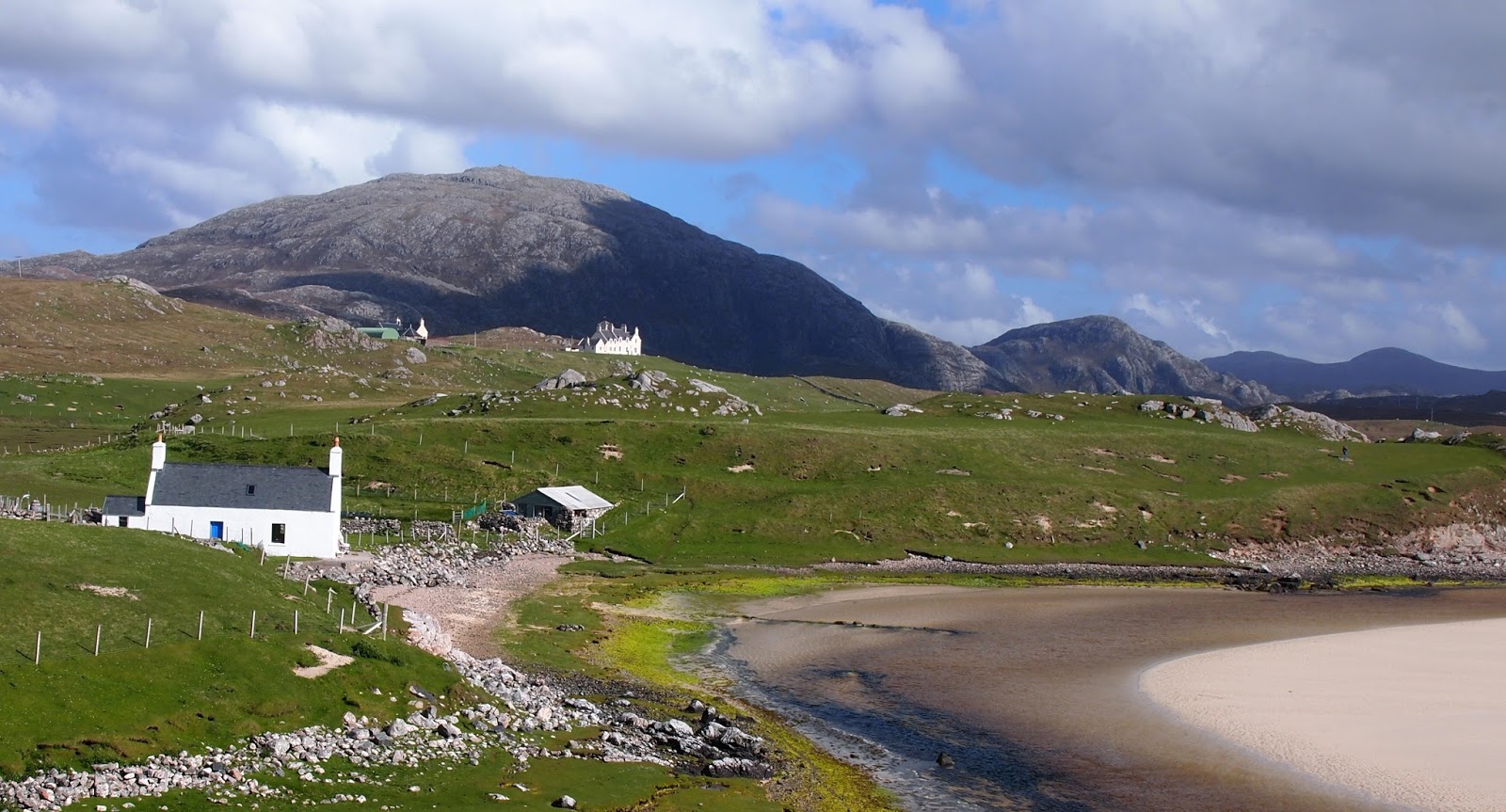
A beach at Uig, Isle of Lewis
(Photo: I.R.M.)
On medical services on the island before the NHS, see Stornoway Historical Society article:
 Early Medical Men of Lewis


Tuesday, 29 March 2016

Then It Could Be Told: book review


The Secret State: Whitehall and the Cold War, by Peter Hennessy. Allen Lane, The Penguin Press, London, 2002, xxi + 234 pp. ISBN 0 713 99626 9.


   Even before it starts, this book plunges the reader into the nightmare world it investigates, with endpapers (at front and back, produced more fully on pp 164-8) listing ‘Probable nuclear targets in the United Kingdom: Assumptions for planning’.  This 1967 document of the Joint Intelligence Committee names 65 ‘targets related to nuclear strike capability’ and 20 major cities, in every part of the country, so we can see just how close the perceived threat came to home.  The text fills in the details of what it would have meant.
   Peter Hennessy displays 'The Cold War state which British insiders built alongside the existing one, from roughly 1947 onwards' (p. xiii) and which his researches and discoveries, in the Public Record Office (PRO) and among surviving participant insiders themselves, have brought to light.  The nuclear factor was, as he says, central throughout the period and as such it is the focus of his study, presented in six fact- and figure-packed chapters (and earlier summarised to an appreciative audience in the Penguin History Lectures 2001).  Some of the material will be familiar, in general terms at least, to those who lived through that era, especially if they tried to expose and oppose the machinations of the Cold War state.  For surviving participant outsiders there may be a certain grim satisfaction in being shown how right they were, not only on the major issue of the scale of nuclear devastation and how close to the brink of it we came, but about the activities of Special Branch - they were watching quite a lot of us - and Civil Defence - no doubt many volunteers meant well, but what a grotesque farce it was.  These and other accoutrements of the Secret State are exposed extensively, though not exhaustively. 
  Although the author remains a corridors-of-power man, relishing contacts in the upper echelons, the unguarded remark of the once-powerful, and the machinations of government at the highest level, he accords sympathetic attention to the activities and viewpoint of dissidents, highlighting for example the ‘Spies for Peace’ episode of Easter 1963.  For him the surprising thing is not that a Campaign for Nuclear Disarmament (CND) developed, but that it took so long, and he cites official statements and analyses which he considers would have kick-started it years earlier, if made known to the public.  In this context the Strath Report of 1955 was a primary source which was still closed to him at the time of writing but has since been opened by the PRO, perhaps thanks to his efforts in getting at and publishing its gist.  Those reviewers who have drawn the inference that after all nuclear deterrence ‘worked’ (and that CND was wrong) are ignoring quite a lot of the story.  As Hennessy notes: ‘It is simple to the point of being seriously misleading to suppose that the creation of a nuclear weapons capability on both sides of what became the Cold War… offers an all-embracing explanation of why the nuclear taboo has not been broken…’  (p.xi)  It is easier to answer the question ‘what if’ x number of bombs had been used (see Table) than ‘what if’ they had never been invented or had remained the monopoly of one country plus or minus its allies, although in the second case, at least a vast amount of money would have been saved.
   The title gives a slightly exaggerated idea of the book’s coverage, largely limited as it is to the nuclear-armed aspect of the Cold War and to certain departmental sources - probably the most significant with regard to policy-making - in Whitehall: the Cabinet Office (which alone covers a multitude of sins), the Prime Minister‘s Office, and Defence.  One way in which the work could usefully be built on would be by looking in more detail at manifestations and ramifications of their policies.  For example, further material is available on surveillance of the peace movement, Admiralty reactions to anti-Polaris demonstrations, and on the war-games exercises and detailed plans drawn up by practically all and sundry.  To dip one’s toes briefly into these last, murky waters: the Ministry of Agriculture, Fisheries and Food (MAFF), as well as conducting elaborate Atom Bomb Target Studies all over the country (PRO: [National Archives ref.] MAF 99/562 1952 etc.) was diligent in considering matters ranging from seed supplies in wartime to monitoring of farm produce for radioactive contamination in wartime, the effects of radiation on bull semen, and the slaughter of livestock following nuclear attack.  All departments were required to think about and prepare for the prospect.  The Ministry of Labour would, via a National Service Officer, direct any person in Great Britain to perform any service of which he ['or she' is implicit] was considered capable, restrict workers from leaving jobs, and so on.  Defence Regulations covered nursing, police, fire, merchant navy; certain other industries and services.  The Home Office excelled both in scaring scenarios and hilarious absurdities, with its much-satirised sixteen pages of Advice to the Householder.  ‘Public control after attack’ was the subject of special consideration; Civil Defence Wardens, and/or your local Street (Party) Leader, would coordinate the effort and should be obeyed.  Church bells were to be rung to signify fallout coming within one hour.  Housing and Local Government proposed arrangements for emergency sanitation and storing of water.  Under a dispersal policy ‘priority classes’ including pregnant women, children, and disabled, totalling about 9.5 million or 43% of the population, were to be moved from major centres to reception areas.  Even the Ministry of Pensions and National Assistance was ready at one stage, if there was a nuclear war, for the NA Scheme to be modified and known as the War Assistance Scheme.  An Index of Official Announcements on such matters was held in readiness for eventual broadcasting. 
   One finding that emerges from documents and interviews is that the state was not so monolithic, and did not present such a united front with its allies, as opponents often tend to assume. There are recurrent allusions to anxiety about the chances of US over-reaction to Soviet ‘provocation’, and the USA wais frequently portrayed as a threat to world peace (plus ça change), needing to be restrained by British reasonableness (well, perhaps some change there), for which British nuclear clout – ‘enough nuclear power to prevent foolish decisions to our detriment by the US’ (p. 62) – was seen to be required. 
   In spite of the end of the Cold War and its effects on international relations, the final chapter reminds us powerfully that this is far from being all over, past history in a supposedly, in some ways, more secure world.  Several nuclear bunkers may now be derelict or refurbished as tourist attractions, but the top people still have their bolt-hole and every British Prime Minister has to decide whether to authorise, for posthumous implementation, mass murder on an awesome scale.  Nuclear submarines carry sealed orders, ready in the event of that say-so to go and kill - whom? - when the rest of us are dead. 
  In spite of its subject, this is an entertaining and not an over-long or difficult read, with the bonus of sharing the author’s pleasure in his research, and triumph at finding the odd significant gem whose ‘sensitivity’ seems to have escaped notice, lurking in an obscure file.  While it is an excellent introduction, there are several areas in which the story could be expanded, and it is reasonable to hope is likely to be, with researchers taking an interest in the topic.  Many files are there to be explored and new ones being released all the time, so that more works of this quality and accessibility may be produced on Britain’s nuclear past, reaching as it does into our present and future.  
L.W.
First published in the journal Medicine, Conflict & Survival, 2003.

From inside the book's back cover
Extract from PRO file HO 226/71:
Casualties from a heavy nuclear attack on the United Kingdom  1958
HO Scientific Advisers’ Branch
 Casualty estimates for ground burst 10 Megaton bombs, Table1:
No. of Bombs
No. killed (no evacuation) 000s
5
7,479
10
12,216
20
17,735
30
21,051
40
23,487
45
24,884
 The comment is added that estimates are almost certainly too low.