Tuesday, 13 October 2015

An Ealing Conscientious Objector’s Work of National Importance

As a 24-year-old single man, Hector Welsman Smaldon of 37 Elers Road, West Ealing, became liable for military service in early 1916. He applied for absolute exemption in February, stating his reasons:
I have a distinct objection to Combatant military service, indeed to every form of military service, consequent upon holding certain views in relation to Christianity [... Biblical quotation, “My Kingdom is not of this world...”] This scripture shows clearly that, as a servant of Christ and a follower of Him, I cannot undertake Combatant service. Nor, as  belonging to the Kingdom of God, could I take up any service in support of a system, in which Violence, and the taking of human life, have place, without contravening my principles. (16th Feb. 1916)
When he failed to convince the Ealing Local Tribunal, he took his case to the Middlesex Appeal Tribunal (Case Number: M5513), restating his position:
As a Christian I have great objection to Combatant Military Service as contrary to the Spirit & teaching of Christ. I consider that to serve in the Army in any capacity would be a surrender  of Christian principles. (March 8. 1916)
The Local Tribunal explained its decision:
The appellant stated that he belonged to the Plymouth Brethren: that he could not undertake military service, either combatant or non combatant, for that would sacrifice his christian principles: that he felt it his duty to do all the good he could, but not as a part of any military system.
The Tribunal did not consider that there were any difficulties of conscience, particularly as two other members of the same religious body had expressed their willingness to undertake non combatant service, and the application was therefore refused.
The Military Representative made no observation on this case.
!3/3/16
By the time the Appeal Tribunal recorded its decision, after an adjournment of the hearing, Hector’s situation had changed.
Decision [1st May 1916].
Temporary exemption 6 mos. from today conditional upon his remaining in the position as an attendant at the City of London Lunatic Asylum, or in a similar position elsewhere.

The exemption was granted on the ground that “a conscientious objection to military service has been established”. His normal employment had been as a Traveller for a firm – the firm* – of Ostrich Feather Manufacturers, Botibol & Co., but he had been referred to the Committee on Work of National Importance which wrote to the Appeal Tribunal on 12th April stating they had been informed that the Medical Superintendent of the City of London Asylum located in Dartford, Kent, had “employment suitable for Mr. Smaldon” and that it was desirable he should take up his duties on the 17th. The arrangement evidently suited him; he asked for it to be made permanent rather than temporary. Instead he had to go through the process of applying for repeated extensions of his exemption throughout the war, resulting in a massive 80-page compilation of filed paperwork. 

He was not usually required to attend the hearings, however. The Medical Superintendent testified to the quality of his work, and didn’t want to let him go A couple of attempts by the local Military Representative to have his exemption withdrawn got nowhere. He stayed in post at least until the end of the war, possibly longer – it was in Dartford that he married, in 1921.

Hector Smaldon was far from being the only CO directed to work in a “lunatic asylum” (there were upwards of 60 as recorded on the Pearce database) but must have been one of the first, and possibly least reluctant. Among his co-workers in 1916-19 were about a dozen overall, for varying lengths of time; Richard Thomas Shirley of Westminster found the work didn't suit him, while Robert William Miller of Islington complained that the strain 'of 14 hour days with lunatics' was making him ill. About 30 COs appear to have been recorded as ‘certified insane’ during the war, but there are few if any matches between the asylums to which they were committed (including Hanwell in at least 4 cases) and those to which their (to some extent) co-thinkers had been sent to do their 'work of national importance'.

Smaldon Family background

Hector’s older brother William James was also a CO, whose objection was recognised by the Ealing Tribunal to the extent of granting him Exemption from Combatant Service only. Apparently without lodging an appeal, he was drafted into the Non-Combatant Corps, and within a few months was in France. He survived to be demobbed after the war, late in 1919.   


The 1911 Census shows the Smaldon household: Hector Welsman (mistranscribed as Welsham on ‘Find my Past’) aged 19, a Clerk in a Drapery Warehouse, living at 37 Elers Road with his widowed mother, and 26-year-old brother William James, a Tramway Motor Man. Both brothers had been born in Hull. There were three boarders, William and Harold Lucas, probably father and son, and Harold Davies whose brother (probably) was also present on census night, visiting from Taunton. In 1901 Hector's and William's father, a ship's watchman, was still alive, and the family were living in Kingston upon Hull.
The Smaldons’ (and boarders') address in West Ealing
Hector eventually returned to his county of birth, Yorkshire, where he died in 1987.

*Botibol: a name to conjure with in ostrich feather circles...
A. Theft from a specified place, 8th October 1912: BREWER, William (32, carman) pleaded guilty, of ... breaking and entering the warehouse of Cecil Munton Botibol and stealing therein 144 ostrich feathers and other articles, his goods...          Sentence: Three years' penal servitude.      http://www.oldbaileyonline.org/browse.jsp?div=t19121008-16
B. Lady Hawk's Folly - Google Books Result. Amanda Scott - 2013 - ‎Fiction      https://books.google.co.uk/books?isbn=1480415294            “... to Oxford Street and the premises of W. H. Botibol, plumassier, in order for Mollie to purchase a pair of ostrich feathers to wear in her hair that evening...”
C. The works of William Makepeace Thackeray: i. "By Saint Botibol, say not false," groaned the elder warrior...        ii. "... A small prince's coronet of gold, from which rose three pink ostrich-feathers...”       https://archive.org/stream/.../workswilliammak15thacgoog_djvu.txt


20190205_120148-1 (1).jpg
A further sidelight on asylum attendants around this time.
Source: https://libcom.org/files/occupational-hazards.pdf - p.53 of pdf, 48 of pamphlet

Monday, 21 September 2015

Protesting against CBW: At Porton Down, 1965

In the official history of the Biological side of the British government’s CBW Research Establishment at Porton Down there are several references to demonstrations being held there  by activists opposed to weapons of mass destruction (a phrase which was in use at least since the early 1950s, the time of the Korean war.) One of these took place just 50 years ago, in September 1965.  
An affable West Country policeman was impressed to hear that some people had hitch-hiked hundreds of miles: 
“I’m sure it’d have taken me many moons,” he commented.
Hammond PM, Carter G, From Biological Warfare to Healthcare: Porton Down, 1940-2000 (Basingstoke: Palgrave, 2002).
Chapter 6 on 'The New Establishment 1948-51' gives an account, of the setting up and construction of the Microbiological Research Department* (to focus on germs rather than gas) as part of the set-up at Porton. [How it appeared to a young female civil servant seconded as one of the first clerical workers there may be seen in fascinating subjective detail in an online publication.]  MRD Experimental Plant No.1 was handed over by the Ministry of Works on 14-10-48, with some work still outstanding, finally handed over to MRD 29-3-49.
Ch.15, 'Public Perceptions' mentions demonstrations, as follows (accuracy of details not guaranteed, obviously):
  • In Spring 1953 pacifists of the Non-Violent Resistance Group held a demonstration described as being against the secrecy of the place.
  • The 1960s brought a rise in protest following the government’s decision that the extension of BW research was to continue; CND and especially the direct-action Committee of 100 were active in this regard.
  • pp.224-5 In an attempted break-in (1963 – reference is made to Spies for Peace and RSGs) two men drove 2 miles within the Porton campus without being challenged, sparking a Special Branch raid on the (alleged) London HQ of the Committee of 100:
  • Special Branch Raids    On Monday, June 24th, at 8p.m., officers of the Special Branch raided the offices of the Committee of 100 and the homes of a number of Committee members… The Official Secrets Act was used to obtain the search warrants and in addition to the material dealing with a forthcoming demonstration at Porton “Germ Warfare” Centre, papers and documents referring to the state visit [by Greek royals, a focus of C100 attention in 1963] were also taken. – “Open Letter to an Old Bailey Court”, pamphlet produced by the Committee of 100, Nov. 1963.

  • A well-planned demonstration (large given the location) in June 1963, attended by about 300 people, led to many arrests, and 3 protestors being jailed. (National Archives file refers: TS 50/142 Threatened demonstration by Campaign for Nuclear Disarmament at Porton Down Experimental Establishment, 29 June 1963.) Preparation had included a leaflet, “Operation Porton – Against germ Warfare” and the authorities had been concerned about what might happen.  Press coverage included the Daily Telegraph, Express, and Mail on 27-6-63, and the Guardian on 28-6-63. 
    Close-up from document below

     
  • Interest in Porton on the part of the peace movement continued, with a 1964 article or supplement in Peace News on ‘Silent Death’. In May ’65 C100 ‘gave notice of intention’ re. further protest. The date of the 1965 demo, ’called by the Committee of 100, following a more spectacular action in 1963’ was set for 11th September, and a leaflet produced calling people to attend ‘Open Day at Porton’. Troops were again to be available to guard the site, but on this occasion, according to the book, the protest was low-key, with no arrests, and only local reporting [see below, however].
  • Subsequent years (summary)
    • Feb. ’67 Action by Porton Action Group: CND, C100 (p.201, 211 with note on the existence of an active Salisbury branch, which gained ‘considerable support on some occasions’), and War Resisters International.
    • May 1968 vigil  (and 1969). Porton hit the headlines that month, thanks to Essex University students: The events of May, 1968 at the University of Essex started with a protest against the recruitment of students to work at the chemical and biological research station at Porton Down. The University's response to this protest led to massive general meetings, which voted to replace the existing university with a "Free University of Essex". [...] On Tuesday, 7th May, Dr. Inch, a scientist from Porton Down arrived to give a talk on toxic chemicals. [...] 
    • p.232 Dark Harvest Commandos 1980. Dumped ‘contaminated Gruinard soil’ near MoD land.
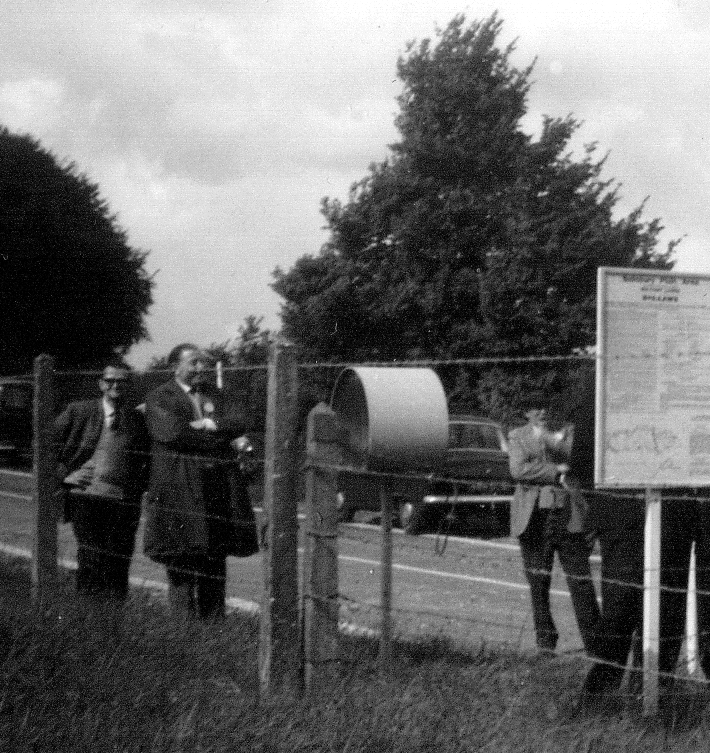
Comparatively ‘low-key’ or not, the 1965 demo was one in which the authorities took plenty of interest.
Scientists (?) observe Demonstrators

Police at the gate

Scientists (?) observe Demonstrators; police at the gate
Demonstrators expected to be letting themselves in for being caught on camera, but probably few if any realised they would actually be filmed: 
[Film] CND (CAMPAIGN FOR NUCLEAR DISARMAMENT) DEMONSTRATION AT THE MAIN GATE OF PORTON DOWN, 1965 [Allocated Title]
16mm  Catalogue number DED 256  Production date 1965; Porton Down (Production company)
Film shot on behalf of the Chemical Defence Establishment [sic] shows members of CND [sic] gathering for a demonstration outside one of the traffic gates into the complex; some of the protesters are filmed trespassing on Ministry of Defence Land. The camera is, for the most part, situated within the perimeter of the Porton Down Establishment. Content description:
Placard on the bridge over the railway at Porton on behalf of a hunger striker reads: "I am fasting to express my contempt for the inhuman work carried out at Porton". A crowd of CND supporters gather at the modest access gate ("Haven Gate"), watched over by older members of the Ministry of Defence Police. The atmosphere is calm. Most of the demonstrators appear to be in their twenties, although there are some older people. Many carry placards: "Porton for the People!", "Reverence for Life - Schweitzer" etc. Camera focuses on their faces; some of the protesters jeer, many give a two-fingered "salute", others try to hide their identities. Many take photographs of the MOD camera itself. Viewpoint moves to Porton Pheasant Road, where demonstrators are filmed climbing gates and fences and trespassing on the broad Porton ranges. Long shots of clusters of people; many are carrying banners - "Porton for Peace" etc. One demonstrator has a large Soviet flag. Soldiers, MOD Police and members of the local constabulary gather up the clusters of protestors and escort them off the land. A small group of protesters climb a meteorological tower on Black Barn Road. Individual protesters are arrested by soldiers and put in the back of an MOD Land Rover; outside, the police take their details (many of the arrestees are sitting or lying on the ground). A group of protesters from the Dundee branch of the anti-war group the Committee of 100 are challenged by police. Some demonstrators sit in road, impeding passing vehicles. Back at Haven Gate, speakers address the crowd. An army lorry tries to leave the complex; it is blocked by the demonstrators who attempt to remove the canvas cover at the rear of the lorry. [Copied from the above link, with a few typos corrected].
No doubt due to this film, there are more pictures from September 1965 at Porton online, available e.g. by searching Images for porton down protest
. . . . . . . . . . . . . . . . . . . . . . . . .
*A note on 'Nomenclature' and control (up to 2002 when the Hammond/Carter book was published, so there have been further significant changes):-
What was the BW section at Porton called?
1940-46 Biology Dept. Porton/ Biological Research Dept., BRD; 1946-57 Microbiological Res Dept, MRD; 1957-79 Microbiology Res Establishment, MRE; 1979-2002- Centre for Applied Microbiol Res, CAMR.
Who was responsible?
It was ‘owned’ by govt. depts. as follows: 1940-59 Ministry of Supply; 1959 briefly Min of Aviation when Min of Supply scrapped; 1959-64 War Dept; 1964-79 MoD [Defence]; 1979-94 Public Health Lab Service under DHSS [Health & Social Services] ;1979-88, DHSS 1988-94, DoH 1988; 1994-2002- Microbiol Res Authority under DoH..
. . . . . . . . . . . . . . . . . . . . . . . . .

Tuesday, 8 September 2015

On the Naming of Winds

(Not a new idea...)

“Public given the chance to name UK and Irish storms”.

From ‘As Safety Saw It’:

What’s in a name?

            Contemporary publications report that a hurricane which tore across America recently at about 100 m.p.h. was known as Ione*, and recalls that last year a similar storm was called Hilda. Here, where during the winter months the wind (we call it breeze) frequently reaches hurricane force there are fascinating possibilities for the local met. men. The weather usually provides plenty of scope and there is a fine range of local names available – Ineag, Dollag or Katag would compare favourably with Ione or Hilda; always provided of course that the met. office issued the usual disclaimer about reference to anyone living or dead. This would prevent misunderstanding should some bodach [old man] put in a claim for insurance on the grounds that Chirsteag [Chrissie] had blown his corn-stack into Broad Bay.

M.S. in Stornoway Gazette, 18 & 21/10/1955
As I See It* column, p.3


*The full collected articles may be read on pdf here (this is an extract from p.4 of the booklet) 


* Hurricane Ione /aɪˈəʊn/ was a strong, Category 4 hurricane that affected North Carolina in September 1955, bringing high winds and significant rainfall.[1][2] It came on the heels of Hurricanes Connie and Diane,[1] and compounded problems already caused by the two earlier hurricanes. Spawned by a tropical wave which left the African coast on September 6, the system became a tropical depression in the tropical North Atlantic, before turning northwest and developing into a hurricane. After turning back to the west east of the Bahamas, Ione turned northwest and northward, moving across eastern North Carolina before moving east-northeastward out to sea. Ione caused $600 million (2005 USD) in damage, much of it to crops across North Carolina. As a result of Ione's impacts seven people lost their lives.
From Wikipedia

Tuesday, 1 September 2015

Ealing’s WW1 COs: Five More from Hanwell

Update  The total number of records from the Pearce Register of Conscientious Objectors available via the Imperial War Museum’s Lives of the First World War website now stands at 17,426. As was to be expected, keyword searches indicate that these include more residents from the (present-day) London Borough of Ealing than were included in the Partial Overview previously posted. The current figures are (some approximately, as false positives and duplicates can’t always be detected without looking at each transcription):  Ealing 85; Acton 50; Southall 27; and Hanwell 15, excluding four COs from other places who were committed to Hanwell Asylum.
The Hanwell transcriptions have been looked at, and all five of the new names (i.e. not previously noted on this blog) also match appellants with case files among those of the Middlesex Appeal Tribunal (MAT)*.
They are:
·         Harry Leon Curtis, Salesman, 103, Elthorne Park Road;
·         Percival Norman Curtis, Salesman and collector, 103, Elthorne Park Road;
·         Arthur Hazell, Grocer's carman, 7, Westminster Road;
·         Alfred Percy Shawyer, Postman, 21, Deans Road;
·         Augustus Willis Smith, Butcher and slaughterman, 16, Half Acre Road. 
   
Four out of five of these appeals were dismissed in what looks like a briskly routine fashion; they did not  give the Appeal Tribunal case much trouble, so the files are comparatively slim. Yet each relates to an individual story.
         
As might be guessed, the first two were brothers, recorded in the 1911 Census as living at the same address in Elthorne Park Road with their father (a Horse Collar Maker from Hereford), mother and maternal grandparents. Harry Leon Curtis, 20, was a Gas Fitter Salesman and Percival Norman Curtis, 15, a Coal Office Clerk. Five years later, Harry was employed as a Salesman for Electrical Lighting & Heating accessories, Percival as a ‘Salesman and collector in Coal trade’. Neither had ‘attested’ their willingness to serve, and both, after their claims for exemption were refused by the local tribunal, lodged appeals dated 2nd March 1916, in very similar terms.

Grounds on which appeal made:
1. That judging from the remarks made by the Local Tribunal [...] I failed to convince them that I have conscientious objections.
2. That I am now in possession of further evidence [...] that I have held these conscientious objections for upwards of nine years, which evidence I wish to submit.
3. That I in fact have such conscientious objections as entitles me to relief, and have held same since childhood.
Harry Leon Curtis
Percival added
4. That I am engaged in a trade of national importance.
The Local Tribunal’s comments were the same for each of them:
Applicant failed to convince the Tribunal of the genuineness of his claim that he had a conscientious objection.
The claim was based on ‘Religious Convictions’:
I have been baptised & confirmed in the Church of England & am a regular Chorister & communicant since youth at St. Thomas’ Boston Rd. Hanwell. [Harry]
I have been baptised, brought up & confirmed into the Church of England & have been since childhood a regular communicant & chorister in same. [Percival]
Side door of St. Thomas's church, Hanwell

Given the vociferous support for the war and hostility to COs expressed by so many spokesmen for the Church of England, probably including members of the Tribunal, it is hardly surprising that these brief statements were not enough to win their case. Any additional evidence adduced is not on file; notices of dismissal of the appeals went out on 22nd March. Transcriptions from the IWM show what happened next.

[Harry] War Service        Essex Regiment; transfer to 1/9th (County of London) Bn. (Queen Victoria's Rifles), killed in action 6.10.16. Thiepval Memorial.

So Harry was already dead when Percival’s ‘War Service’ (possibly deferred due to his work in the coal trade) began. He survived and was duly awarded the British War and Victory Medals: 28.2.17 Hounslow, Suffolk Regiment (Reserve Garrison); transfer to Labour Company 15.3.17 Northants. Regiment ; Home Service: 28.2.16 to 24.3.17; France: 25.3.17 to (?) ; Demob.14.12.19.
The older church building
              where the Curtis brothers were choristers.
Unlike the Curtis brothers, and very unusually for a CO, Arthur Hazell, Wholesale grocer's carman living at 7 Westminster Road, had ‘attested’, at Southall Library. According to his IWM transcription he is recorded as having lodged an “Appeal in CO (F), his employers also appealed but refused”.  Only the latter appears to be on the MAT file, which does not supply much information about him (e.g. his age is not indicated).
Grounds on which appeal made:
Inability to replace him.
50% of our staff have joined the forces.
Necessity of supplying food to the people.
Goldway Bros.,
Southall,
25/2/16
The local (Southall-Norwood) tribunal explained its refusal:
After hearing both employer & him on 23rd Feby 1916 Claim dismissed insufficient grounds.
His subsequent fate, after the appeal was likewise dismissed, is not recorded.

Postman Alfred Percy Shawyer, from Paddington, was already a Boarder at 21 Deans Road in 1911, staying with an older fellow-postman, Ernest Cohill (also born in Paddington), and his wife. They would no doubt have been acquainted with another Hanwell CO and Post Office worker, George Brodie, who lived at 50 Deans Road. Shawyer was employed at Hanwell Sorting Office. Aged 30 in 1916, he applied for Absolute exemption from military service on 19th February on the dual grounds of ‘Moral conviction’ and being medically unfit, citing ‘Testimony of Dr. Hope, Postal Medical Officer’.
He was partially successful:
FOR LOCAL TRIBUNAL
Granted exemption from Combatant Service and from other than Garrison duty at home & abroad.
[Signed]     6th March 1916
His fitness for Garrison duty at home or abroad had been stated in a letter of 4th March from the Army Recruiting Office in Bond Street, Ealing, by the doctor who examined him. A further examination was ordered for the Appeal hearing, resulting in a more favourable outcome, in the short term at least, insofar as:
... the Appeal Tribunal have decided that the man be exempted from the provisions of the Military Service Act 1916. The exemption is temporary for a period of six months from the 27th March, 1916.
The ground on which exemption is granted is that ill-health has been established.
A handwritten note at the front of the file confirms
Shawyer.     Passed for sedentary work only.
According to new regulations he will be retained on the reserve but not called up at present.

The occupation of Augustus Willis Smith, ‘Butcher and slaughterman', 16 Half Acre Road, hardly fits the profile of a typical Conscientious Objector. Whether or not it struck them as incongruous, his claim got short shrift from the local tribunal. He stated his grounds briefly without elaboration, or reference to religion.
Conscientious grounds. Moral convictions. Absolute exemption.
I have an honest & sincere objection to all forms of military service.
This was not regarded as enough.
Applicant entirely failed to convince the Tribunal that he had a Conscientious objection.
The statement in a letter from applicant’s father (annexed) that he is engaged in a certified occupation, was not considered by the Tribunal, applicant stating that he made no claim on those grounds but confined his claim to the ground of a Conscientious objection.
Evidently it did not occur to them to draw the inference that his failure even to attempt to play the certified-occupation card might be a sign of his sincerity. Their decision was endorsed by the Military Representative:
1. The appellant described himself as a butcher and slaughterman, but as exemption as been granted to three other slaughtermen in Hanwell, and no claim was made on the ground of occupation, it is submitted that the appeal should not be allowed on this ground.
2. The Members of the Local Tribunal have an intimate knowledge of the appellant’s circumstances, and believe that the true ground of the appeal that the appellant’s father, who is also a butcher, wishes to retain him to help in his business [...]
3. The Local Tribunal were convinced that the appellant had no conscientious objection whatever.
The father gave his occupation as Master Butcher in the 1911 census, when the family were living at 14 Maunder Road, Hanwell. (They were settled in the area – Augustus was born in Ealing, and his mother and sister in Hanwell.) 
The letter referred to by the Military Representative, unhelpful as it turned out to be, is on file:
16 Halfacre Rd.
Hanwell, W
28/2/16
To the Chairman of the Tribunal,
Gentlemen,
I am appealing on behalf of my only son who’s [sic] Convictions were known to me from the earliest days of the war. I know that he absolutely refuses any military service whatever, not only that he is in a reserved trade as slaughterman assisting me in my own work and as slaughterman for the County Asylum Hanwell at present I am sorry to say that it is impossible for me to do without him having strained the muscles of my back besides what man can pull a bullock about weighing 8 or 9 hundred pounds by himself. *
Yours faithfully
F.W. Smith       * [Augustus was aged 22 in 1916, his father 46]
The Appeal Tribunal decision was that the appeal be dismissed, but Smith’s claim to be a Conscientious Objector was later vindicated as ‘genuine’ by the Central Tribunal, and like others he suffered for his beliefs, eventually joining the inmates (including some from his home area) not only of prisons but in the notorious Dyce camp and Dartmoor Work Centre. The transcription outlines the recorded stages of the rest of his war:
Central Tribunal at Wandsworth MP (Military Prison) 9.8.16 - CO class A, to Brace Committee; Central Tribunal Nos. W.196 M.13 Class: A - Genuine
War Service     1 (R) Garr. Suffolk; CM (Court Martial) Tilbury Fort 20.6.16 - 2yrs.HL (With hard labour) commuted to 3 months HL Maidstone CP (Civil Prison)
Work Centre    24.6.16 to HOS (The Home Office Scheme, administered by the Brace Committee); 22.8.16 to Dyce Camp, Aberdeen; 19.9.16 released from Dyce Camp on health grounds - Illness
May 1917 Dartmoor, Secretary of Dartmoor NCF (No-Conscription Fellowship) branch.

Thus the man judged to have “no conscientious objection whatever” emerges as one of the most steadfast and committed of COs.
==============
* MAT file details (as listed by National Archives):

Case Number: M11. Harry Leon Curtis of 103 Elthorne Park Road, Hanwell. Occupation: Salesman, Electric Lighting and Heating Accessories. Grounds of Appeal: F: On the ground of a conscientious objection to the undertaking of combatant service. Catalogue reference:  MH 47/8/6


Case Number: M12. Percival Norman Curtis of 103 Elthorne Park Road, Hanwell. Occupation: Salesman and Collector in Coal Trade. Grounds of Appeal: F: On the ground of a conscientious objection to the undertaking of combatant service. Catalogue reference:  MH 47/8/7

Case Number: V69. Arthur Hazell of 7 Westminster Road, Hanwell. Occupation: Wholesale Grocer's Carman. Grounds of Appeal: F: On the ground of a conscientious objection to the undertaking of combatant service. Catalogue reference:  MH 47/72/51

Case Number: M190. Alfred Percy Shawyer of 21 Deans Road, Hanwell. Occupation: Postman. Grounds of Appeal: E: On the ground of ill-health or infirmity. F: On the ground of a conscientious objection to the undertaking of combatant service. Catalogue reference:  MH 47/9/13

Case Number: M13. Augustus Willis Smith of 16 Half Acre Road, Hanwell. Occupation: Butcher and Slaughterman. Grounds of Appeal: F: On the ground of a conscientious objection to the undertaking of combatant service. Catalogue reference:  MH 47/8/8

Thursday, 27 August 2015

Jenny’s not so Well: Some summer holiday pictures from Moray

On the Moray Coastal Trail 2015           
A Walk on the Wet Side        

From The Megalithic Portal: 12 September 2006
Holy Well or Sacred Spring in Moray
To find Jenny’s Well join the coastal path in Portknockie, near Bow Fiddle Rock, and follow it towards Cullen. A short distance after descending to sea level and before the sandy beach, Jenny’s Well is on the right.
Site Name: Jenny's Well Alternative Name: Janet's Well
Country: Scotland County: Moray Type: Holy Well or Sacred Spring
Nearest Town: Portknockie
Map Ref: NJ495682
Latitude: 57.700762N  Longitude: 2.848947W
Condition: 5 Ambience: 3 Access: 4 Accuracy: 3

Other sites featuring Jenny's Well include:
http://www.walkhighlands.co.uk/moray/cullen-bay.shtml continue on the path to reach Jenny's Well.-
http://www.walkhighlands.co.uk/moray/buckie-cullen.shtml “along the base of the cliffs to reach Jenny's Well”.
http://www.discovercullen.com/localwalk-cullenbay-portknockie.php “walk around the rocks on the path until you reach Jenny's Well.”

Sadly, walkers on this part of the Moray Coastal Trail, on the way to the Whale's Mouth rock formation from Cullen this August, found that the path to the Well was overgrown with waist-high (for an adult - small children were submerged) bracken, nettles, mint and other plants - and when they got there the well had been blocked off. The problem was evidently not that the flow of water had dried up - seepage into the ground in the vicinity was making parts of the track very water-logged, even in summer. One can only wonder why this has been done (misguided "Health and safety"? Costs of maintenance?), and whether the effects have been thought through. 

Water from the well, 2013
Disappointment, 2015: Not what it was

(They still made it to the Whale's Mouth.)

For a long time the walk to Jenny's Well has been a favourite one for local Cullen residents such as Calum Smith as well as featuring on the itinerary, and among the holiday memories, of many tourists and visitors to the area.


Representatives of 3 generations at the Well, 1990s

Looking east to Cullen from the Well, 2011
Near Jenny's Well, c.2011

Whale's Mouth with rainbow, 2014


A View over the Moray Firth
by Sir David Murray, RA (privately owned)