Showing posts with label Newfoundland. Show all posts

Monday, 2 September 2019

Fletts in Newfoundland Fisheries Venture 1907-1908

This blog has previously looked in some detail at the novel Bid for Fortune, by "J.S.[Joseph] Flett" (Moray Press, 1934), and in particular among other aspects at the ways in which its author drew on his experience of living in Canada, or more accurately Newfoundland, at that time a distinct 'colony' or dominion of Britain with its own government. But 1915 was not the first occasion on which he had made the transatlantic crossing in the interests of the family fishcuring business. Eight years previously, aged 19, he had been delegated to take responsibility for a pioneering attempt to transform the Newfoundland herring fishing industry, a venture which not only drew the attention of newspapers but involved government sanction and international repercussions.

Banffshire Advertiser, 9-5-1907, p.8

New Departures in Fishcuring
----------------
Local Workers off to Newfoundland 
---------------
Interesting Experiment
   Much local interest is evinced in a fishing experiment undertaken by Mr Alexander Flett, fishcurer, Buckie, Findochty, and Aberdeen, who has entered into a three years' agreement with the Government of Newfoundland* to carry on drift net fishing for herring and curing after the Scottish method in Newfoundland. This experiment differs from that of Mr Cowie of Lossiemouth, who is in the service of the Canadian Government, while Mr Flett's venture is in charge of Mr Joseph Flett, his son, who sailed in company with Mr G. Flett "Crawford" [nickname/tee-name], Findochty, on 9th April. Mr Flett has already shipped Buckie-made curing stock, and to-day the staff will leave here for Liverpool, whence they sail for Newfoundland on Saturday. [Details of those engaged: 3 fishermen, all Fletts from Findochty; 4 coopers, 3 from Buckie and one from Findochty; 6 (female) fishworkers, 3 surnamed Reid from Buckie, and 3 Mair from Portknockie, 'also three girls from Nairn'.] One of the stations to be opened up will be at Twillingate Island, Notre Dame Bay,. The output of cured herring for export from Newfoundland at present ranges from 100,000 to 200,000 barrels per annum, and everyone will join in wishing that success may crown the venture, so that new markets may be opened up and the present ones extended.
 * "Newfoundland was a British dominion from 1907 to 1934 when it surrendered dominion status by ending self-government..."

A slightly shorter story appeared in the Aberdeen Daily Journal (Press & Journal) 9-5-1907

The Newfoundland Herring Fisheries
The herring exports of Newfoundland at present total from 100,000 to 200,000 barrels annually, and with a view to increasing the output, the Newfoundland Government has - as briefly reported yesterday - concluded a three years' agreement with Mr Alexander Flett, fishcurer, Buckie, Findochty, and Aberdeen, to introduce into Newfoundland waters the Scottish method of catching herrings by drift net, and curing them as is done in this country. Mr Flett has already shipped salt and barrels and to-day a party leaves the Moray Firth shores for the Atlantic voyage. The venture is in charge of Mr Flett's son, Joseph...
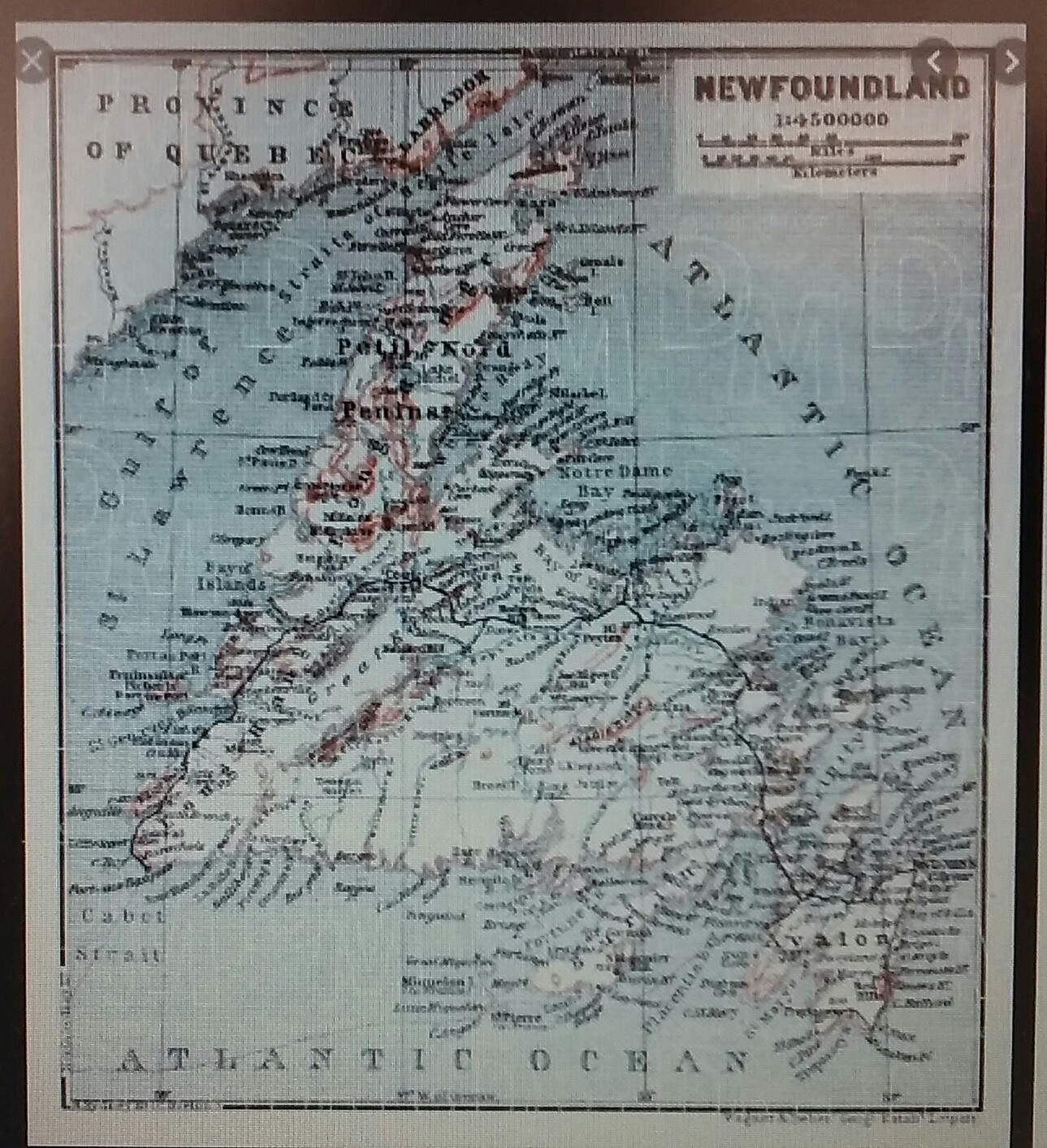
Newfoundland in 1907
Four months later the 'P&J' returned to the topic, evidently quite a hot one in the context of a long-running dispute over access to fishing grounds involving diplomatic wrangling with the USA, In a column on 'The Newfoundland Fisheries' (under 'Sir Robert bond's Speech: American Opinion') the paper noted:

Aberdeen Daily Journal (Press & Journal) 12 September 1907 


Important Development
----------------
Agreement with Buckie Fish Curers
-------------
   The "Standard" says an arrangement has been entered into between the Newfoundland Government and Messrs Alexander Flett and Son, fishcurers, Buckie, Banffshire, to carry on herring fishing operations off Newfoundland upon the Scottish system. Whether the project will have any effect on the differences with the United States remains to be seen, but the experiment is to be tried in earnest. It is not a private speculation on the part of Messrs Flett. A formal agreement has been entered into between the Newfoundland Government and Messrs Flett and Son for three years to develop the herring fishing in the manner in which it is carried on upon the east coast of Scotland. A few months ago a number of fishermen, coopers and girls went out from the east coast of Scotland to train the Newfoundlanders in conducting the industry. It is understood that the Newfoundland Government have granted a substantial subsidy in order to give the venture a fair trial. There will be no curing at sea. The fish will be landed at convenient places, and cured in barrels both for home consumption and export. The advantage of the Scottish system is that Newfoundland will reap the full benefit from the fishing, and it is understood that there is an abundance of herring off the Newfoundland coast. The value of the herring fishing on the east coast of Scotland this year is estimated at £1,300,000 sterling, and it can be understood that to a fishing country like Newfoundland the adoption of fishing methods that bring in such a splendid harvest would be a matter of the highest importance. Naturally the Messrs Flett are very reticent on the matter, but they are very hopeful of success, and a member of the firm has gone out to superintend the operation.
-------------------------------------

Unfortunately the hopes of success were looking rather forlorn within less than a year.

26 March 1908 - Banffshire Advertiser

Newfoundland Herring Fishing Experiment Reported a Failure
Some time ago, Messrs Alexander Flett & Company, fishcurers, Buckie, sent out a representative and workpeople to Newfoundland by arrangement with the Government. St. John's " Evening Chronicle " contained the following reference hereto:-  
  We understand that Mr Flett, the Scottish herring packer, who is described by the "Herald" as having the profoundest faith in the future of the herring industry in the island, but is alleged by Captain Eli Dawe to have lost 26,000 dollars in the venture here, is reported in Government circles to be desirous of leaving the Colony and abandoning the venture entirely, if he can induce the Government to recoup him for the outlay he has made in the drift-net fishing so far. This would include the Schooners, outfits and gear he provided, and it is held on behalf of Mr Flett that it would be cheaper for the Government to do this than to continue the project for another two years and pay out 5000 dollars each year as a subsidy to him, which will have to be done in the event of no arrangement being now arrived at. Probably outside of a comic opera there is nothing to equal the Government's bungling with this drift-net project... [Details of false starts and failed arrangements since 1905] ... Now, after a season's trial in Green Bay, it is found that he caught just twelve barrels of herring in the outer waters, and for this the Colony has to pay him 5000 dollars.
=================
Neither family tradition nor public records so far discovered give the full story of how and when the 'venture' ended; it may have been affected by a 'modus vivendi' accommodating US demands with regard to the Newfoundland Fisheries (reported in the Press & Journal 14-8-1908). Whatever its losses, however, the firm survived and was evidently sufficiently well regarded and prosperous for a renewed attempt to establish itself in the 'Colony' to appear a reasonable proposition in 1915. This time Joe as its representative stayed for nearly six years, and it was the death of his father Alexander which brought him and his young family back to north-east Scotland in 1921.
Record of Joe's voyage out in 1907 (last name in the second column)


Saturday, 21 May 2016

A Findochty Flett in Canada

In Imagination and Memory...

Joseph Flett was aged 27 when he sailed to North America in August 1915, 28 when his young wife and baby daughter joined him in May 1916. While he may at that time have intended to make a permanent home in Canada, circumstances decreed otherwise and he had returned to Scotland 13 years before his novel Bid for Fortune was published in 1934. The book contains several chapters set in Newfoundland where he had spent over five years. Although a work of fiction presented as an escapist adventure story, it clearly draws extensively on the author's knowledge and experience (as well as his thoughts and feelings), including some about his temporarily adopted country.

Written on May 21, 1916:
"No desire to return to Scotland", but circumstances decreed otherwise five years later
In the context of post First World War alienation and lack of prospects the four main protagonists in the novel, after a failed business venture, turn to less legal schemes for securing some kind of future for themselves. While one takes care of the main plan, to smuggle accidentally-acquired diamonds into the USA with a view to disposing of them, the other three proceed via Newfoundland to rendez-vous with him in New York. Rather than wait idly, they decide to have a go at putting another idea into practice, rum-running from the French colony of St. Pierre to the Prohibition-era dry States. Rum-running to the USA, one of them has argued, would constitute a "real service" as well as being "almost respectable":

"For the greater convenience of rum-runners and Newfoundland fishermen - they've got Prohibition even in their foggy clammy island, poor devils! - there happens... to be two bits of rock off the south coast of Newfoundland that still belong to the sensible and thirsty Républque Française... an oasis in an arid land." (Chapter 5, p.55)

Anyway: "The Americans didn't despise law-breakers; the only thing they really despised was poverty. And rum-running was by now almost a respectable industry in the States."  (Chapter 14, pp.128-9)

On board ship their fellow passengers "cursed Prohibition. It was leading the youth of the country astray... It was killing the young men and corrupting the young women." (Chapter 17, p.148)

The next morning they were swishing through slob ice, with an occasional bump and grinding into the harder hummocks. Late in the afternoon they came up to the narrows of St. John's harbour. Huge cliffs towered above the narrow channel, bare grey rock plastered white in every cranny with snow, formidably wild and desolate-looking. Wooden huts and scaffoldings of fishermen [boats] perched on shelves of rock just above the water. A grim land it looked. Passing through the narrows, they entered a calm, land-locked harbour, full of drifting ice and little anchored schooners, Christmas-toy-like in their frosted shrouds and the long icicles pendent from bow and stern and gunwales.
 ... A small fleet of sleighs awaited the landing of the passengers... A grim country. A devil of a climate. (Chapter 17, p.148-149)

These first impressions are expanded into a more elaborate description of the place (with a small sting in the tail): "A rover of the sea turned merchant... St John's achieves, too, the metropolitan air... shares in the councils of the nations. She has a parliament all of her own... active mentally, and that's the great thing... It loves to take the stranger in, in one way or the other." (Chapter 18, p.150)


The next objective was to be Saint-Pierre-et-Miquelon, travelling to which was possible but advised against by locals at this time of year, the advice being heeded by only one of the three: "Jimmy, listening to the proposed itinerary, ruled himself out of it. He wouldn't, deliberately and of his own free will, shove himself into such horrible discomforts. But Tommy and Jock were still of the mind to go through with it." (p.151)

Tommy and Jock decide to kit themselves out, gradually, in seamen's clothing –

Then, on pretence at first of touring the outports, they crept down the coast, from one fishing hamlet to the next... until at last, from long rubber thighboots to mackinaw and ear-flapped cap, there was naught to distinguish them outwardly from the most native of natives. The local accent, a peculiar blend of West-Country English with the Irish brogue, presented much more difficulty to Jock... Jock, they decided, would have to pass as a Cape Breton Gaelic-speaking Scotsman, in whom any variety of English, from the purest to the most broken, gives no surprise to anybody - or at least so they had gathered from their boon companions in St. John's.
From Placentia... they drifted down... Everywhere they landed they found houses that would take in the weary traveller for a dollar or two... (p.154)

After an enforced wait that turns out to be "comfortable and jolly" in Grand-Bank, Fortune Bay, "there came a morning at last, even in a Newfoundland February, when the raging seas simmered down into a sullen heave of swell."

They landed on rocks at an unfrequented part of the island...
Saint-Pierre was quiet.. The transatlantic headquarters of the French cod-fishing fleet, its busy time was over for a year, except for the occasional visit of a big French trawler and its surreptitious activities in the rum-running trade...
The cod-fishing business was not what it had been. Newfoundland long ago had done its direst to kill that trade by prohibiting the sale of Newfoundland bait to the French, and in any case the business of fishing was getting more and more into the hands of big steam-trawling companies... (p.157)


While this adventure proceeds:

Jimmy put in the three weeks' waiting at St. John's pleasantly enough. He skated on the ice-rinks; he practised snow-shoeing until he quite fancied himself as an expert; he played poker and bridge; avoided women... As soon as it was certain that Jock and Tommy had made the passage, Jimmy packed up and took sleigh for the railway station.

The journey turns out to be something of an epic one. "The train lurched and bumped... in a manner disconcerting to the novice", eliciting the reassurance that [JF does the voice
"This ain't the season yit foh upsets. Next month now, yoh go to sleep mebbe in a lowah berth and waken up in a uppah berth with the train turned right upside down"  - in which case the procedure would be to climb out by the windows, with "drifts of snow fawty feet deep sometimes" at the "tops'ils". Asked "How do you like it up here?" the attendant replies that there are drawbacks and 'vantages: "We coloured gemmen have fah moah considuation up heah, sah. But dis consumption play the devil with coloured folks up heah, sah." (p.181-182)

The same attendant breaks the news to him when they get snowed in, and the conductor confirms that nothing can be done until the storm blows itself out and the "rotary" clears a way for them, which might take weeks. There are very few passengers in the sleeper - "Only the strongest urgency could persuade anyone to do the cross-country voyage at this time of year" - and after three days of being cooped up with them Jimmy, "ready for anything, no matter how desperate, that would break the monotony", decides to set out walking. Grand Falls he reckons is only about 80 miles away; some houses are scattered along the route; he expects to find "lots of English people there, employees of Northcliffe's paper mills".  Although he goes equipped with snow-shoes and green-tinted spectacles bought from a fellow passenger, his initial optimism as he begins "to follow the line of railway telegraph posts over the deep and pathless snow" is seriously misplaced.

On the point of collapse, he is rescued by a gaunt elderly woman and then tended by her two young attractive daughters, in whom he observes "that peculiarly well-bred manner, direct and fearless, treating all as equals and none as superiors, of those brought up in the complete independence of the wilds". However (half way to Grand Falls after ten days):
The happy interlude was brief, as usual. One morning smoke was seen down the line; then came the rotary, throwing up cascades of snow before it.. [The train] did not come along until the next day. With the usual obligingness of Newfoundland trains it stopped for Jimmy's excited wavings and took him aboard. (p.204)


The remainder of the journey is more pleasant - 
Without much apparent thaw the snow had long since begun mysteriously to disappear... The first taste of spring comes sudden and sweet in the countries of the long long snows…
The barren monotony of the interior changed as they came to the West Coast to high hills and woodlands. The River Humber roared through its steep and matted gorge down to Bay of Islands, still fast and serene under six feet of ice. It was a strange sight to Jimmy to see horses and heavily laden sleighs creeping over the frozen sea.

The country had a further test of endurance in reserve - 
"... when they arrived at Port-aux-Basques, the terminus of the railway and the port of transhipment for Canada. The s.s. Kyle had already been waiting there two days, already full of passengers who had come with her direct by sea from St. John's; the gulf was full of heavy ice, now packed close and tight to the land by the in-wind that had been blowing... The usually spick-and-span mail-boat had been putting up a losing fight against overcrowding and delay... (p.206)
"Another day of dank, smelly, tedious misery... then Jimmy woke up to woke up to the throbbing of engines and the swish and grind of a ship forcing her way through ice...
Up on deck the air was dancing, the ice-fields glittering in the strong sunlight. 

Finally - 
Here was the land again, praise be! and freedom from the mob. A drink!.. He had been looking forward to it ever since he smelt that ship. Now without preparation or softening the blow was dealt to him. Nova Scotia was dry. The country of all countries that needed a drink to was down its miserable dullness was dry!
The Syrian, who had been a fellow-passenger... now proved a friend in need. Nova Scotia was dry all right; but you could get all you wanted just the same; the only real difference was that you now had to pay through the nose for it.
... In defiance of all law, Jimmy was a bit flushed and smiling when he joined the train at North Sydney that evening. (p.209)

Jimmy's farewell to Canada is not final. After the four friends are reunited and share some further adventures and difficulties, they each end up (spoiler alert) with a substantial sum of money, and the partnership is dissolved. Jimmy,'with whom the narrative has opened, also occupies the closing chapter, in which after much soul-searching and existential agonising, he diagnoses the root cause of his troubled state as "nothing but that most common of ailments, the mating fever".
He had been unhappy... ever since he had left that lonely spot in the wilds... His mind went back to that scene, visioned the snow and the lake and the little fir tree.. Suddenly young Susie's face flashed up and filled his mind...
Having been characterised as English (distancing him from Joe) and therefore prone to snobbery, he has to account for his choice of this young woman from the wilds (while remaining apparently unfazed at the prospect of an intermittently homicidal axe-wielding mother-in-law). A momentary misgiving is set aside - "Susie was not a young savage; she was a native princess in her own right... glorious and free." (pp.271-273)


Recollecting -  her mother had said there was "no keeping young girls at home nowadays"  - that "she had been thinking of going away, of leaving home; a lamb going out innocently unafraid into the jungle" (pp.275-276) he loses no more time in organising his return, "a different man", to a different experience:
The s.s.Kyle, now neat and clean enough. Port-aux-Basques, raining as usual, but this time warm muggy rain. The casual leisurely crawl of the Newfoundland train... the homely genial atmosphere that more than made up for all discomforts... No such thing as time in Newfoundland: nothing for it but to wait, as tranquilly as everybody else. (pp.277-278)
The train may be slow, but the story now skips briskly onwards to the required happy ending.

*****************
(A more thorough and critical review of the novel appears later on this blog.)

J.S.Flett, Bid for Fortune. Moray Press, Edinburgh & London, 1934
The adventures of four young men. Price 7/6 [Seven shillings and sixpence = 37.5p. 
Second-hand copies have been available on-line at different highish prices, e.g. at £35 about 12 years ago, £399 (80 years after publication), £50 without jacket (currently).]

The book sat well with its mid-1930s contemporaries in the Moray Press list
 of (would-be) popular but far from unintelligent adventure yarns.

Wednesday, 20 April 2016

A Stornoway Girl in New York, 100 Years Ago

A world away from the war...?


A Letter from Canada, May 1916

The writer of the letter transcribed below, aged 22 at the time of writing, was the daughter of a Stornoway shopkeeper. After some time as a student at the prestigious Atholl Crescent College of Domestic Science in Edinburgh, in 1913 she married Joe Flett from Findochty, whose family's fish-curing business took him to Canada in August 1915. This was before the introduction of conscription, but his involvement in work of national importance (food supply) might have rendered him exempt in any case.

Outward Bound passenger records show Joseph Flett, aged 27, Fish Curer, sailed 20/08/1915 on the Tabasco from Liverpool to St Johns, Newfoundland. Country of last permanent residence England, intended future permanent residence Newfoundland.


Outward Bound passenger records show Mrs. Flett, H'Wife, sailed 23/04/1916 on the Tuscania from Liverpool to New York, not shown to be accompanied by husband or child: Country of last permanent residence “Br. Protectorates” [maybe they didn’t know where the (old) Hebrides were?!]; intended future permanent residence USA.
[Some of this doesn't quite fit, but perhaps her seasickness prevented her details being recorded properly if this was done after embarkation, and explains her child not being close by - see letter.]

In fact Mrs. Flett (Lizzie) had her 15-month-old daughter with her and they were going to join Joe in Canada. He met them off the boat in New York and they spent the next 4 days in the city.

Atlantic crossing record for Joe


Atlantic crossing record for Lizzie
Border crossing (Canada-US) for Joe, 27-4-1916
--------------------------
A. Flett & Co.
of Buckie Scotland
Herring Curers


Curling, Newfoundland
21st May 1916

Dear Ma,
            At last I have reached my destination & found time to write. It is more than a fortnight now since we landed; we spent a week in New York & took 4 days to go from there to St Johns where we stayed another few days & finally reached here last Wednesday.
            Marjorie is none the worse of all this moving about & is as fat & rosy as ever. The people in New York used to stand & gaze at her rosy cheeks, the children are all very pale & pasty there. She was not a bit sick on the "Tuscania" but I was bad the first two days. I don't know what would have become of Marjorie those days, but fortunately I fell in with an Irish girl who took a great fancy to her & looked after her all the time. She was going out to Bermuda as housekeeper to a naval doctor; she was one of the most decent creatures I have ever met. She thought that babies should get a bit of everything that was going & when I came up on the 3rd day I found Margie having a high old time with peppermints & ginger cake. She even used to get her share of biscuits & cheese at lunch.
            It is a wonder to me she wasn't half dead, but she fairly enjoyed the trip & was the pet of the whole ship - "Red coat" was all the rage. You would have laughed to see her trotting down the deck in a breeze with the deep sea rowl & her head down in the approved style. Joe met us at New York & fortunately she went to him at once - I was quite thankful. He was wild because I did not travel first class & understood all the time that Mary was coming with me. We had a most glorious time in New York, it beats London & Paris to sticks - better shops, better theatres, better restaurants & better fashions & far nicer things to eat. I was just enchanted with the famous Broadway & 5th Avenue. We went about all the time with Mr & Mrs Vidvotsky wealthy Russians in the herring trade. They were awfully nice to us - their servant took Margie out in the afternoons & stayed with her at nights. We bought a nice small American pram which was most useful - you should have seen Joe pushing it down 5th Avenue - I wouldn't dare put my hand near it. We used to take her out ourselves in the mornings, then the girl took her to the park in the afternoon while Mrs Vidvotsky & I went to a matinee or shopping & our husbands did business. Then after we had put Margie to bed we would all go off together to dinner, the theatre & have supper at some dancing cabaret. Mrs Vidvotsky is awfully nice - she is only 24 & has been married 5 years - they have no family. She showed me round all the shops - I bought two nice hats & some white blouses also a white linen dress. The childrens clothes were simply lovely. I got some nice dresses for Marjorie - a fine yellow linen empire, with turned back cuffs & collar of white & a black velvet belt - short sleeves. She is a dream in it with blue socks & black patent slippers; I also got her a blue in same style & a white linen with blue smocking. All this description is for Mary A's edification.
            We came up to St John's by boat & of course I was sick again. It is quite a busy place but the shops are not up to much and the fashions very demo. If I was old fashioned in New York, I was the biggest swell in St John's by a long chalk. This place is nearly a day's journey from St John's. It is very quiet, but pretty & I think I will like it all right. Joe is not yet sure whether we will be here for any length of time. He likes being here very much & says he has no desire to return to Scotland. He says I may go home for 2 months every winter if I like, but who would be bothered crossing the Atlantic in winter for that.
            Joe is quite balmy about Marjorie - I found that everyone in the place had seen her photo & knew her name, age & weight & one kid had a doll called after her. [...]

            I will be expecting a letter soon with all the news. [...]

                        Love from us all

                                    Lizzie

Birthplace of the couple's two younger children
"Curling is a sub-division of the city of Corner Brook, Newfoundland and Labrador. Located in the humber arm of the Bay of Islands, Curling was originally a fishing community. It is the oldest section of Corner Brook."

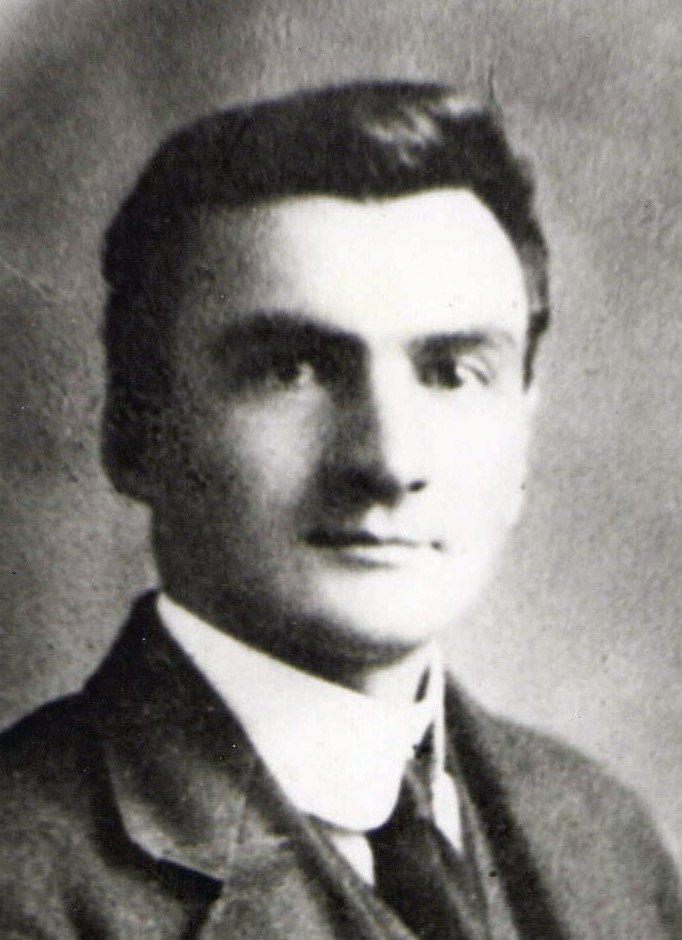
Studio portrait of Joe
Studio portrait of Lizzie


Toddler Marjorie
in Newfoundland

The letter was addressed to her mother in Francis Street, Stornoway

SS Tuscania was a luxury liner of the Cunard subsidiary Anchor Line, named after a town in Italy. She was torpedoed in 1918 by the German U-boat UB-77 while transporting American troops to Europe and sank, sending 210 people to their deaths.[3] https://en.wikipedia.org/wiki/SS_Tuscania_(1914)
See also; http://www.islayinfo.com/loss-troopship-tuscania-islay.html


commemorative service was held on the centenary of the Tuscania tragedy (BBC Scotland news item 5-2-2018, also available in Gaelic.) [And see comment below].